
P Abigail Sadhana Rao
“Abstraction allows man to see with his mind what he cannot physically see with his eyes… It is the emancipation of the mind.” – Arshile Gorky
Look around your room right now. The sharp corner of a desk, the perfect arc of a coffee mug, the quiet grid of a window pane, geometry is quietly framing our lives.
There is a beautiful, timeless comfort in these forms. Long before modern galleries existed, geometric symmetry thrived in our homes and sacred spaces. It lived in the precise weave of a textile, the intricate stone layouts of ancient architecture, and the visual rhythms of cultural traditions. Shapes and patterns have never been just decorative; they are ancestral blueprints for balance, rhythm, and quiet power.
Yet, when we hear the word “geometry,” our minds often drift to school math problems or sterile blueprints. We expect it to feel cold. But beneath the clean lines of contemporary geometric art lies something deeply, surprisingly emotional.
The Soul Behind the Line
Geometric art speaks directly to the heart without needing a storyline. It doesn’t demand that you decode a complicated narrative or recognize a human face. Instead, it communicates through pure visual energy.
The magic happens in how an artist treats the canvas. A repeated grid, painted with a steady but softly textured hand, can instantly bring a sense of calm and stability to a chaotic day. Sharp, angular triangles overlapping in rich pigments can generate a thrill of energy or a spark of urgency. Meanwhile, circular forms suggest continuity, wholeness, and a gentle, meditative movement.
When you sit with a piece of geometric art, you aren’t just looking at shapes, you are responding to a felt rhythm. Your eyes move across the canvas, discovering unexpected pauses, subtle layering, and moments of beautiful silence within the structure.
From Sacred Yantras to Modern Canvases
In India, this visual language is woven into the fabric of daily life. We see it in the welcoming symmetry of a morning rangoli at the doorstep, the rhythmic precision of handloom weaving, the sacred geometry of yantras, and the repeating motifs of folk art. Today’s contemporary Indian artists are reclaiming these traditional visual systems through a modern lens. They aren’t looking for rigid perfection; they treat geometry as a living, breathing language.
Some artists find their inspiration in the sharp, overlapping shadows of urban architecture. Others look inward, using dense layering, vibrant colour systems, or minimalist ink washes to transform ancient spiritual symbols into modern visual meditations. This beautiful fusion of heritage and abstraction gives the artwork a unique ability to transcend time, feeling simultaneously ancient and completely new.
Exploring Abstract Geometric Art
One of the reasons geometric art is so deeply loved in contemporary interior design is its incredible adaptability. It has a unique ability to anchor a room without overwhelming it. In minimal and monochromatic spaces, a large-scale geometric artwork adds structure and architectural depth, acting as a serene focal point. Whether it be a creative studio and modern apartments, vibrant, layered compositions introduce movement, playfulness, and a conversational spark. In intimate corners, smaller, detailed geometric works invite you to step closer, offering a quiet moment of focus when layered into a personal gallery wall.
Because these works are abstract, they don’t lock you into a single mood or message. As the light changes in your room throughout the day, the relationship between the shapes, colours, and shadows shifts too. It is art that rewards patience; the more time you spend with it, the more secrets it reveals.
On Mojarto, India’s leading online art platform, we feature an exclusive collection of geometric artworks that underscore how beautifully creators are pushing the boundaries of form and practice. Let’s explore some of them here.
The Presence Within
In the painting, Geometric Abstraction, the eye is immediately greeted by a fresh, captivating harmony of striking red and soothing nude tones. It is a composition that beautifully balances a clean, graphic sensibility with an unexpected emotional warmth. While every eye brings its own unique perspective to abstract art, a patient look at these intersecting lines reveals a beautiful secret: the gentle, geometric silhouette of Ganesha emerging from the canvas.
This striking artwork possesses a versatile soul, capable of effortlessly enhancing the beauty of its surroundings. Hung as bedroom wall paintings or placed over an office desk, its soft cream backdrops and curved lines offer a quiet, meditative space to rest, while its vibrant crimsons and structured grids inject a focused, creative energy into the workspace.
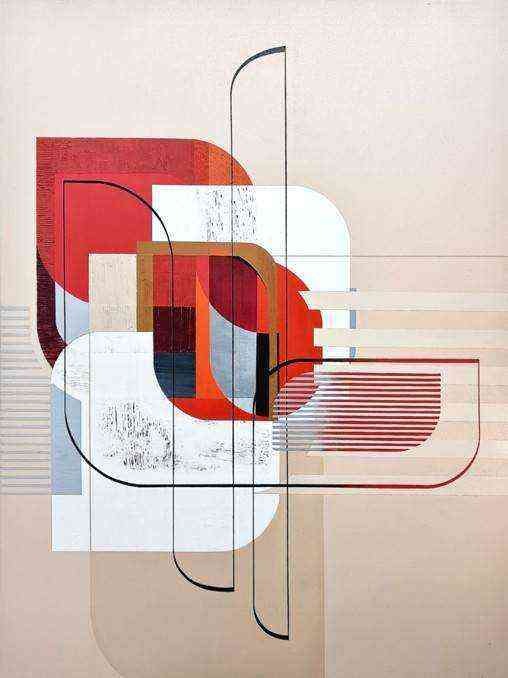
This flawless dance between structure and emotion is driven by the unique background of the artist, Aarti Sharma. As a graphic and interior designer by vocation and an abstract artist by choice, Sharma beautifully blends the best of both aesthetic worlds onto her canvas. Heavily influenced by mid-century modern design, her compositions explore the intricate world of fractals, increasingly complex, repeating patterns filled with light and shifting colour.
Look closely at this artwork and you can feel her deeply process-oriented approach; through a meticulous, repeated cycle of pouring, dense layering, and intricate brushwork, she creates a powerful visual space where warm and cool tones coexist to achieve an immense sense of depth, intensity, and harmony. This is why people who love design purely, frequently look to buy geometric art online when anchoring a room.
The Dual Energies of Surya and Naga
In the limited-edition serigraph, Surya and Naga by the legendary master of Indian modernism, S.H. Raza, beautifully channels the passionate, symbolic, and emotive values of India’s landscape and metaphysical thought. Known as a profound colourist, Raza frequently leaned into radiant, hot palettes inspired by his childhood memories spent in the dense forests of Madhya Pradesh. However, in this striking composition, he proves his immense range by subverting expectations with a cool, oceanic landscape of layered blues, deep teals, and midnight blacks.
The piece functions like a visual triptych: a vibrant orange sun (Surya) blazes over a textured sea on the left, geometric gradients of inverted triangles anchor the centre, and the right panel features a dark, circular Bindu – the sacred focal point Raza considered the ultimate fountainhead of energy and creativity, cradled by the concentric, undulating coils of a serpent (Naga).
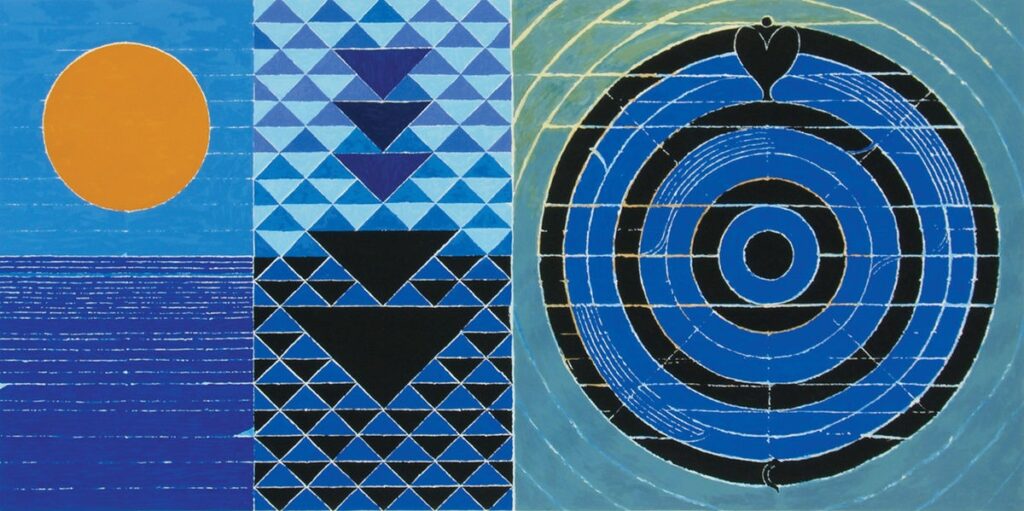
While the intense palette and repeating geometric forms in Raza’s body of work have occasionally caused viewers to mistake his style for Neo-Tantric art, the artist firmly maintained that he held no affiliation with that school. Instead, he was a modernist deeply preoccupied with immanent energies, focusing on the purely plastic qualities of art and how form emerges natively on the canvas surface.
Having spent decades living and creating between the vibrant art scenes of Paris and the quiet landscapes of Gorbio in southern France, Raza’s late-career masterworks like this artwork stand as a testament to his global modernist vision. It remains a deeply compelling piece that rewards repeated viewing, effortlessly bringing a historic, museum-quality gravity to contemporary art for home decor.
The Mind’s Chessboard
In the acrylic canvas diptych, King, the contemporary artist and scholar Amit Rajvanshi masterfully explores the intricate themes of urban social life and human psychology. Known for his profound focus on the human figure, Rajvanshi structures this captivating composition around two opposing, geometric profiles shaped like stylized chess kings. The artwork stands as a brilliant visual metaphor for the internal conflicts and roles of the human mind, infusing deep psychological inquiry with a delightful dose of subtle humour.
The visual narrative unfolds across two contrasting fields of energy: the left canvas glows with warm, terracotta and crimson tones, while the right canvas cools into moody indigos and deep blues. Scattered throughout both panels are floating, simplified shapes of chess pawns and a knight, inviting the viewer to ponder whether these human figures are the ultimate players or merely pawns in a larger social game.
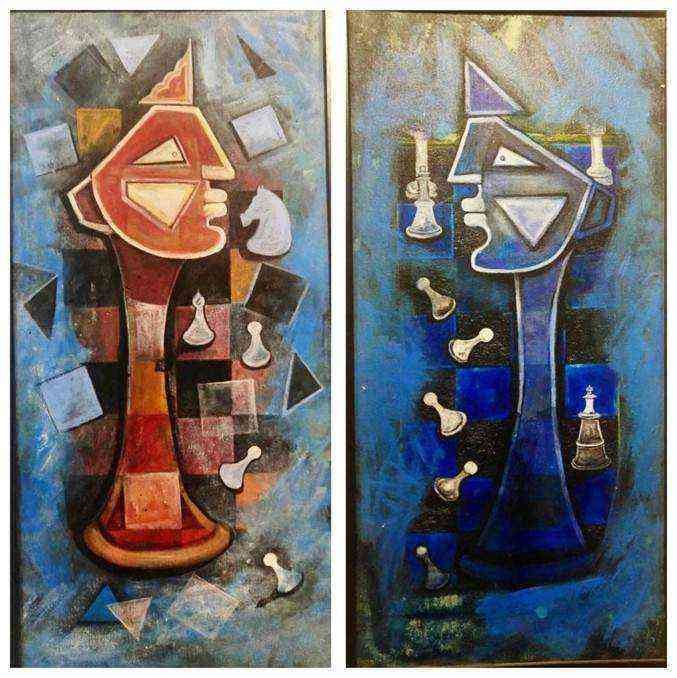
This seamless fusion of graphic precision and emotional depth is a hallmark of Rajvanshi’s highly academic and process-oriented style. Born in Indore and currently serving as a professor of drawing and painting in Ajmer, he channels his extensive background, including a doctorate in the field, into a meticulous manipulation of medium and space. In this painting, Rajvanshi relies on the simplification of forms, sharp structural lines, and bright, harmonious colours to construct a powerful presence. By skillfully blending acrylic with charcoal, he instils the canvas with a variety of rich, weathered textures that mimic an ancient chessboard. In so many ways, this artwork completely rejects the clinical coldness often associated with geometric abstraction, offering instead a textured, deeply human commentary on modern life that functions perfectly as modern office wall art or a focal piece in a living room.
Deconstructing Cosmic Typography
In the textured acrylic-on-paper painting, titled Bramhaakshar, artist Salil Sakhalkar presents a striking visual symphony where ancient letterforms melt into contemporary geometric abstraction. Set against a commanding, fiery crimson background, the composition features a central, shield-like vessel teeming with rich earth tones of ochre, terracotta, and deep charcoal.
Within this structured space, Sakhalkar masterfully deconstructs elements of traditional calligraphy and sacred symbols, allowing the fragments of lines and curves to echo the silhouettes of a cosmic alphabet. A stylized, golden stem rises vertically through the centre, blooming into organic, flower-like geometries that beautifully soften the hard edges of the abstract forms. It is an artwork that feels simultaneously ancient and hyper-modern, transforming the rigid rules of design into a soulful, meditative atmosphere that anchors a room with warmth and intellectual gravity.
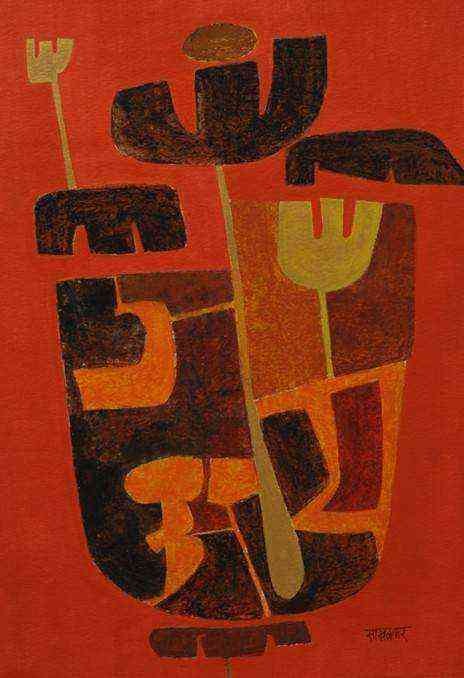
This flawless marriage of innovative imagery and brilliant typography is the culmination of a distinguished, decades-long journey in design. An alumnus of the prestigious Sir J.J. School of Art in Mumbai, Sakhalkar advanced his creative philosophy through specialized research in typography and calligraphy at the Industrial Design Centre, IIT Bombay under the legendary Prof. R. K. Joshi, while also mastering the psychological weight of symbols under Prof. Yeshwant Chaudhary.
Backed by more than 22 years of rich communication design experience with leading advertising agencies both in India and abroad, he infuses his canvases with a rare level of structural intent. Through this small piece of artwork, his profound understanding of visual hierarchy and corporate identity shines through, proving to collectors looking for modern abstract paintings that when geometry is handled by a true master of form, simple lines can transcend language to communicate pure emotional energy.
Kaleidoscope of Youth
In the radiant painting, Playful Strokes, Bangalore-based artist Bharathi Senthilvelan captures the pure, unadulterated joy of childhood through an abstract imagination of colourful patterns. The canvas operates much like a living kaleidoscope, fracturing nostalgic memories into a vibrant grid of shifting geometric shapes, floating balloons, and playful motifs like hearts and stars. Senthilvelan possesses a unique ability to view the world in a celebratory, high-vibrancy format – a stylistic trait born from her formative days spent marveling at the endless patterns of light and colour thrown by a childhood kaleidoscope.
At the heart of this artwork, joyful silhouettes dance across a heavily textured surface, transforming a simple canvas into an atmospheric celebration of youth. It is a deeply wholesome piece that effortlessly introduces a bright, celebratory energy into contemporary family spaces, creative studios, or living rooms.
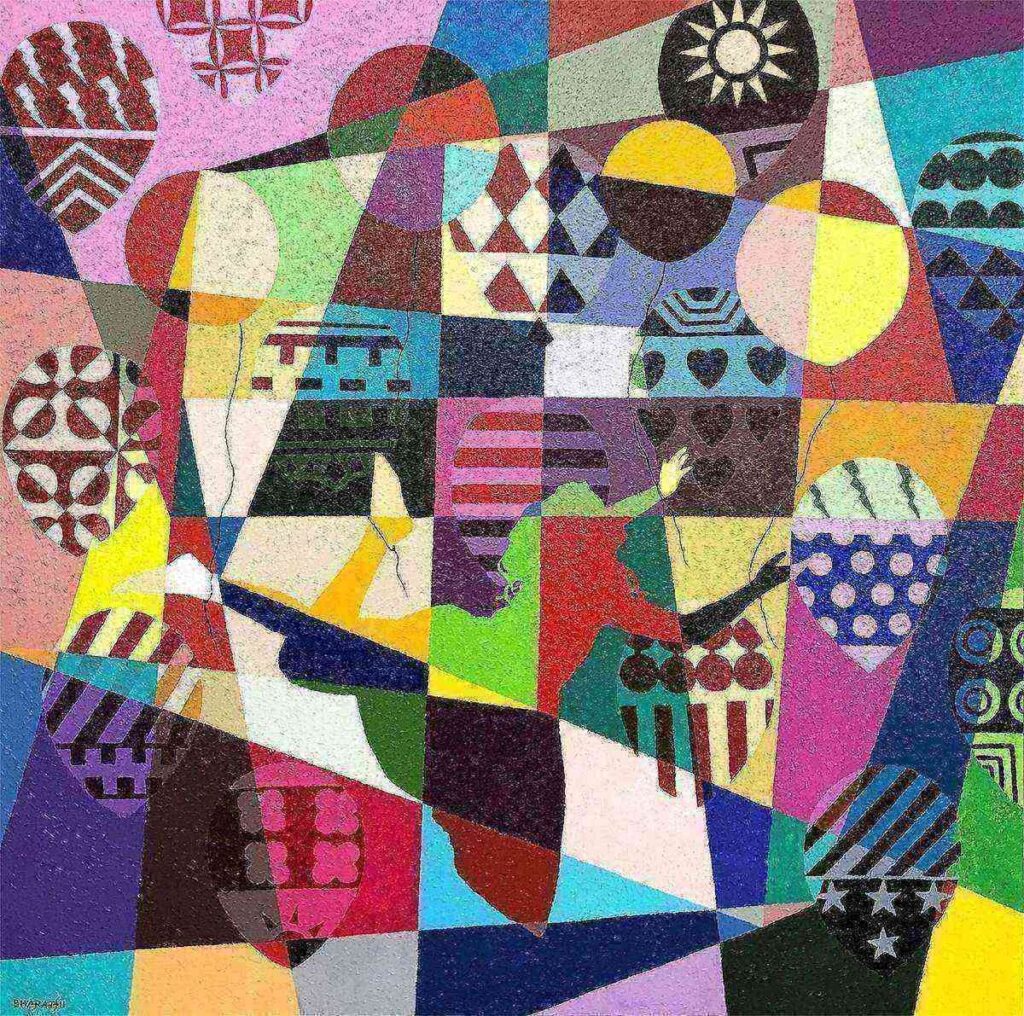
This masterful play between structured patterns and emotional warmth is rooted in Senthilvelan’s rich cultural and professional journey. A native of Kumbakonam, a historic temple town in Tamil Nadu renowned for its sublime Chola architecture. Her natural exposure to traditional art forms and the intricate geometry of ritualistic kolams laid the foundation for her love of symmetry and form.
Following an MCA graduation, she spent over a decade working in animation and graphic design. It was during the countless sketches required for her design work that she discovered a profound desire for fine art painting. To hone this instinct, she completed a formal painting course at the Karnataka Chitrakala Parishath in Bangalore. Today, her ongoing series themed around a ‘Colourful Childhood’ serves as a testament to her creative evolution, demonstrating how a lifetime of design expertise can culminate in home decor wall art that radiates pure happiness.
The Light Ahead
In this arresting monochrome artwork, Perspective 2, artist Anju Kaushik expertly channels the spirit of the Optical Art movement to devise a complex, deeply immersive spatial illusion. Utilizing a strict geometric art discipline, the canvas unfolds as a towering architectural tunnel composed entirely of repeating vertical stripes and parallel lines that rhythmically recede into the distance. Through a meticulous manipulation of pattern, symmetry, and the stark juxtaposition of light and shadow, Kaushik generates a powerful kinetic energy across the pictorial surface.
Yet, while the cascading black and white columns create a volatile figure-ground relationship that appears to swell and warp before the eye, the visual tension is masterfully controlled. The artist deliberately balances these lines to ensure the perceptual ambiguity never overwhelms, maintaining a courteous relationship with the viewer and inviting them into a space that ultimately rewards patience with a sense of structural harmony.
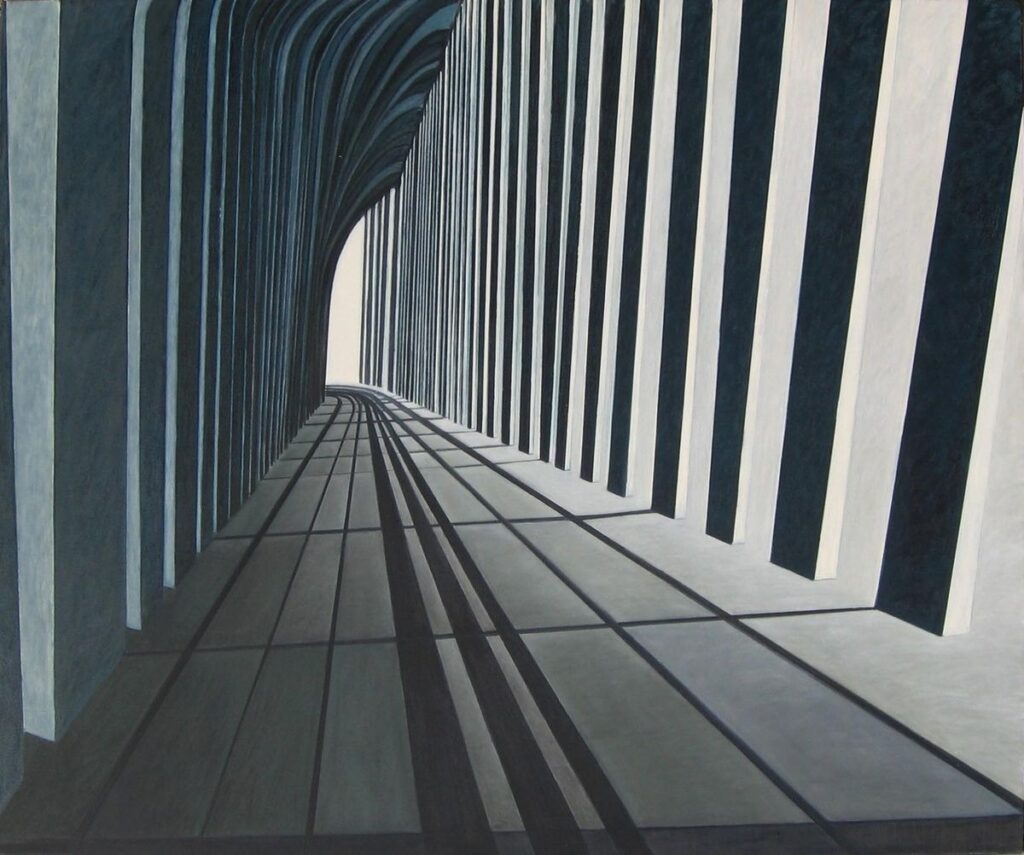
This calculated interplay between movement and restraint offers an intriguing glimpse into Kaushik’s unique creative psychology. While her works rely heavily on the tools of Optical Art to build tension, her ultimate intent is to convey the exact opposites: an overarching feeling of calm, ease, and meditative focus. The rigid order and absolute control visible in the symmetry of this masterpiece stands as a stabilising force, proving that structured geometry can be used to anchor and quiet the mind.
Mostly non-representational in her approach, Kaushik seamlessly evaluates geometry through a lyrical lens, giving equal importance to both positive and negative spaces. The true emotional climax of the piece rests at the far end of the corridor, where the dark, repetitive structures finally give way to a brilliant, glowing aperture. This light at the end of the tunnel serves as a powerful symbol of hope, joy, and radiating energy, demonstrating how masterful composition can transform cold, mathematical perspective into a deeply comforting human journey for anyone looking to add high-concept minimalism to their minimalist home interiors.
Begin Your Journey Now
Whether you are drawn to the quiet safety of a monochromatic grid or the joyful dance of vibrant, interlocking triangles, geometric art offers an enduring presence that evolves alongside you.
We invite you to buy art online by exploring the full curated collection on Mojarto today. Find the piece that doesn’t just fill a space on your wall, but shifts the very atmosphere of your home.