
A fashionable Bengali gentleman sits on a Victorian chair. His hair follows a European style, his shoes have buckles, and a hookah rests elegantly in his hand. He looks confident, perhaps a little too confident. The artist has captured every sign of status, but the picture is not offering admiration. It is quietly laughing at him.
This is the sharp, memorable world of Kalighat paintings.
At first, the style can appear simple. A bold figure occupies a plain background. The colours are bright, the outline moves confidently and unnecessary detail has been removed. Yet that simplicity is deceptive. Behind the smooth brushwork are observations about religion, fashion, marriage, hypocrisy, gender, wealth and life under colonial rule.
Kalighat artists were not detached commentators working inside private studios. They painted for a busy public. Pilgrims, traders, local residents and visitors encountered their work near Kolkata’s Kalighat temple. What began largely as portable religious imagery gradually became one of the liveliest visual records of 19th-century urban Bengal.
For collectors exploring Indian folk art through Mojarto, these works offer more than decorative charm. They reveal how ordinary artists turned popular painting into social commentary.
The History of Kalighat Paintings
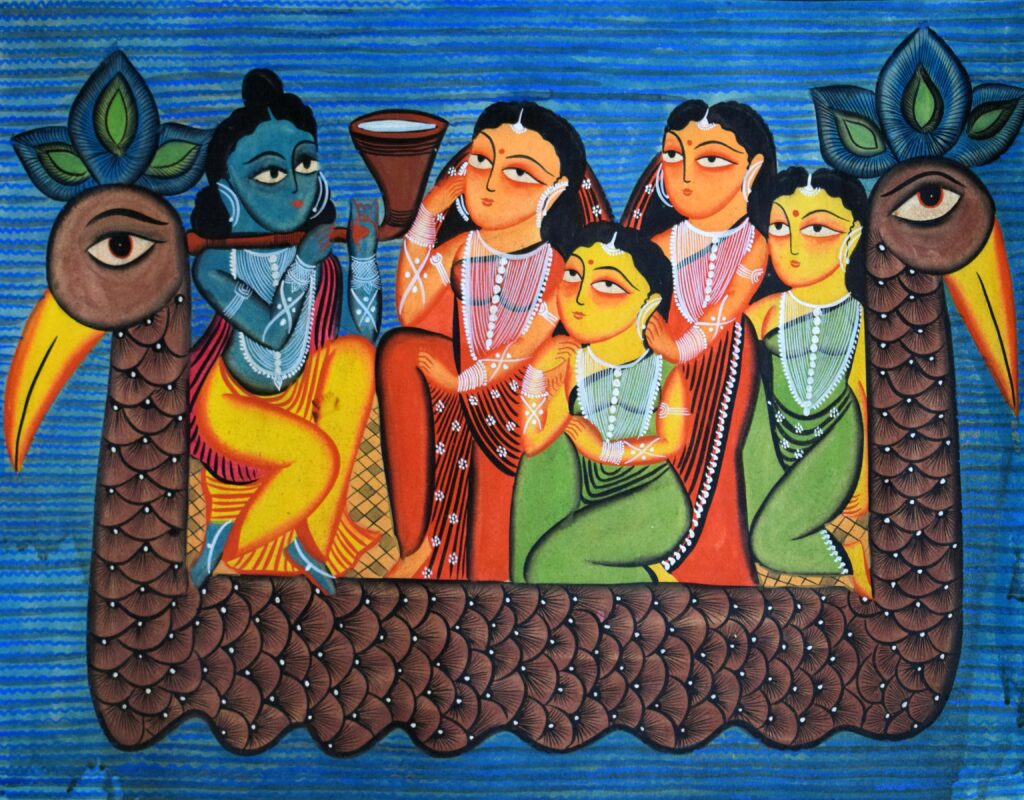
The History of Kalighat paintings is closely tied to the growth of 19th-century Calcutta, now Kolkata. The city was expanding as a colonial port, commercial centre and administrative capital. People arrived from across Bengal in search of work, including patuas, the traditional painters and storytellers associated with long narrative scrolls.
Kalighat was already attracting large numbers of pilgrims. Artists recognised an opportunity to produce affordable pictures of Kali, Shiva, Durga, Krishna and other religious figures for visitors to carry home.
The format changed in response to this new urban market. Instead of painting a long scroll containing several connected scenes, artists began producing single-sheet images with one or two central figures. Plain backgrounds and limited details allowed the work to be completed efficiently while keeping the subject immediately recognisable.
Cheaper mill-made paper and ready-made pigments also influenced production. The combination of new materials, quick brushwork and strong visual design helped create a form that was both accessible and unmistakably modern. The Victoria and Albert Museum dates its large collection across roughly the 1830s to the 1930s and describes Kalighat painting as a mass-market genre developed by patuas in 19th-century Kolkata.
This commercial origin should not be mistaken for a lack of artistic quality. Kalighat painters needed control, speed and an instinct for what the public would notice. A few lines had to establish posture, personality, clothing and emotion.
The artists were making images for buyers, but they were also watching a city change in front of them.
From Sacred Images to City Life
Religious subjects remained important throughout the tradition. Kali with her extended tongue, Durga defeating Mahishasura, Shiva carrying Sati and scenes from the Ramayana or Krishna’s life were familiar choices for visiting devotees.
Over time, however, Kalighat painting themes expanded far beyond mythology.
Artists painted musicians, courtesans, policemen, servants, domestic arguments, pets, fish, birds and figures from contemporary news. Some pictures captured occupations or scenes from everyday life. Others turned public scandals into visual narratives that audiences could recognise immediately.
This change made Kalighat painting especially unusual. It remained connected to pilgrimage and folk practice, yet it also developed the speed and topicality of popular media.
A major scandal, an unusual court case or a new urban fashion could become the subject of a painting. The patua was no longer only illustrating a story inherited from religion or oral tradition. He was responding to events unfolding in the city.
That responsiveness gave the art its bite. Viewers could look at an image and recognise not only a deity or animal, but also a type of person they encountered in daily life.
The Babu, the Bibi and Colonial Performance
Among the most recognisable Kalighat paintings of colonial Bengal are depictions of the Babu.
The Babu was often shown as a wealthy or educated Bengali man who had adopted the manners, clothing and aspirations associated with British colonial culture. He might wear European shoes, arrange his hair in a fashionable style, sit on imported furniture or display exaggerated refinement.
Kalighat artists treated this figure with suspicion and humour.
The Cleveland Museum of Art’s painting English Babu Holding a Hookah, dated around 1890, presents a Bengali clerk seated cross-legged on a Victorian chair. His clothing and accessories mix Indian and British fashions, creating the very cultural contradiction the caricature was designed to expose. The museum describes the work as a satire of vain, newly wealthy Babus imitating their colonial masters.
The comedy came from performance. These men wanted to appear modern and sophisticated, but the pictures suggested that the performance was artificial.
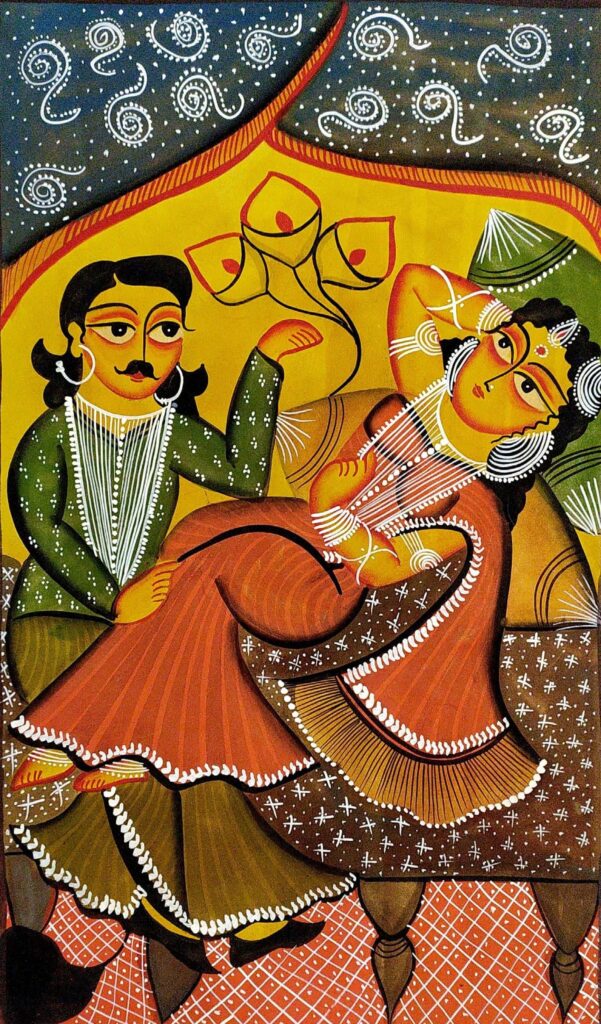
Women, often referred to as Bibis in these scenes, were portrayed in equally interesting ways. Some appeared richly dressed, confident and socially powerful. Others participated in flirtation, domestic disputes or reversals of expected gender roles.
These images can be humorous, but they also reflect social anxiety. Colonial urban life was changing how people dressed, spent money, formed relationships and understood respectability. Kalighat painters captured that uncertainty through recognisable characters.
Social Satire in Kalighat Art
Social satire in Kalighat art did not depend on long written explanations. A gesture, object or reversal of power could deliver the joke.
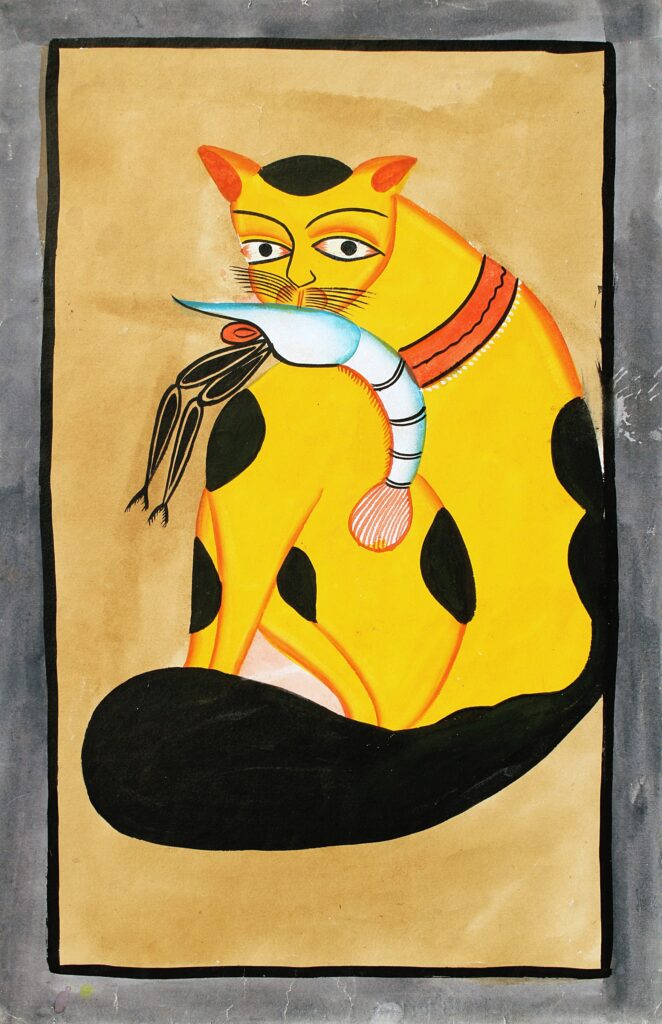
A cat carrying or eating a fish might appear playful, but it could symbolise a hypocritical holy man pretending to be innocent while secretly enjoying worldly pleasures. A henpecked husband might be shown controlled or punished by his wife, turning expected domestic authority upside down. A corrupt official could be exposed through a single unmistakable act.
The satire frequently targeted hypocrisy rather than poverty. Wealthy men, religious authorities, fashionable elites and people who displayed false virtue were natural subjects.
This made Kalighat painting a form of public criticism. The images were affordable enough to circulate outside elite institutions, and their meaning could often be understood quickly. Humour allowed the artist to comment on uncomfortable realities without producing a formal political statement.
One of the best-known groups of works concerns the Tarakeswar scandal of the 1870s, involving the temple mahant, a woman named Elokeshi and her husband. The affair, murder and subsequent trial became a major public sensation. Kalighat painters turned the episode into a sequence of dramatic scenes, treating contemporary news almost like an illustrated serial. The V&A’s collection includes works showing the mahant and Elokeshi together, demonstrating how public events entered the visual vocabulary of the style.
The paintings were entertaining, but entertainment was not their only purpose. They invited viewers to judge behaviour.
Who was pretending? Who held power? Who was being deceived? Who had abandoned moral responsibility for status or pleasure?
Those questions gave Kalighat satire its lasting relevance.
Why the Style Looks So Modern
A classic Kalighat image often has a broad, flowing outline and a figure placed against an almost empty background. Colour is applied in clear areas, while subtle shading gives the body volume. Faces may be stylised, but posture and gesture communicate character instantly.
The lack of elaborate scenery is one reason the figures remain so powerful. Nothing distracts from the person, deity or animal.
This economy was partly practical. Artists serving a public market needed to work efficiently. Yet efficiency became an aesthetic strength. The picture communicates in seconds, much like a poster, cartoon or editorial illustration.
The V&A explains that the patuas moved away from long narrative scrolls towards single images, removed non-essential details and relied on basic colour combinations. These decisions established the main visual qualities associated with the Kalighat genre.
The style later attracted modern Indian artists because it offered a confident alternative to academic realism. Its clean shapes, bold contour and direct storytelling showed that an indigenous popular form could feel modern without imitating European painting.
Jamini Roy is among the most frequently discussed artists influenced by this visual language. Mojarto’s earlier article on Kalighat painting focuses particularly on that connection, including Roy’s use of folk-inspired lines, subjects and simplified forms.
What Should Collectors Notice?
A collector should begin with the line.
In a convincing Kalighat work, the outline feels assured. It does not appear hesitant or overworked. The curve of a shoulder, the angle of an eye or the position of a hand gives the figure its personality.
Next, look at the balance between simplicity and expression. A plain background does not mean the composition is empty. The space around the subject should make the figure feel stronger.
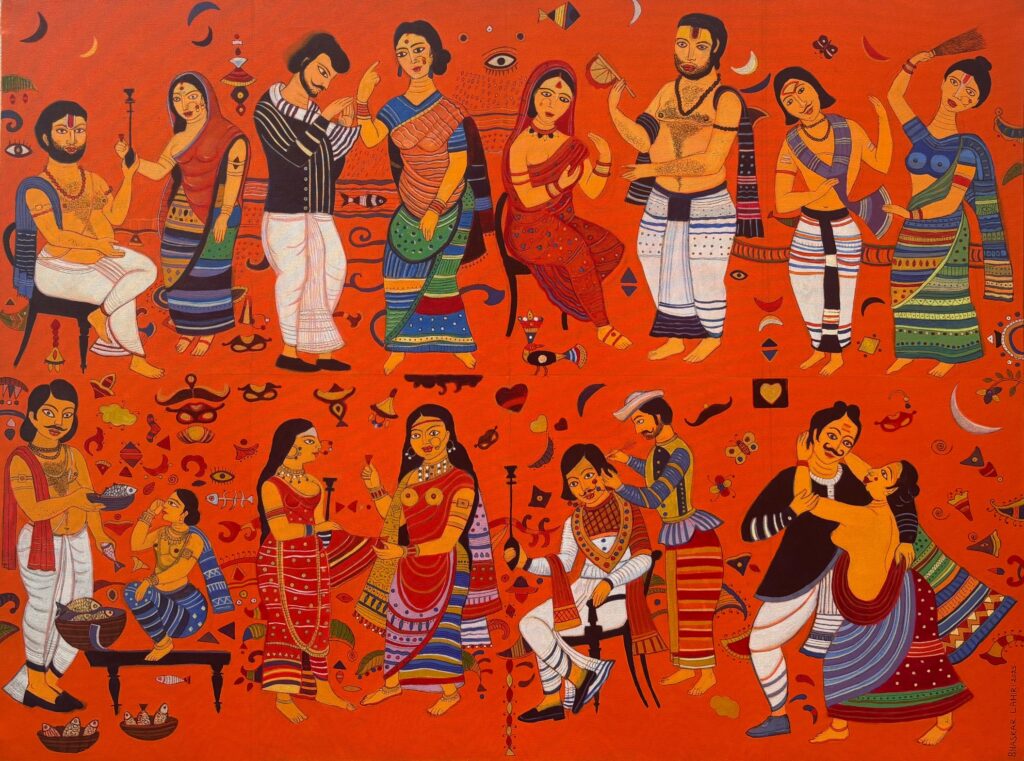
The subject also matters. Is the artist repeating a familiar deity without adding much interpretation, or is there wit and observation in the scene? In contemporary Kalighat-inspired work, a recognisable visual tradition may be used to comment on present-day habits, politics, technology or urban life.
Collectors should also distinguish between an older historical work, a contemporary work created within an inherited patua practice and a modern painting merely inspired by Kalighat aesthetics. Each can be interesting, but they should not be treated as the same category.
Read the artist information and artwork description. Check the medium, year and stated style. Compare several works by the same artist to see whether a personal approach emerges.
A good choice is rarely based only on the fact that an artwork contains a fish-eating cat, a Babu or a bold black outline. The strength lies in how convincingly the artist uses those elements.
Finding Kalighat Art on Mojarto
Collectors who want to buy original Kalighat paintings online can explore Mojarto’s Indian folk art collection and compare works associated with Kalighat and related Bengali traditions. The platform currently features Kalighat works by contemporary artists as well as pieces listed within its wider folk art selection.
One contemporary example is Bhaskar Chitrakar’s Kalighat Cat with Sitar, Crows & Flying Fish. The work draws upon familiar humour and animal imagery while presenting them through the hand and imagination of a living artist. Mojarto describes it as a work rooted in traditional Kalighat training with a playful contemporary character.
Browsing several artworks together helps reveal how flexible the style can be. One artist may stay close to devotional subjects. Another may use cats, fish or urban personalities to revive the satirical spirit of the old painters.
That comparison is valuable. It helps the collector move beyond a label and recognise artistic individuality.
Mojarto’s relevance lies in making this discovery process easier. Art lovers can explore Indian folk traditions, study artist profiles and identify works that carry both visual appeal and cultural meaning.
A Popular Art Form with a Sharp Memory
Kalighat painting emerged from the meeting of pilgrimage, commerce, migration and colonial city life.
Its artists learned to paint quickly, but they did not look carelessly. They observed clothing, ambition, romance, corruption, religious pretence and the growing desire to appear modern. They turned those observations into images that ordinary people could enjoy and understand.
That is why Kalighat paintings remain more than historical souvenirs.
They show how Indian folk artists responded to modernity on their own terms. They borrowed new materials without surrendering their visual identity. They painted gods, but they also painted scandals. They served a market, but they also questioned the people shaping that market.
For today’s collector, the strongest works still possess that combination of beauty and intelligence. The curve of the brush attracts the eye. The humour holds it. The history gives the image weight.
To understand Kalighat art is to see colonial Bengal not only through official buildings and political records, but through the quick, observant hand of the street artist.
Frequently Asked Questions
1. Where did Kalighat paintings originate?
Kalighat paintings developed around the Kalighat Kali temple in 19th-century Kolkata. Patua artists created portable religious pictures for pilgrims and later expanded their subjects to include urban life, scandals and social satire.
2. What are the main Kalighat painting themes?
Common themes include Hindu gods and goddesses, mythology, animals, domestic scenes, musicians, courtesans, fashionable Babus, public scandals and satirical depictions of colonial Bengali society.
3. Why are Kalighat paintings considered socially important?
They documented changing attitudes towards wealth, gender, religion, fashion and colonial influence. Their satire criticised hypocrisy and pretension while making contemporary events understandable to a broad public.
4. What are the main visual features of Kalighat art?
Kalighat works are known for bold outlines, fluid brushwork, bright colour, simplified forms, expressive gestures and plain backgrounds that keep attention on the central subject.
5. Can collectors find contemporary Kalighat artworks on Mojarto?
Yes. Mojarto features Indian folk art, including contemporary works created in or inspired by the Kalighat tradition. Collectors can compare artists, mediums, subjects and descriptions before choosing a work.