
By P Abigail Sadhana Rao
Color is my day-long obsession, joy and torment. — Claude Monet
Few artists have transformed the act of looking quite like Claude Monet. Rather than simply reproducing the world before him, Monet was fascinated by the way light, colour and atmosphere could continually alter what the eye perceived. A garden, a river, a cathedral or a field could become an entirely different image depending on the hour, the season or the weather. His paintings are recognised for their luminous colour, loose and expressive brushwork and fleeting impressions of a particular moment. His celebrated Water Lilies series, painted in the garden at Giverny, became a lifelong exploration of reflections, water, flowers and light, turning an intimate garden into one of the most recognisable subjects in modern art.
Monet was one of the central figures of Impressionism, a movement that emerged in France during the late nineteenth century and challenged the conventions of academic painting. Impressionist artists moved away from highly finished compositions and historical subjects, instead turning their attention towards everyday scenes and the changing experience of the natural world. They experimented with broken colour, visible brushstrokes and the effects of natural light, seeking to capture an impression rather than a perfectly defined representation. More than a century later, these ideas continue to resonate, finding new interpretations in contemporary Indian art.
On Mojarto, paintings of water, gardens, flowers and landscapes reveal how the fascination with light, colour and atmosphere continues to inspire artists in distinctly contemporary ways.
Water Lilies in a Contemporary Palette
Waterlilies by Swati Kale draws the eye into a tranquil pond where lavender and white blooms float among lily pads in shades of turquoise, green, mauve and soft yellow. The simplified forms and vibrant palette give the water an almost dreamlike quality, while the flowers appear to emerge effortlessly from the surface. Her fascination with flowers as symbols of the universe and expressions of nature lends the painting a contemplative dimension beyond its visual beauty.

The subject naturally echoes Monet-inspired, particularly the enduring fascination with water lilies as a way of exploring colour, reflection and the changing mood of water. Yet the vivid, almost jewel like palette gives Kale’s interpretation its own identity within contemporary Indian art. The painting could introduce a refreshing burst of colour into a home, while its meditative subject invites moments of stillness and reflection.
Where Landscape Becomes an Impression
Born in the Kashmir Valley, artist Zargar Zahoor discovered his artistic inclination at an early age and chose to pursue it professionally in 1971, when he joined the M.S. University of Baroda. There, he studied under influential figures including Ghulam Mohammad Sheikh, Jeram Patel and K.G. Subramanyan. His lifelong engagement with landscape has been shaped by a fascination with the fleeting qualities of weather, light and nature. Rather than relying on dramatic contrasts, he creates luminosity through a harmony of lighter tones, giving his landscapes an almost ethereal quality.

This nuance is evident in the first work, where blue, ochre and muted earth tones gently merge across the landscape. The forms appear through refined brushwork, creating a sense of nature observed in a passing moment. There is a quietness to the composition, with the atmospheric treatment encouraging the eye to linger rather than settle immediately on defined forms. It is this attention to changing light and fleeting impressions that places the work naturally within the conversation around impressionist paintings in India. Its restrained palette and meditative quality could lend a contemplative character to a reading corner, study or softly lit room.

This second landscape carries a warmer temperament, with earthy reds, greens and ochres unfolding beneath an expansive sky. Here, colour becomes the means through which atmosphere is conveyed, rather than simply describing the elements within the scene. Much like the Impressionist vision of Claude Monet, the scene prioritizes the subjective experience of light and atmosphere over rigid depiction. Yet the work remains distinctly rooted in the Indian landscape tradition. Its breadth and warmth give it a presence suited to a more expansive wall, where the shifting tones can gradually reveal themselves and create an evolving visual experience.
Water Lilies Meet the Light
Desert Oasis by Amita Dand is a luminous exploration of light, colour and the quiet poetry of nature. The painting draws the eye into a tranquil water lily pond, where delicate blooms and layered reflections seem to dissolve into one another beneath a warm twilight glow. Its emphasis on water, changing light and fleeting atmosphere recalls the visual language that makes Claude Monet inspired paintings so enduring, while Dand brings the subject into her own contemporary Indian vocabulary.
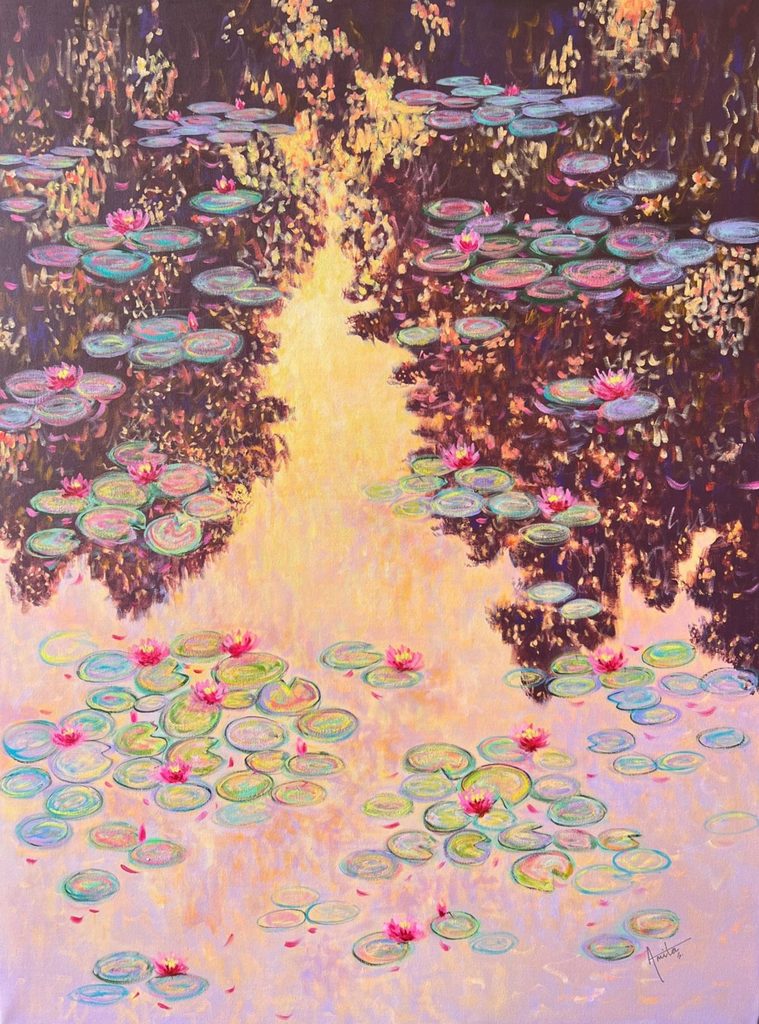
As a self taught artist, Dand left her career in IT to pursue painting full time. She is especially known for her distinctive water lily ponds and richly textured impasto works, working primarily in acrylics while also exploring oils and pastels. Her paintings invite a personal and emotional response, leaving room for interpretation. This artwork can bring the serenity of a garden into the home. Its luminous palette and immersive pond scene can also create a contemplative focal point in a contemporary living space, making it a work that feels both decorative and deeply atmospheric.
Stillness of the Water Garden
A lush pond filled with lotus blooms forms the heart of Sumita Maity’s Untitled (Lotus Pond in Pink, Blue, and Green). White and blush pink flowers emerge among broad lily pads, slender stems, unopened buds and yellow seed pods, creating a layered composition alive with colour and movement.
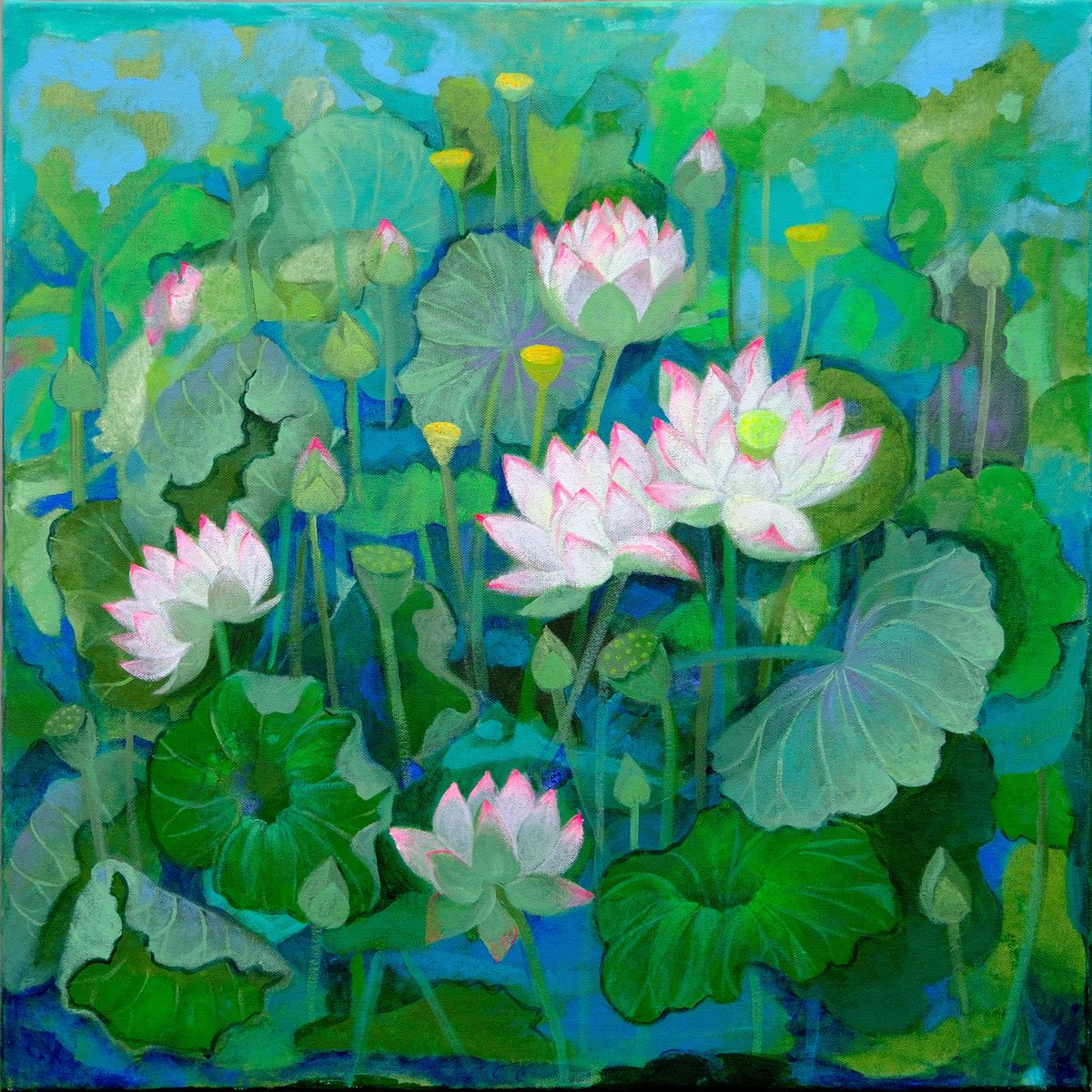
The interplay of water, foliage, and flora mirrored in the changing light mirrors the core spirit of Monet’s iconic water lily series Yet Maity’s interpretation remains distinctly her own, bringing the familiar water garden into a contemporary Indian context through vivid greens, blues and pinks. Rich in colour and detail, the painting rewards slow looking and could introduce a refreshing sense of nature into a contemporary space.
Light Through the Trees
Green Canopy by Sunil Linus De captures a quiet moment along a shaded woodland path, where a solitary figure moves through a canopy of trees. The strong interplay of light and shadow gives the watercolour a sense of depth, while washes of green, yellow and earthy brown create an atmosphere that feels spontaneous and alive.
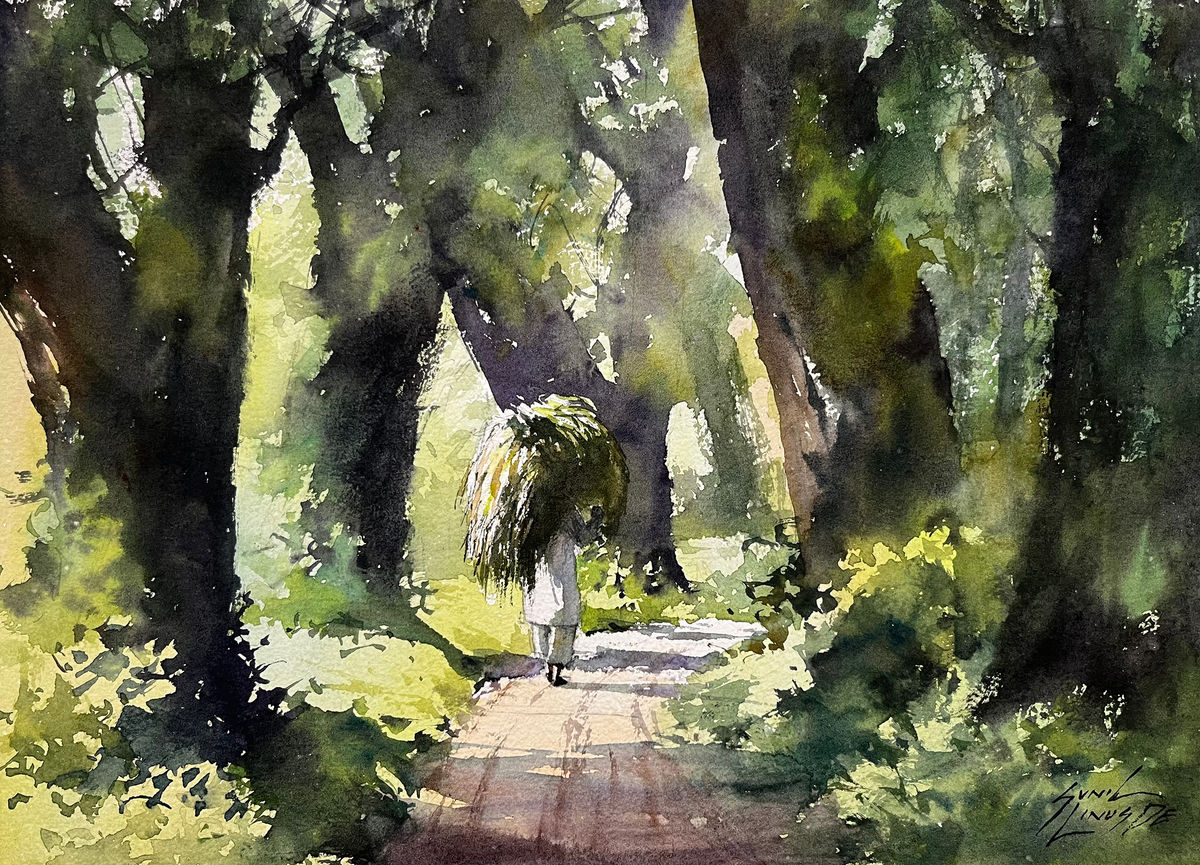
This sensitivity to natural light and fleeting moments creates a subtle connection with Monet-inspired art, where observation and atmosphere take precedence over rigid detail. Born in Kerala, De has spent over twenty five years working with watercolour and is recognised for his evocative depictions of rural life. His fluid handling of the medium makes this work a refreshing choice for bringing nature and movement into a home or office.
An Urban Resonance
Tejinder Kanda’s Cityscape transforms the post-monsoon quiet of an Indian street into a symphony of light, texture, and movement. As the downpour eases, the city awakens: rickshaws, bicycles, shopfronts, and passing pedestrians merge into a vibrant, rhythmic momentum. Beneath them, the rain-slicked asphalt turns into a liquid canvas, fracturing and echoing the surrounding world in shimmering ribbon-bursts of electric blue, radiant yellow, soft pink, and cool grey.

Executed with sweeping, energetic brushstrokes, the composition prioritises sensation over strict realism. Form dissolves gently into pure atmosphere, capturing the transient magic of a single, fleeting breath in the urban rush. This poetic treatment of fleeting moments taps into the heart of Impressionist traditions adapted to the Indian landscape, where the interplay of light and mood reigns supreme over literal line. Deeply aligned with the luminous heritage of Claude Monet and the atmospheric majesty of John Constable, the artwork bridges classical European sensibilities with the raw, irresistible vitality of modern India.
A Garden of Reflections
Lotus Pond Under Bridge by Surekha H M draws the viewer into a richly coloured landscape where a cascading waterfall, an arched bridge and a pond filled with white lotus flowers come together in a harmonious scene. Layers of violet, turquoise, blue and green create a dreamlike atmosphere, while the water reflects the surrounding foliage and light.

The composition brings to mind the quiet immersion found in contemporary Indian paintings inspired by Monet, particularly in its treatment of water as both subject and surface.Yet the bridge, waterfall and abundance of lotus blooms give the work a distinctly Indian character. The dense vegetation and luminous palette create a sense of stepping into an enchanted garden, making the painting an evocative choice for a space that calls for colour, movement and a connection with nature.
Nature Finds Its Rhythm
Mahmood Ahmad’s Landscape turns the natural world into a vibrant interplay of movement, colour and texture. Rolling green hills stretch towards the horizon, while a winding body of water creates a gentle rhythm through the composition. In the foreground, dense strokes of orange, red and green suggest a field alive with vegetation, giving the scene remarkable energy.

Rather than presenting nature as a static view, the work captures its constant transformation, an approach that resonates with the atmospheric qualities of Impressionist landscape paintings. Ahmad describes his art as an encounter with nature and a means of expressing and liberating his emotions. This personal connection gives the landscape an expressive quality, allowing its colours and flowing forms to bring vitality and movement to a contemporary space.
The Poetry of Moving Water
Waves, by artist Sathya Arunachalam, captures the sea as a constantly changing landscape of light, movement and colour. Deep blues and turquoise tones sweep across the surface, punctuated by flashes of white that suggest the restless rhythm of the water, while the distant land gently dissolves beneath a luminous sky. Rather than defining the ocean through precise forms, the painting allows colour and expressive brushwork to convey its changing mood.

The shifting interplay of light and atmospheric quality also connect the work to paintings that mimic Monet-like impressionist style. It reflects a shared interest in capturing the changing character of nature. Painting has been a way of life for Arunachalam since childhood, guided by an instinctive fascination with light, movement and nature. This artwork carries that lifelong engagement onto the canvas, bringing the openness and energy of the sea into a contemporary space.
Born from Imagination
Blue mountains rise beyond a tranquil stretch of water, while vivid red and orange trees punctuate the scene, drawing the eye through the composition. Reflections ripple across the water, creating a sense of depth while loose, textured strokes keep the landscape feeling fluid and expressive. Landscape with Red Trees by Bolleddu Sridhar presents a landscape shaped entirely by imagination.

The heightened colours give the work an almost dreamlike atmosphere, moving beyond a literal representation of place. This imaginative approach offers another perspective on contemporary Indian paintings inspired by Monet, where landscape can become an exploration of colour, light and personal perception. Unlike a direct study of nature, Sridhar constructs his own setting, allowing the viewer to enter a world shaped by memory and imagination. Its vivid palette and serene composition could bring a lively yet calming presence to a contemporary collection.
Transform Your Walls with Monet Inspired Elegance
From tranquil lotus ponds and shimmering waters to rain washed streets and sunlit landscapes, these works demonstrate how the visual language of Impressionism continues to evolve through contemporary Indian art. While each artist approaches nature, light and colour differently, their paintings share an appreciation for fleeting moments and the atmosphere they create.
Translate your love for Monet into your own interior, explore Mojarto’s contemporary artworks to discover a piece that breathes life and movement onto your walls. From familiar subjects seen in unexpected ways to artists developing and expressing their own distinctive style, there is always another work waiting to be discovered, collected and lived with.