
By P Abigail Sadhana Rao
Christopher Nolan’s The Odyssey made me think about journeys. I have not yet seen the film, but its arrival brought me back to the first time I read Homer’s ancient epic and followed Odysseus on his long, perilous journey home to Ithaca. What stayed with me was not simply the adventure, but the idea of how deeply a journey can transform us. Perhaps that is what makes journeys so compelling; we set out towards a destination, only to discover ourselves somewhere along the way.
Perhaps that is why the idea of an odyssey feels so familiar. We may not cross mythical seas or encounter gods and monsters, but we all leave something behind and move towards something else. Sometimes the journey is physical: a pilgrimage to a sacred mountain, a train through a city, a road towards an unfamiliar place. Sometimes it is quieter, unfolding through memory, emotion, relationships, dreams or the simple passage of time. We may know our destination, or we may discover it only along the way.
Indian art offers an extraordinary body of work depicting such journeys. Across landscapes, pilgrimage routes, cities, villages and imagined worlds, artists have depicted not only movement through space, but the inner transformations that accompany it. A journey can be an act of faith, an encounter with a place, a wandering through uncertainty, a return to memory, a search for belonging, or a movement towards a hope that exists only in the imagination.
The artworks that follow do not tell one journey. Together, they reveal many ways of travelling through a life. In them, roads become rivers, mountains become thresholds, cities become memories, crowds become companions, and the landscape sometimes disappears altogether, leaving only colour, emotion and the self.
The Journey Begins
The first journey is perhaps the oldest: the journey undertaken with faith. In Nageswara Rao’s evocative painting of the pilgrimage to Amarnath, stylised, fragmented figures move through the formidable Himalayan landscape, their walking sticks creating a quiet rhythm of endurance.

Cool blues and greys heighten the sense of austerity, while touches of warmer colour animate the procession. The rugged terrain becomes more than scenery; it becomes a threshold between the physical and spiritual, where each step carries the promise of transformation.
When the Place Becomes the Journey
From the arduous ascent towards Amarnath, the journey moves into the living, layered landscape of Banaras in Anuradha Date’s On the Banks of Banaras. The dense architecture, crowded ghats and quiet movement of boats create a world that feels simultaneously intimate and immense.

Her fluid handling of colour and form transforms the city from a destination into an experience. Date describes art itself as a kind of migration, a way of travelling through memory and imagination when the physical world remains beyond reach.
Into the Unknown
But journeys are not always pilgrimages towards a known destination. In Ranjith Raghupathy’s The Night Journey, movement becomes dreamlike and uncertain. Horses and riders emerge through a dense, indigo forest, their fragmented forms seeming to dissolve into the surrounding landscape.
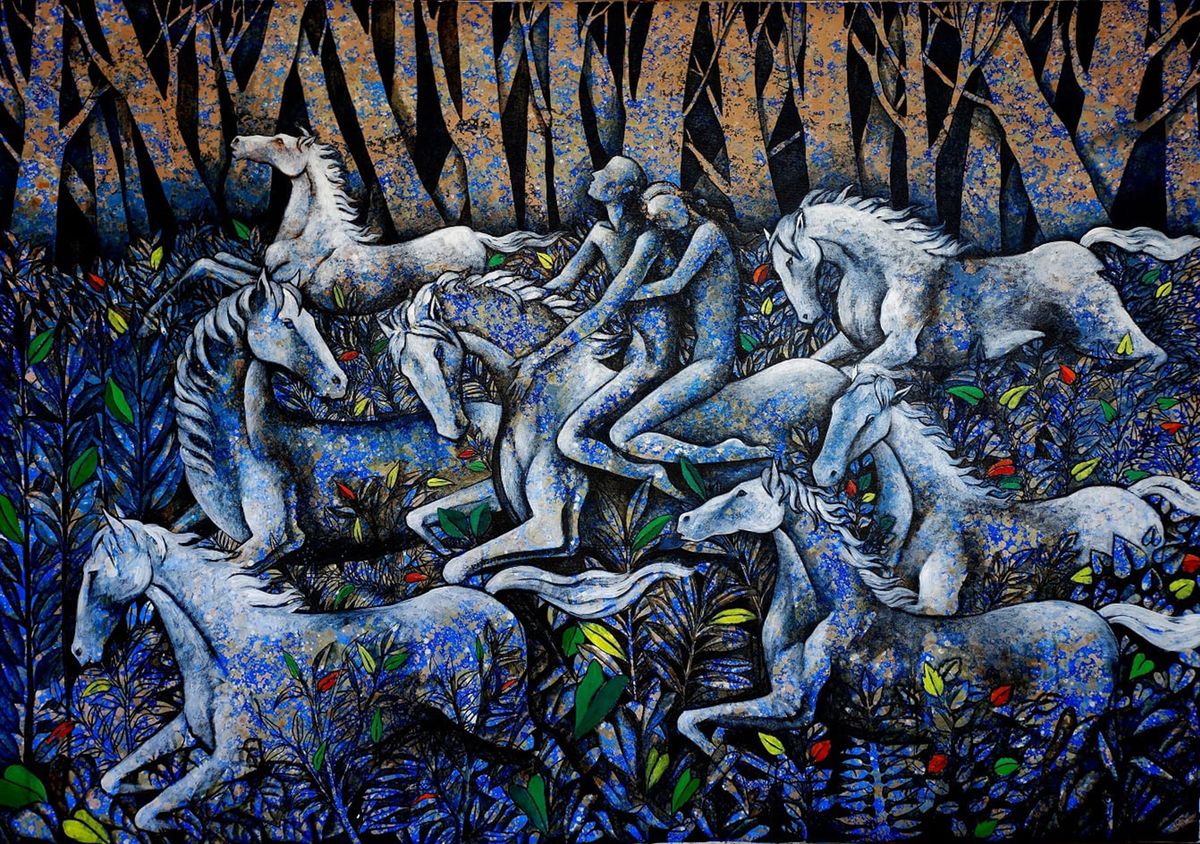
The absence of a clear road or horizon deepens the mystery, while the restrained yet vivid palette creates a world suspended between reality and imagination. Here, the journey becomes psychological: a passage through uncertainty, illusion and the unknowable terrain of existence.
The Journey Within
If the night journey takes us into uncertainty, Ketki Fadnis’s Journey Within turns the direction entirely inward. Built through multiple layers of acrylic, the abstract work unfolds through repetitive, gestural marks, where subtle and contrasting hues accumulate like fragments of memory.

There is no road, figure or destination to guide the eye; instead, the surface becomes a landscape of moods and energies. For Fadnis, painting is an intuitive, meditative process, transforming imagination and lived experience into a journey that each viewer can enter differently.
Journeys of Everyday
From the inward landscape of memory, Shitangshu Mondal’s Today’s Journey brings us back to the familiar rhythm of everyday life. A Kolkata tram moves through a composition layered with maps, architectural fragments and intersecting lines, turning an ordinary commute into a meditation on movement and time.

The tram has a destination, yet everything that happens along the way remains unknowable. Perhaps that is the quiet truth of life: not every journey announces itself as one, even as it carries us towards becoming someone new.
Towards a Destination
Every Odyssey, however uncertain its course, carries the idea of somewhere to arrive. In Ananta Mandal’s Taj Mahal in Sunset Glow, the destination takes on an almost dreamlike quality. Rendered in luminous washes of amber, ochre and violet, the monument dissolves into the atmosphere of dusk, while its reflection shimmers across the water.

A tiny traveller and camel appear almost incidental beside its grandeur. Yet perhaps that is the point: sometimes we journey not towards a place itself, but towards what it represents, love, memory, beauty, belonging or an imagined ideal.
Journeys We Share
Not every journey is solitary. In Arun Mishra‘s Gram Yatra, the journey unfolds as a collective experience, bringing villagers together at a weekly market. The crowded composition teems with figures, animals, carts and colour, with the eye constantly moving between small encounters within the larger scene.
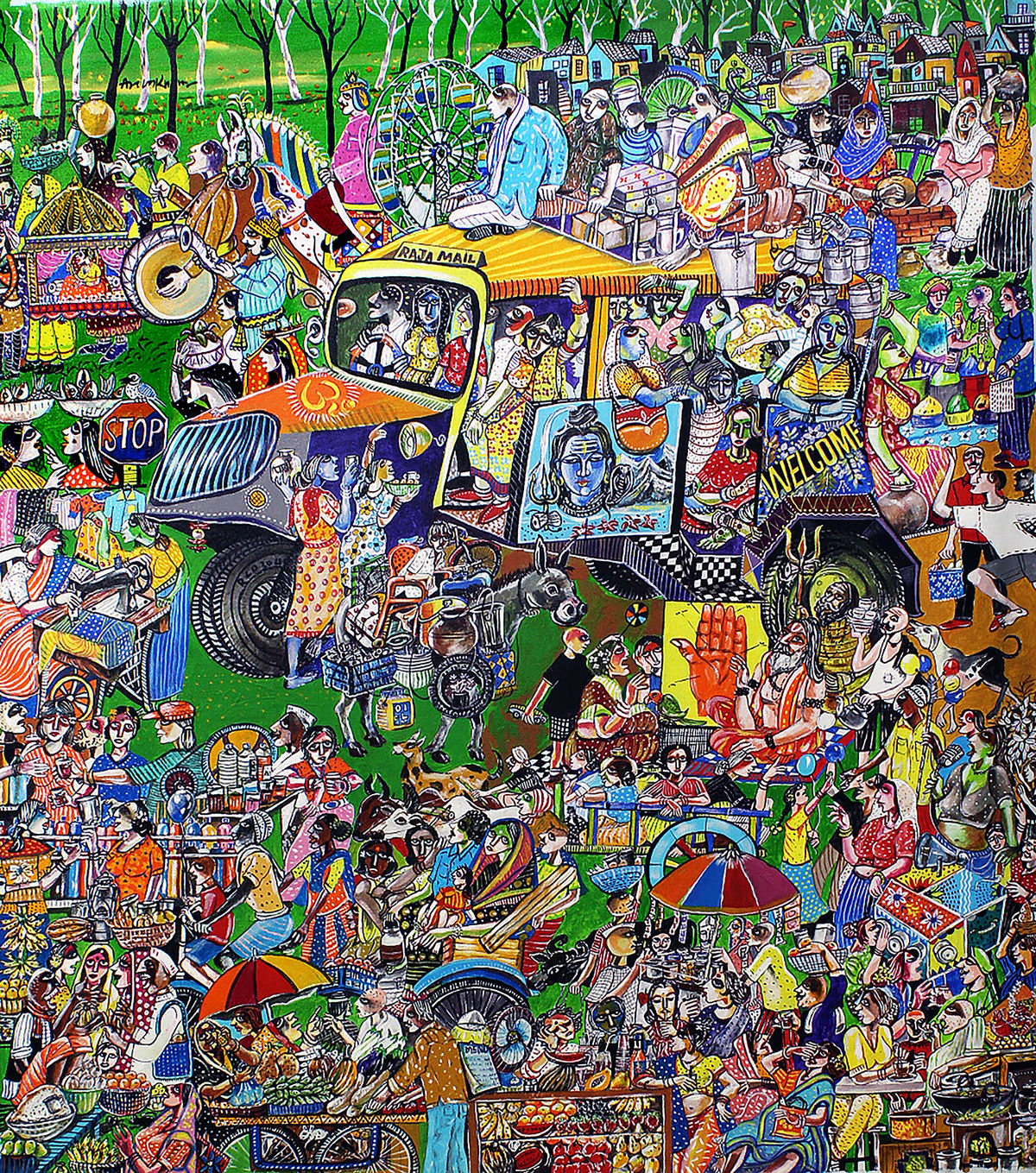
There is no single protagonist or fixed destination; instead, many individual journeys intersect for a moment. In this sense, Mishra expands the idea of an Odyssey beyond the lone traveller, reminding us that much of life is shaped by the journeys we share with others.
Finding the Thread
Yet even shared journeys have moments when the way forward becomes difficult to see. Uttam Bhattacharya’s Labyrinth of Dreams turns that uncertainty into an evocative metaphor, placing winged figures within a winding, dreamlike maze. Their wings suggest aspiration and freedom, while their slow, grounded movement speaks of effort and vulnerability.

Drawing on the Greek myth of Ariadne’s thread, Bhattacharya reminds us that those who love and support us can become our guiding thread through life’s twists and turns, helping us recover lost dreams and find our way forward. The labyrinth also brings us back to Homer’s Odyssey, where Odysseus, too, must navigate a succession of unknown worlds, relying on courage, ingenuity and the help he encounters along the way. In both, the journey is as much about finding one’s way as it is about reaching the destination.
What We Carry With Us
If the labyrinth asks who helps us find our way, Brajmohan Arya’s Journey of Emotion asks what we carry along the way. Faces, dancing figures, flutes and kites emerge through layers of warm ochres, yellows and blues, drawing upon fragments of Indian cultural memory.

The central figure appears almost suspended within this constellation of forms, as though surrounded by memories rather than a physical landscape. Here, the journey becomes emotional: shaped by childhood, culture, relationships and experiences that remain with us long after the places themselves have disappeared.
The Hope That Carries Us Forward
Perhaps no journey can continue without the belief that something lies ahead. Dhan Prasad’s Journey of Hopes and Wishes brings together people from different walks of life, united by faith, purpose and quiet anticipation. The closely gathered figures create a sense of collective movement, while the vibrant palette lends the scene an atmosphere of optimism.
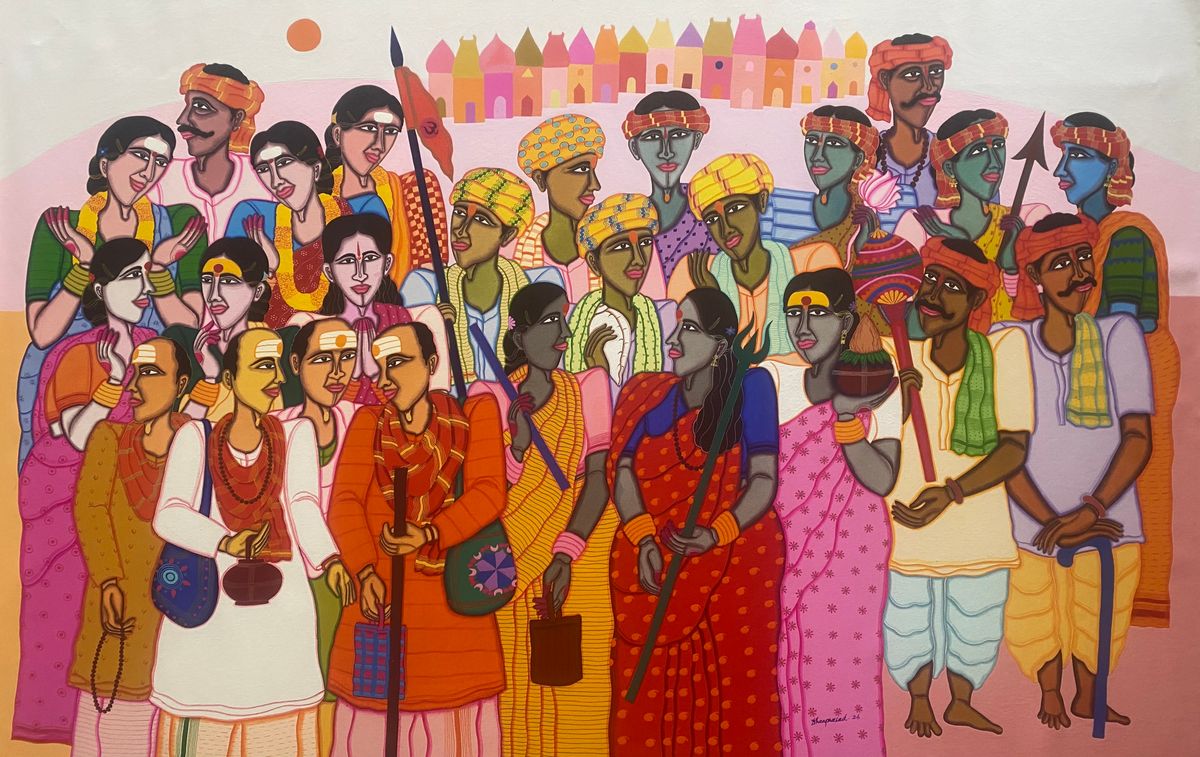
Here, the destination remains unseen, yet the journey has direction because of what the travellers carry within them: hope, devotion and the possibility of fulfilment. In this sense, every Odyssey begins with a wish to reach somewhere beyond where we are.
What We Become Along the Way
We often speak of journeys as if they are defined by where they take us. Yet perhaps their deeper significance lies in everything that happens between departure and arrival. The journey is the destination, after all. This may be what makes an Odyssey endure, whether in Homer’s epic or in the journeys represented through these artworks. We set out with faith, wander through uncertainty, encounter places and people, retreat into memory, carry our hopes and dreams, and continue towards whatever lies ahead. The destination may change, but so do we. What remains is everything the journey has left within us, and the person we become along the way.
Continue the Journey On Mojarto
Explore these artworks and discover the artists behind them on Mojarto. For more journeys through art, take a look at our curated collection Ride into Art, bringing together works that invite you to travel through new landscapes, perspectives and possibilities.