
By P Abigail Sadhana Rao
We often approach art expecting to find something beautiful. Sometimes it is the pleasure of looking at a painting, sometimes the quiet it brings into an otherwise busy day, and sometimes simply the opportunity to experience something beyond the familiar. Art has long been associated with beauty, contemplation and the ability to offer an escape from the ordinary.
But what happens when an artwork refuses to offer us any comfort?
Some of the most compelling works of art do not invite us to escape the world but insist that we look at it more closely. They bring our attention to histories we have overlooked, injustices we have learnt to live alongside, and realities that are easier to acknowledge from a distance. They might leave us unsettled or even uncomfortable. Their significance, however, does not necessarily lie in how they make us feel, but in what they compel us to recognise.
Perhaps this is one of the more interesting things about art: it does not always have to be beautiful in the conventional sense, nor does it always have to make us feel good. Sometimes, its purpose is to interrupt the very comfort we seek from it.
When Beauty and Discomfort Occupy the Same Space
Can an artwork be aesthetically compelling while depicting something deeply disturbing? More importantly, should beauty and suffering be considered opposing ideas in the first place?
The relationship between art and beauty has never been quite as straightforward as we might imagine. While we often associate beauty with harmony, balance and pleasure, artistic expression has continually found ways to challenge these expectations. An artwork can be visually arresting without being particularly pleasant to look at. Its colours, composition, scale or visual language might draw us closer, even as its subject matter makes us want to look away.
This tension becomes particularly significant when we consider art and social issues. Here, the artwork is not necessarily concerned with creating an idealised representation of the world. Instead, it becomes a way of examining the conditions that shape it. Violence, displacement, economic inequality, social divisions and collective grief are not always subjects that lend themselves to comforting representations. Yet, they are realities that deserve to be seen, remembered and questioned.
The distinction is important. Art does not have to aestheticise suffering to communicate something meaningful about it. Nor does the presence of beauty diminish the seriousness of what is being represented. Sometimes, the visual language of an artwork creates precisely the kind of tension that makes its subject difficult to forget.
When Home Becomes a Site of Conflict
Consider Slum Eviction by Krishnapada Maity, an artwork that brings attention to the human consequences of forced displacement.
Through a composition marked by destruction, smoke and scattered fragments of what once constituted people’s homes, the artist presents a landscape of instability and loss. Corrugated metal structures appear partially collapsed and scattered across the canvas. Amid the wreckage, however, people remain visible. Their presence becomes central to understanding the painting. They are not simply witnesses to a demolished landscape; they are individuals whose lives, routines and sense of belonging have been disrupted.
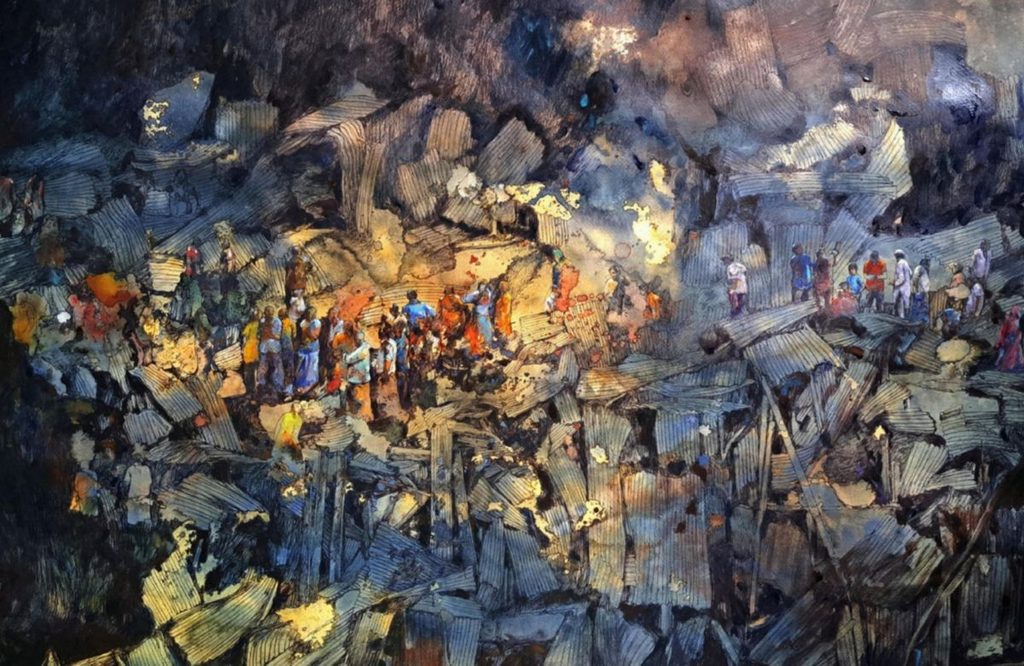
What makes the painting particularly affecting is the way it draws attention to something we often take for granted: the security of having a place to call home.
Eviction is frequently discussed through the language of urban development, land ownership and infrastructure. These conversations often focus on the physical transformation of cities, the allocation of land and the practical considerations surrounding urban planning. But behind these discussions are people whose homes are also repositories of memory, relationships and everyday life.
A home is rarely just a physical structure. It is where ordinary routines take shape, where relationships develop and where a sense of familiarity is built over time. When people are forcibly displaced, the loss extends beyond walls and roofs. It can mean the disruption of livelihoods, social networks, access to education and the security of an established community.
Maity’s painting asks us to look beyond the physical structures being dismantled and consider the lives affected when they disappear. There is no romanticisation of displacement here. Instead, the work confronts us with the uncomfortable reality that what might appear as urban transformation from one perspective can mean the loss of security and dignity from another. Perhaps this is where art becomes particularly important: in making visible the human experiences that are so easily reduced to statistics, policy discussions or passing news reports.
The Human Cost Behind the Idea of Progress
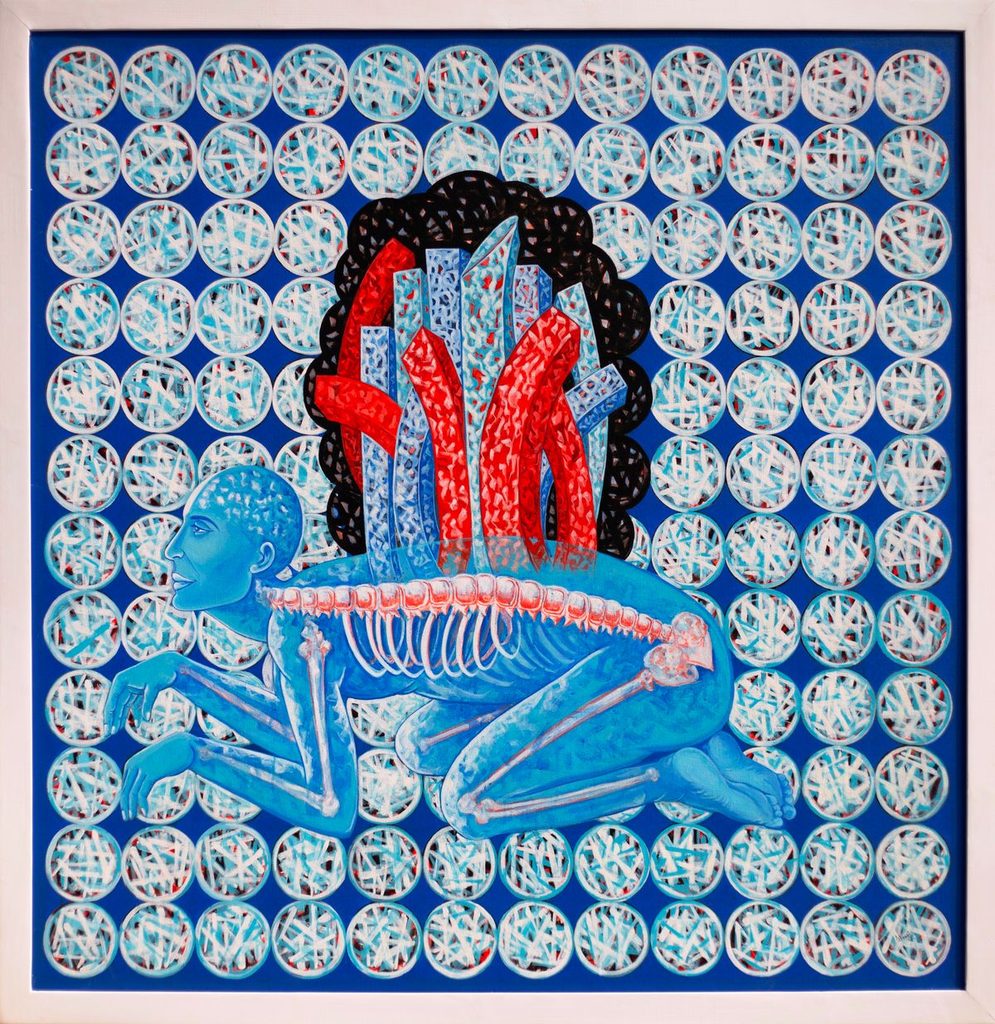
If Slum Eviction draws our attention to the relationship between displacement and belonging, The Son of Soil II by Manoj Kumar Paswan takes us towards another uncomfortable question: who bears the cost of a nation’s progress?
At the centre of the composition is a skeletal human figure, its exposed rib cage and crouching posture suggesting physical exhaustion and vulnerability. The artist uses this striking representation to convey the dedication and sacrifice of farmers, whose labour remains fundamental to the country’s sustenance and development. Behind the figure, a series of rising architectural forms symbolise national growth, creating a visual contrast between the aspirations of a developing nation and the physical realities of those who contribute to it. What makes the painting particularly thought-provoking is this tension between the individual and the larger idea of progress.
We often celebrate agricultural productivity, economic development and national growth without necessarily considering the people whose labour makes these achievements possible. The farmer is frequently represented as a symbol of abundance, tradition and the enduring relationship between people and land. Such representations have their place, but they can also obscure the physical demands, economic uncertainties and vulnerabilities associated with agricultural life.
Paswan’s painting takes a different approach. The farmer is not presented through an idealised image of rural life or romanticised associations with the land. Instead, the skeletal figure introduces a sense of fragility and sacrifice that challenges more comfortable representations of agricultural labour.
The contrast between the figure and the rising structures becomes particularly significant. While the structures suggest growth and development, the human body draws attention to the cost that can accompany these aspirations. It invites us to reconsider the relationship between progress and human dignity. If the growth of a nation depends, in part, on the labour of its farmers, what does it mean when the people sustaining that growth are themselves depicted through images of physical depletion?
This artwork does not offer an easy answer. Instead, it asks us to look beyond the familiar celebration of progress and acknowledge the people who often remain at the margins of that narrative. There is something deeply uncomfortable about recognising that the prosperity of a society and the wellbeing of those who contribute to it do not always move together.
When Conflict Becomes a Human Creation
While some artworks confront us with the visible consequences of social and economic injustice, others examine the very conditions that make conflict possible. Artist Saritha Uthappa’s Conflict approaches this subject through symbolism, bringing attention to the divisions that human beings create around borders, race, religion and resources.
At the centre of the composition, a human figure appears suspended within a series of concentric circular forms. Barbed wire runs around the figure, while hands holding arrows emerge from the surrounding red space. The Indian flag motif on the figure’s clothing adds another dimension to the work, inviting reflection on identity, belonging and the politics of national boundaries.
The artist’s accompanying statement makes the intention particularly clear. Conflict, she suggests, is not simply a consequence of disagreements between people or nations. It is also something humanity perpetuates through its attachment to divisions, competing interests and identities.
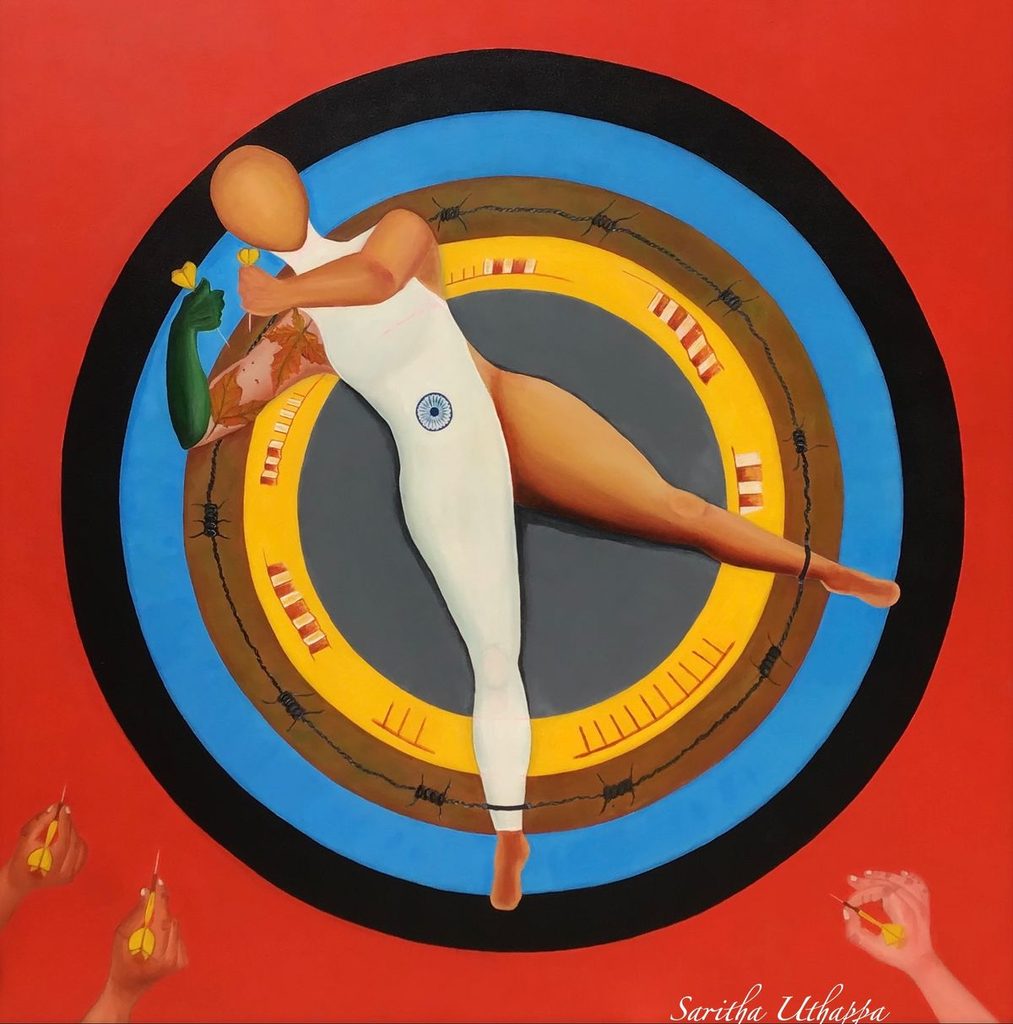
What makes the painting particularly compelling is the relationship between its visual symbolism and its underlying message. The central figure appears caught within a structure from which escape is difficult to imagine. The surrounding elements suggest that the sources of conflict are not necessarily distant or external. They can emerge from the very social structures and beliefs through which we organise our lives.
There is an uncomfortable contradiction here. We create boundaries in the name of protection, defend identities in the name of belonging and pursue resources in the name of progress. Yet, these same pursuits can become sources of hostility, exclusion and violence. Uthappa’s painting invites us to consider the human consequences of these contradictions. Rather than presenting conflict as an inevitable feature of human existence, it raises the possibility that many of the divisions we suffer from are also divisions we have created.
And perhaps this is one of the more unsettling questions art can leave us with; if human beings are capable of creating these conflicts, what responsibility do we have for allowing them to continue?
The Responsibility of Looking
There is a difference between seeing an image and really looking at it.
We encounter an extraordinary number of images every day. Photographs of conflict, destruction, protests and suffering appear alongside advertisements, entertainment and images of everyday life. The sheer volume of visual information can make it difficult to remain attentive to any one thing for very long.
Art asks something different of us. It asks us to spend time with its composition, its figures, its silences and the relationships between its elements. It allows us to consider what might exist beyond the immediate image.
But looking also comes with a responsibility. When an artwork addresses a difficult subject, it is worth asking whose experience is being represented, what social context informs the work, and whether our interpretation is shaped by assumptions we have not examined.
There is also a danger in treating suffering as an aesthetic experience alone. To admire the visual language of an artwork while ignoring the reality it represents would be to miss an important part of its meaning.
The challenge is to hold both things together: an appreciation of the artist’s visual language and an awareness of the human experiences informing it.
This is especially important when engaging with art that addresses displacement, labour, inequality and political conflict. These are not simply interesting themes to be encountered within a gallery. They are realities that continue to shape people’s lives.
When Art Refuses to Look Away
Perhaps we have become too accustomed to expecting art to provide an escape. There is nothing inherently wrong with seeking pleasure, calm or beauty in an artwork. Art can offer all of these things, and there is immense value in that experience.
But it would be limiting to expect every artwork to serve the same purpose.
Some paintings invite us to linger. Others demand that we reconsider what we have taken for granted. Some offer a sense of familiarity, while others expose the discomfort of encountering something unfamiliar or difficult to accept.
The three works discussed here approach these realities from different perspectives. Krishnapada Maity brings attention to the human consequences of forced eviction and displacement. Manoj Kumar Paswan examines the relationship between agricultural labour, sacrifice and national progress. Saritha Uthappa questions the divisions that humanity creates and the conflicts that emerge from them.
Their approaches differ, but each invites us to reconsider the relationship between art and the world beyond the canvas.
Together, they remind us that the subjects we might prefer to look away from are often the ones that deserve our attention the most.
Art does not have to resolve every conflict it represents. It does not have to offer consolation for every injustice or provide an easy way of understanding the complexities of human experience. Sometimes, its significance lies in its refusal to let us remain indifferent.
We may enter a gallery looking for beauty and leave thinking about something far less comfortable. We may encounter an artwork that challenges our assumptions, unsettles our certainties or makes us reconsider a reality we thought we understood.
Not every encounter with art needs to be reassuring.
Sometimes, the value of an artwork lies precisely in its ability to disturb us, to make us look again, and to remind us that looking away is not always the same as understanding.
Discover original artworks on Mojarto that invite you to look beyond the canvas and engage with the powerful human stories and social realities that shape our world.