
There is a quiet continuity that runs through Indian art. It does not announce itself loudly, yet it shapes every brushstroke, every form, every experiment. What we often describe as new in Indian modern art is rarely a complete break from the past. Instead, it is a conversation. A reworking. A subtle but powerful negotiation between memory and imagination.
For collectors, viewers, and cultural observers, this relationship is not just fascinating. It is essential. To understand Indian modern art today is to recognize how deeply it is rooted in classical Indian art themes, and how contemporary Indian artists use that foundation to build something entirely their own.
Platforms like Mojarto sit at the center of this shift, bringing together voices that reflect both inheritance and invention. What emerges is not nostalgia, but evolution.
The Enduring Presence of Tradition
Indian art has never existed in isolation from its past. From temple murals and miniature paintings to folk traditions and courtly aesthetics, artistic expression in India has always been tied to storytelling, symbolism, and philosophy.
Classical Indian art themes often draw from mythology, spirituality, nature, and human emotion. These themes are not static. They are layered with meaning and open to interpretation. This openness is what allows them to travel across centuries.
When we speak about tradition in contemporary art, we are not referring to repetition. Tradition here functions more like a starting point. It offers a language. What contemporary Indian artists do with that language is where things become interesting.
Reinterpretation, Not Replication
A common misconception is that contemporary artists either reject tradition or replicate it. In reality, most do neither. They reinterpret.
The idea behind How contemporary Indian artists reinterpret classical themes is not about preserving a fixed visual style. It is about engaging with ideas that have already lived many lives and allowing them to take on new meanings in a different context.
Take mythology, for example. Figures like Krishna, Durga, or Shiva have been depicted for centuries. Today, artists are less interested in traditional iconography and more drawn to the psychological, symbolic, or even political dimensions of these figures.
A modern portrayal of Durga might speak about feminine power in urban India rather than divine mythology. Krishna might appear not as a god, but as a metaphor for longing, love, or duality in contemporary life.
This shift allows Indian modern art to remain culturally grounded while also being globally relevant.
The Shift from Narrative to Interpretation
Classical Indian art often focused on storytelling. Miniature paintings illustrated epics. Temple sculptures narrated divine tales. The intention was clarity and devotion.
Contemporary Indian artists approach these same themes differently. The narrative becomes less literal and more interpretive. Meaning is no longer handed to the viewer. It is suggested, fragmented, sometimes even challenged.
This transformation reflects broader changes in society. As audiences become more diverse and global, art adapts. It invites dialogue instead of offering answers.
The phrase Tradition as starting point in modern Indian art captures this transition well. The past is not discarded. It is questioned, reshaped, and sometimes even resisted.
Materials, Mediums, and Modern Language
One of the most visible ways in which the evolution of Indian art traditions unfolds is through material and medium.
Classical forms relied on natural pigments, handmade paper, textiles, and temple surfaces. Today, contemporary Indian artists experiment with acrylics, mixed media, digital formats, and unconventional surfaces.
But the shift in medium is not just technical. It changes the language of art itself.
A folk motif rendered in bold acrylic strokes on canvas feels different from the same motif painted in its original context. A traditional pattern reimagined through abstraction carries a different emotional weight.
This is where Indian artists evolving classical motifs becomes more than a phrase. It becomes a lived practice. Artists are not bound by how things were done. They are inspired by why they were done.
Folk Traditions in a Contemporary Frame
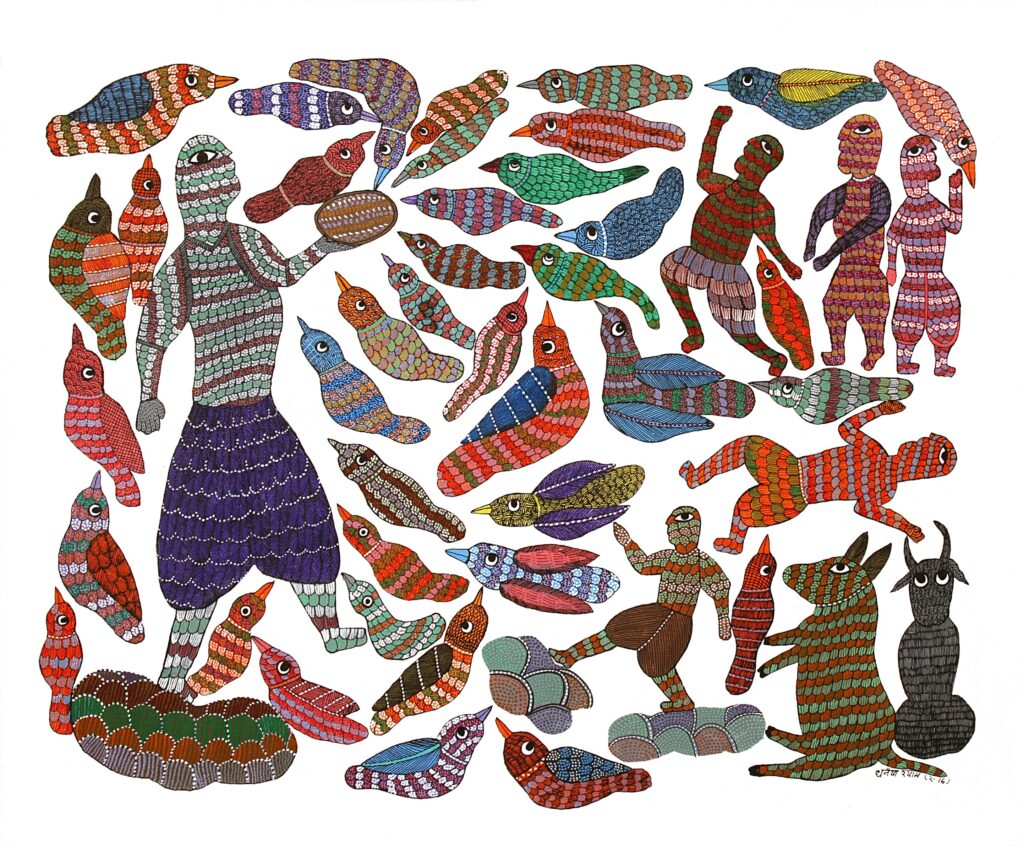
Indian folk art has played a particularly significant role in shaping contemporary expression. Styles such as Madhubani, Warli, Gond, and Pattachitra have found new life in modern contexts.
What is striking is not just their visual appeal, but their adaptability.
Contemporary Indian artists often draw from these traditions, not to replicate their aesthetic, but to borrow their visual vocabulary. Patterns, symbols, and storytelling techniques are reinterpreted to reflect current realities.
A Warli-inspired composition might explore urban migration instead of village rituals. A Gond-inspired piece might speak about environmental concerns rather than folklore.
This interplay ensures that folk traditions remain alive, not as static heritage, but as evolving cultural expressions.
The Influence of Personal Identity
Another layer in the evolution of Indian modern art is the role of personal identity. Contemporary artists bring their own experiences, beliefs, and questions into their work.
This was less common in classical traditions, where art often served religious or royal patronage.
Today, artists explore themes of gender, politics, migration, and memory through the lens of tradition. A classical motif becomes a vehicle for personal storytelling.
This shift adds depth and complexity to the work. It allows audiences to connect with art on multiple levels.
It also aligns with the idea of Contemporary evolution of Indian classical art, where tradition is not just inherited, but actively redefined by each artist.
Global Influence and Local Roots
Indian modern art exists within a global ecosystem. Artists are exposed to international movements, techniques, and audiences. Yet, what distinguishes their work is how they remain anchored in Indian contexts.
This balance is not accidental. It is carefully negotiated.
A contemporary Indian artist might draw inspiration from Western abstraction while still grounding their work in Indian symbolism. The result is art that feels both familiar and new.
For collectors and enthusiasts, this duality is compelling. It offers a sense of cultural authenticity while also engaging with global conversations.
Platforms like Mojarto play a crucial role in bringing this diversity to the forefront. They provide access to works that reflect the many directions in which Indian modern art is moving.
Why This Evolution Matters for Collectors
From a sales and marketing perspective, the evolution of Indian art traditions is more than a cultural phenomenon. It is a value proposition.
Art that bridges tradition and contemporary expression tends to resonate with a wide audience. It appeals to those who appreciate heritage as well as those drawn to modern aesthetics.
For collectors, this creates opportunities. Works that reinterpret classical Indian art themes often carry both emotional and cultural significance. They tell stories that feel timeless yet relevant.
There is also a growing global interest in Indian art. As contemporary Indian artists gain recognition internationally, their work becomes increasingly sought after.
This makes Indian modern art not just an aesthetic choice, but a meaningful addition to any collection.
The Role of Digital Platforms in Shaping Visibility
The way people discover art has changed dramatically. Digital platforms have made it possible for artists to reach audiences beyond traditional galleries.
Mojarto, in particular, has created a space where the evolution of Indian art traditions can be experienced in its full diversity. It connects viewers with artists who are pushing boundaries while staying rooted in cultural narratives.
For buyers, this accessibility is transformative. It allows them to explore, understand, and engage with art in a more informed way.
It also reflects a broader shift in how art is perceived. No longer confined to elite spaces, it becomes part of everyday cultural consumption.
A Living Tradition
Perhaps the most important thing to understand about Indian modern art is that it is not separate from tradition. It is an extension of it.
The idea of tradition in contemporary art is not about preserving the past in its original form. It is about allowing it to grow, adapt, and respond to the present.
This is what makes Indian art so dynamic. It carries centuries of history while remaining open to change.
For contemporary Indian artists, tradition is not a constraint. It is a resource. A starting point that offers both grounding and freedom.
The Emotional Connection
Beyond aesthetics and market trends, there is an emotional dimension to this evolution.
Art that draws from classical Indian art themes often carries a sense of familiarity. It evokes memories, cultural references, and shared experiences.
At the same time, its contemporary interpretation introduces an element of surprise. It challenges expectations and invites new ways of seeing.
This combination creates a powerful connection between the artwork and the viewer.
It is not just about what is depicted. It is about how it makes you feel.
Looking Ahead
The future of Indian modern art lies in its ability to continue this dialogue between past and present.
As new generations of artists emerge, they will bring their own perspectives to classical themes. They will question, reinterpret, and redefine what tradition means in their time.
This ongoing evolution ensures that Indian art remains relevant, vibrant, and deeply connected to its roots.
For platforms like Mojarto, this presents an exciting opportunity. To showcase not just art, but the journey of ideas across time.
Final Thoughts
The relationship between tradition and contemporary expression in Indian art is not a simple one. It is layered, complex, and constantly evolving.
But at its core, it is about continuity. About carrying forward a legacy while allowing it to transform.
Indian modern art stands as a testament to this balance. It honors classical Indian art themes while embracing change. It reflects the richness of tradition in contemporary art while pushing boundaries.
For anyone looking to engage with art that is both meaningful and modern, this space offers endless possibilities.
And perhaps that is the true power of art. Not just to preserve the past, but to reimagine it.