
P Abigail Sadhana Rao
“Eyes are not required to see dreams, because people who do not have eyes also dream.” — Anupam Pal
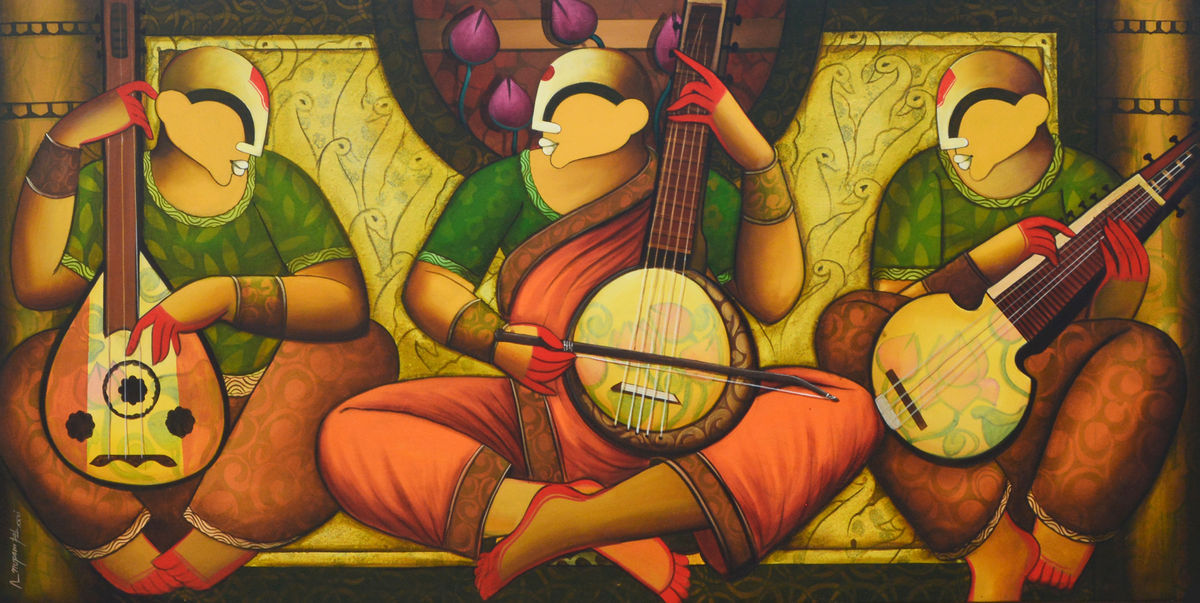
Among the artists reshaping how contemporary India understands its own inheritance, Anupam Pal occupies a singular place. Very few artists bridge the gap between ancient cultural heritage and modern abstract expressionism quite like Pal.
Born on October 11, 1991, in Jamshedpur, he has spent the better part of two decades building a body of work that moves fluidly between ancient devotion and modern unease, between the hush of temple courtyards and the restlessness of a country still working out what it wants to become. He has captivated art collectors and critics across the globe, from Mumbai’s iconic galleries to the historic halls of the Florence Biennale in Italy.
To look at a Pal canvas is to encounter a face that could belong to any century, painted with a hand that clearly belongs to this one. Here at Mojarto you can explore several spiritual paintings which move a viewer both emotionally and visually eliciting an an holistic spiritual experience that transforms traditional Indian mythology into modern, universal storytelling.
An Artist Shaped by Two Disciplines
Pal’s education reads almost like a deliberate experiment in combining opposites. He spent six years at the Tagore School of Arts, also known as Tagore Academy, in his native Jamshedpur, absorbing the discipline of classical drawing and the patient logic of composition that any serious fine arts training demands.
Rather than stopping there, he then travelled to Kolkata to study 3D animation and VFX at the Maya Academy of Advanced Cinematics, a decision that at first glance might seem like a departure from painting altogether. In practice it did the opposite.
The spatial thinking he absorbed while working with digital depth, lighting and perspective quietly re-entered his canvases, giving his flat acrylic surfaces an uncanny sense of volume and atmosphere that few painters trained only in traditional methods ever achieve.
The Signature Anatomy
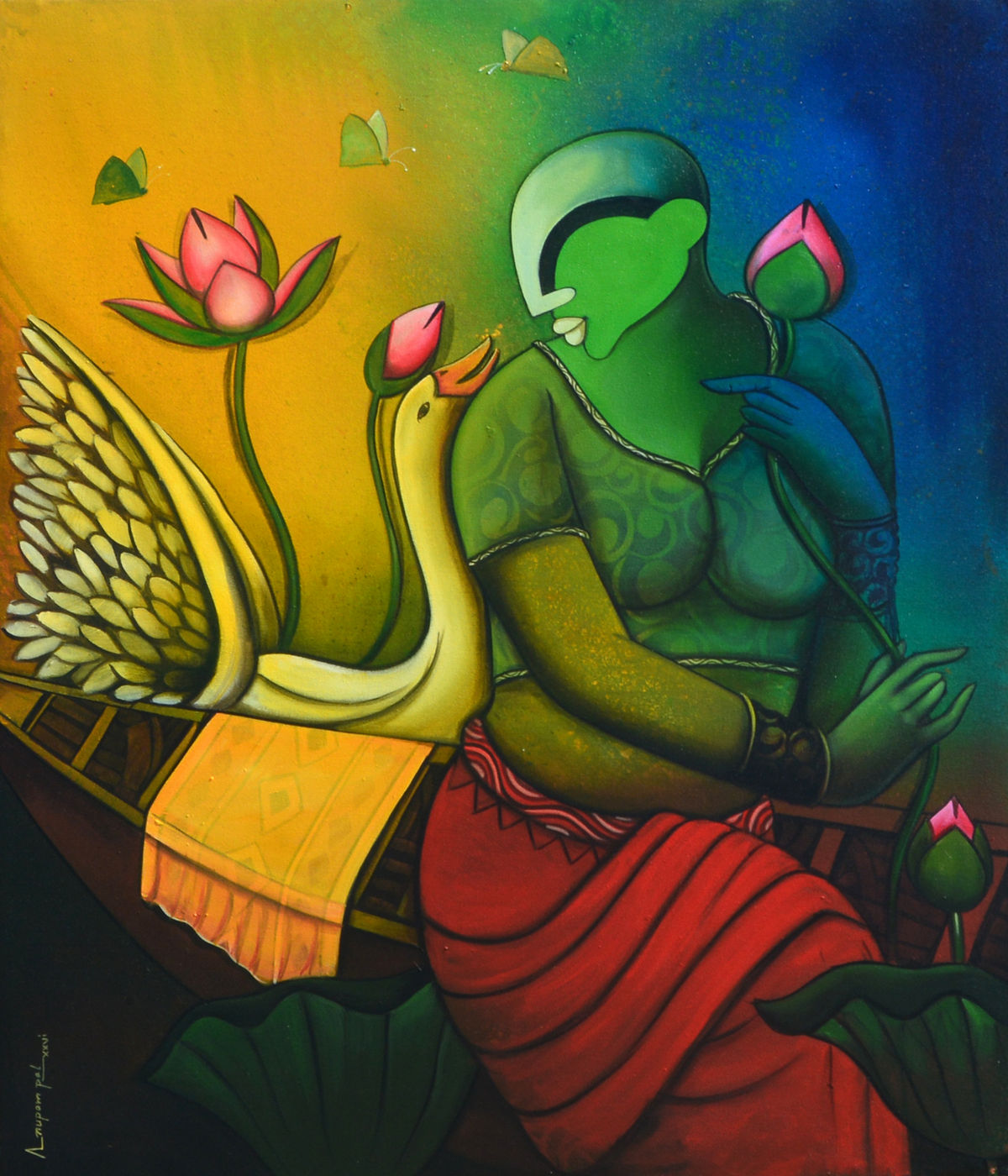
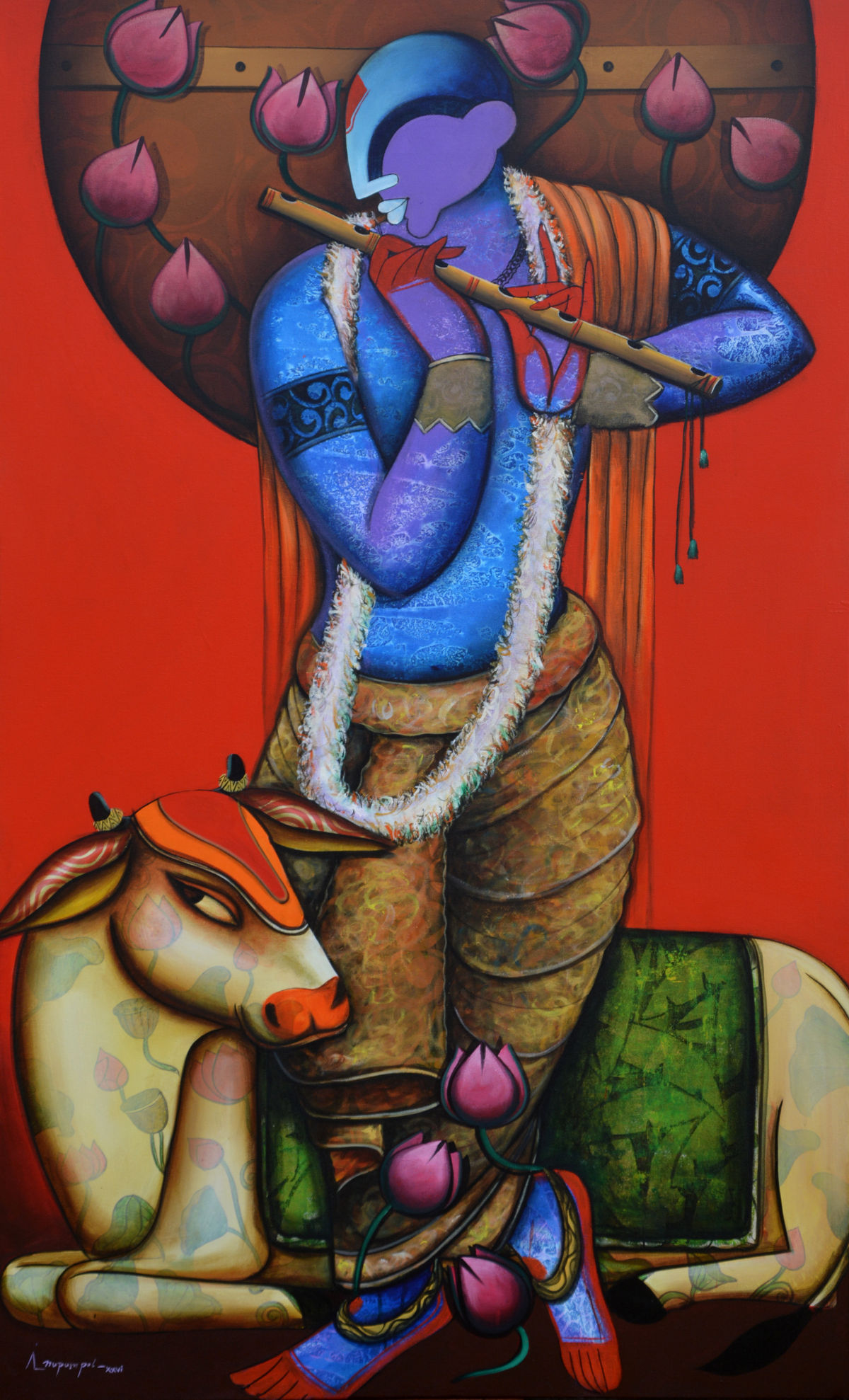
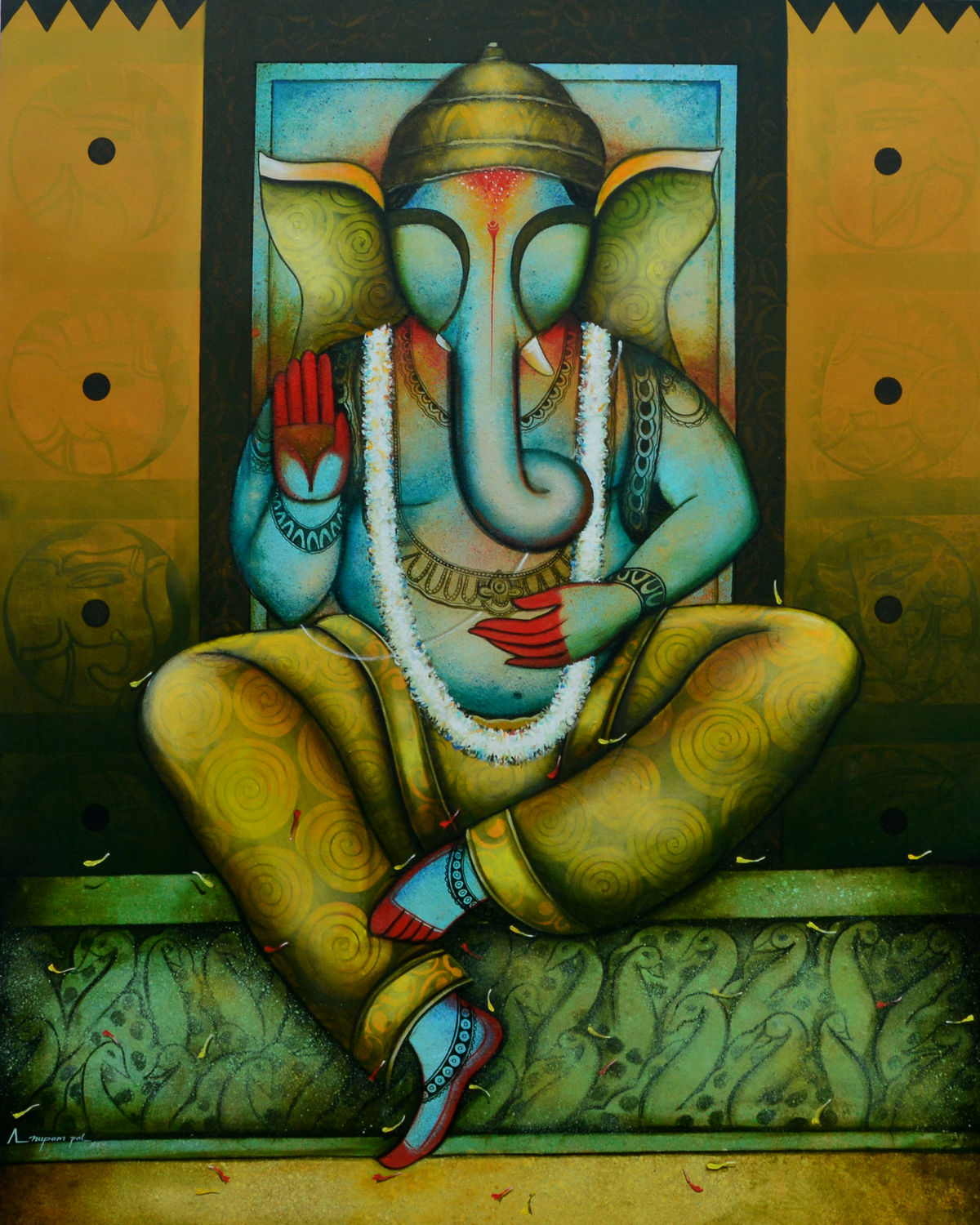
Anyone who has spent time with Pal’s work will recognize his figures instantly, even from across a crowded gallery. His canvases feature stylized human forms defined by an almost architectural grace, foreheads stretch upward, eyebrows sweep into long, confident arcs, and the eyes are left soft and featureless, rendered as subtle suggestions rather than sharp detail.
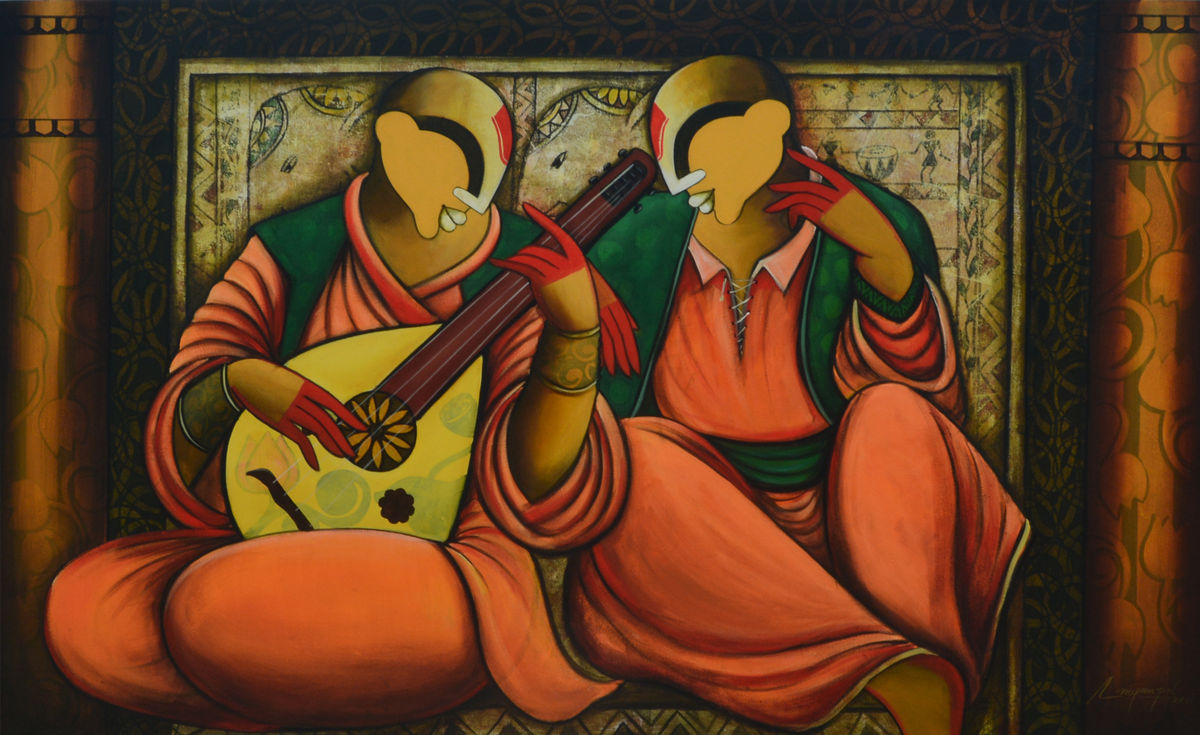
Far from a stylistic shortcut, this intentional abstraction removes the one feature that most insists on a single, fixed identity. By refusing to pin his subjects down with specific irises or pupils, Pal allows them to transcend the individual. The resulting blankness is generous rather than empty: a viewer grieving a loss might find grief looking back, while someone in a state of quiet contentment finds that very peace reflected. In stripping away the specific, Pal invites us to project our own emotions, longings, and meditative thoughts directly onto the canvas.
The Alchemy Behind the Glow
The captivating luminosity that radiates from within Pal’s backdrops is the product of a patient, almost obsessive technique rather than a simple choice of color. He begins with dark, earthy underpainting, often in deep umbers and blacks, and then builds upward through many thin translucent layers of acrylic in gold, sunflower yellow, turquoise and crimson. Because each glaze is sheer enough to let light pass through and bounce back off the darker layer beneath, the surface appears to glow from the inside rather than simply reflect light from the outside, an effect closer to stained glass than to conventional acrylic work.

Onto this luminous ground he then works with coarse bristled brushes in a dry technique known as scumbling, dragging pigment across the raised weave of the raw canvas so that colour catches only on the high ridges while the darker grooves stay exposed beneath. The result is a rich, tactile surface that feels less like fresh paint and more like a centuries-old tapestry, worn in places, glowing in others, and carrying the quiet gravity of a long history.
Indian Mythology as a Living Language
At the core of Pal’s work lies a deep reverence for Indian philosophy, where ancient Indian myth functions not as mere decoration, but as a living visual vocabulary, a language he reaches for to express and wants to say something about longing, devotion or stillness.
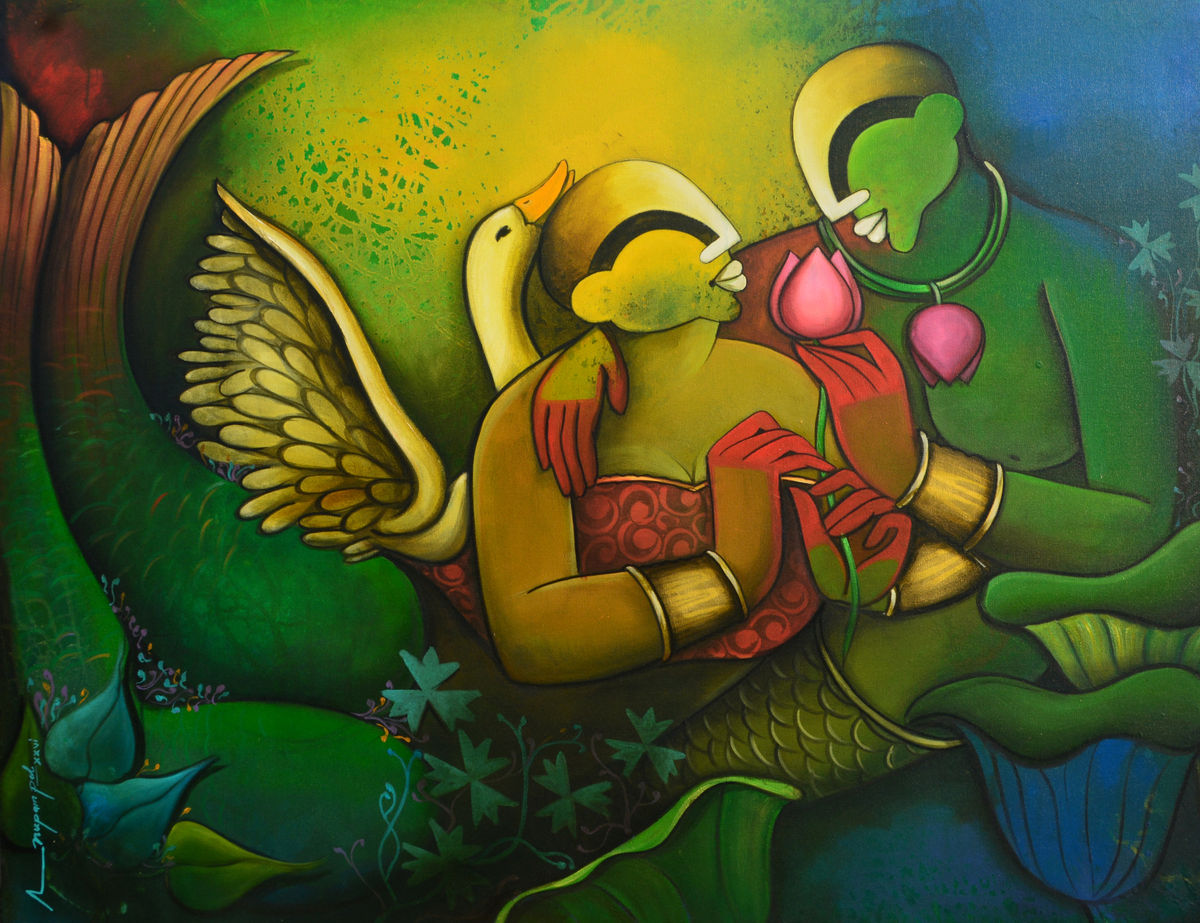
Rather than relying on the ornate, jewel-heavy poses typical of traditional devotional art, his abstract series on devotional bloom reinterprets divine love as a pure emotion. Through fluid brushwork and atmospheric fields of warm terracotta, luminous gold, and ethereal blue, he evokes a feeling rather than depicting a literal scene. Similarly, his Buddha figures strip away narrative clutter to offer a visual refuge of quiet meditation, a moment of enforced stillness built out of restraint, color, and absolute peace.
Visualizing Musical Rhythm
Music and dance stream through his artistic oeuvre like an unbroken cadence. Among his most celebrated masterworks, Melody Of The Lotus captures the spirit of classical Indian tradition of music and dance without portraying a literal stage.

At the center of the composition is a serene figure that plays a flute, garlanded in flowers and lotus buds, while a graceful swan drifts beside them against a warm golden field. The lotus itself carries the weight of the composition, standing in as it so often does in Indian visual culture for purity and quiet transcendence, while the whole scene seems to hum with a rhythm that has no need of sound to be felt.
For art collectors, these motifs offer a profound addition to any living environment. In both Vastu Shastra and Feng Shui, the lotus and flute-playing figure represent purity, spiritual growth, and harmonious energy flow, making this piece ideal for inviting tranquil balance, creative inspiration, and serene prosperity into a home or office spaces.
Power, Bulls, and the Pulse of Life
Pal is equally capable of trading serenity for force. In Vital Energy, a stylized bull rendered in vivid red and green stands against a heavily textured field, serving as a study in resilience and raw life force rather than aggression. Glory of the Bull pushes the same subject further into abstraction, wrapping it in geometric ornament, bold red accents and intricate patterns to showcase the bull as a symbol of cultural mysticism and majestic strength.

For collectors seeking purposeful art placements, the bull holds immense spatial significance. In Vastu Shastra and Feng Shui, the bull is a quintessential symbol of financial stability, unyielding stamina, and grounding wealth, making these works particularly powerful for executive offices, studies, or main living areas where confidence, protection, and steady momentum are favored.
Social Commentary and Art in the Time of Crisis
While deeply tied to spiritual myths, Pal remains acutely aware of contemporary social issues. He never treated the past as an escape from the present.
Conservation series turns its lens toward the traditional conservatism that continues to shape how Indian society treats women, using the same elevated visual language he applies to gods and animals to examine a deeply contemporary discomfort. By casting his stylized, transcendent figures into narrative spaces of tension and resilience, the series acts as a quiet yet powerful critique. Rather than relying on overt protest, Pal uses artistic restraint and symbolic grace to champion women’s empowerment, bringing modern societal challenges into a realm of profound dignity and unspoken strength.

That same instinct for cultural relevance produced Lockdown Hope, painted during the depths of the global COVID-19 pandemic as a moving tribute to the resilience of migrant workers and the tireless humanitarian efforts that carried so many through that period. The canvas struck a deep emotional chord, gaining widespread acclaim across digital platforms and drawing an unusually broad online audience. Its quiet impact eventually caught the attention of actor and philanthropist Sonu Sood, who personally added the painting to his private collection, a gesture that transformed a poignant pandemic tribute into a powerful public acknowledgment of collective endurance and hope.
From Jamshedpur to the World Stage
Pal’s public exhibition history began early and close to home, with a first solo show titled Immortal Love at the Nandalal Bose Art Gallery in Jamshedpur in 2011, followed a few years later by two further solo presentations, Inarticulate 1 and Inarticulate 2, at Shilpangan Kala Niketan in Asansol. Group exhibitions soon carried his work further afield, into the Jehangir Art Gallery in Mumbai, the Birla Academy of Art and Culture in Kolkata and the Lalit Kala Akademi, each appearance adding another layer to a reputation built steadily rather than overnight.
The most significant recognition arrived when he was invited to present his work at the tenth Florence Biennale in Italy, a milestone that placed him among a small group of Indian artists to cross so directly into the European contemporary art conversation. His paintings now live in private collections, corporate spaces and galleries across Europe, the Americas and Asia.
A Quiet Case for Collecting Anupam Pal
As interest in South Asian figurative abstraction continues to grow among collectors outside India, Pal has positioned himself as something rarer than a trend, an artist who offers heritage and contemporary sensibility in the same brushstroke. His canvases do more than occupy wall space. They bring rhythm, spiritual quiet and a sense of unfolding story into whatever room they hang in, which may explain why his work continues to find buyers on platforms such as Mojarto, Fine Art America, and at international fine art auctions well beyond the borders of the country that shaped him.
For readers who want to spend more time with this world rather than simply read about it, Mojarto carries a curated selection of Anupam Pal’s Spiritual paintings, from his early influences into his more recent explorations of myth and social memory. Browsing the collection is the natural next step after meeting the artist here, and often the moment his work stops being a description and starts being something you want on your own wall.