
Some art traditions change slowly. Others change because the world around the artist suddenly changes.
The story of Kalighat painting belongs to the second kind.
Its roots can be traced to Bengal’s patua community, artists and storytellers who carried painted scrolls from village to village and unfolded stories before their audiences. Their paintings were not silent objects. They were part of a performance involving pictures, songs, mythology, local events and shared memory.
Then came Calcutta.
As the nineteenth-century city grew around trade, pilgrimage and colonial administration, some patuas moved towards its expanding urban markets. Near the Kalighat temple, they encountered a very different audience. Pilgrims did not necessarily have time to watch a long scroll being unfolded panel by panel. Visitors wanted images they could see quickly, understand immediately and carry home.
The artists adapted.
Long narratives became single compositions. Crowded storytelling gave way to one or two dominant figures. Backgrounds became sparse. Lines grew sweeping and confident.
Out of this shift emerged one of India’s most recognisable urban folk-art traditions.
To understand the history of Kalighat painting, it helps to begin not in the city, but in the villages of Bengal where the patua tradition had already been telling stories through pictures for generations.
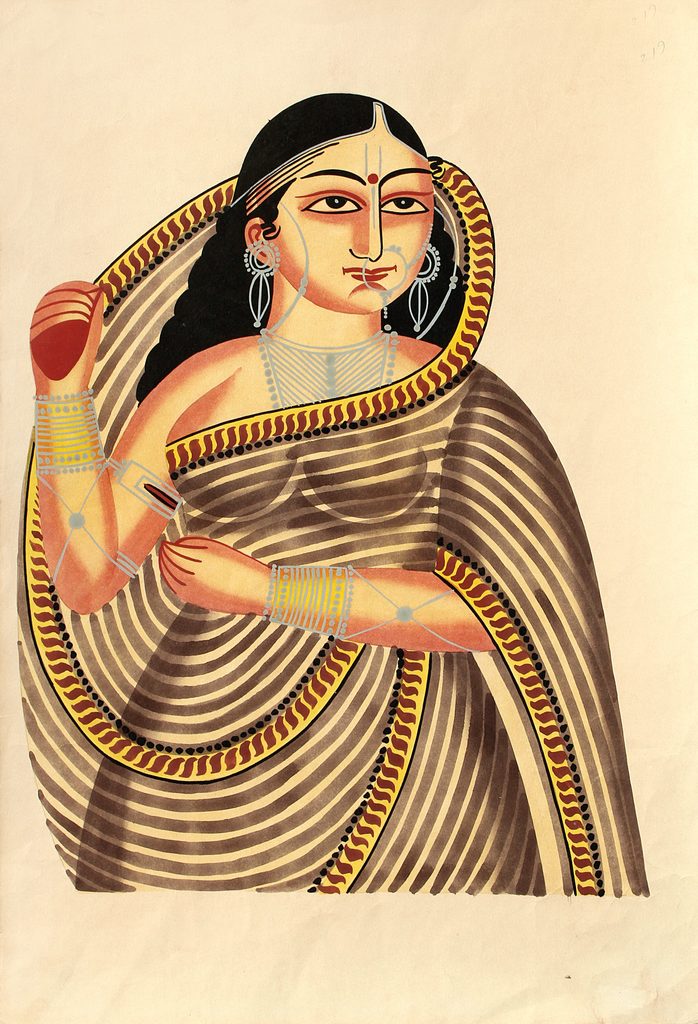
Bengal Pattachitra: When a Painting Was Also a Performance
The word pata broadly refers to a painted surface or scroll, while chitra means picture. In Bengal, Pattachitra developed as a narrative tradition practised by communities of artists commonly known as patuas or chitrakars.
Unlike a painting intended to remain fixed on a wall, traditional Bengal Pattachitra art could function almost like a visual storybook.
A long scroll might contain a sequence of scenes. The patua would reveal each section while singing the story represented in the images. Religion and mythology were important sources, with episodes involving Krishna, Durga, Shiva, local deities and other familiar figures forming part of the repertoire.
But Bengal’s scroll painters were never restricted entirely to mythology.
Stories from village life, social behaviour and current events could also enter their work. That ability to absorb the world around them would become especially important when some patuas began working in Calcutta.
The artist, in other words, was not simply producing an attractive object. The artist was storyteller, performer, observer and image-maker at the same time.
This explains something important about the later Kalighat painting style. Its bold pictures may look radically simplified when compared with narrative scrolls, yet the instinct to tell a recognisable story remained.
The format changed. The urge to communicate did not.
What Happened When the Patuas Reached Kalighat?
Nineteenth-century Calcutta was becoming one of the most important cities in British India. It drew merchants, labourers, craftsmen, professionals and visitors from different parts of the region.
Kalighat itself attracted large numbers of pilgrims visiting the famous Kali temple.
For artists, that meant an audience.
A village scroll designed to be gradually revealed during a performance was not ideally suited to this environment. A pilgrim passing through the temple neighbourhood might prefer a single image of Kali, Durga, Shiva or another deity that could be purchased and carried away.
Artists responded to that demand with remarkable flexibility.
Instead of long scrolls containing numerous episodes, they began creating compact paintings on individual sheets of paper. The compositions became quicker to read. Figures occupied much of the available space. Extraneous scenery disappeared.
This practical adjustment helped shape the visual identity of Kalighat painting.
The transformation also shows why folk art should never be treated as something frozen in the past. Artists were responding to customers, materials, city life and changing tastes.
In modern marketing language, they understood their audience.
They knew where the viewers were, what they wanted and how their existing artistic skill could be translated into a new format without losing its cultural vocabulary.
That makes the evolution of Bengal folk art particularly fascinating. Kalighat did not simply replace Pattachitra. It grew from the same artistic ecosystem while responding to a different market and a different pace of life.
From Sacred Souvenir to Sharp Social Commentary
Early Kalighat works were closely connected with devotional subjects. Images of Hindu gods and goddesses made obvious sense near one of Bengal’s major pilgrimage destinations.
Yet the artists soon began looking beyond temple imagery.
Calcutta was giving them plenty to observe.
The nineteenth-century city was experiencing enormous social change. Western fashions, new occupations, changing gender relationships and the emerging urban middle classes all provided material. The celebrated babu became a recurring figure.
The babu could be fashionable, self-important, Westernised and eager to display his social position. In Kalighat works, such characters were sometimes treated with humour rather than admiration.
Women appeared too, often with a confidence and visual presence that made them central to the composition. Domestic relationships, scandals, professions, animals and public personalities entered the visual vocabulary.
This is where the history of Kalighat painting becomes especially interesting for today’s viewer.
The artists were making popular images, but they were also commenting on their society.
Look at the economy of the pictures. There may be no elaborate landscape and very little architectural detail. Yet posture, clothing, facial expression and gesture can tell you exactly what kind of person is being shown.
A raised eyebrow, the angle of a hand or an exaggerated pose could carry the joke.
It is visual storytelling stripped to its essentials.
That is one reason Kalighat works can still look surprisingly current. They share something with caricature, editorial illustration and even modern visual culture, where one image must communicate its idea quickly.
How the Kalighat Painting Style Became So Distinctive
The strongest Kalighat paintings are remarkably easy to recognise.
One reason is the line.
Figures are often enclosed by smooth, sweeping contours. The brush moves with confidence, giving bodies, clothing and faces a rhythmic quality. There is little visual clutter to distract the eye.
Colour tends to appear in broad, controlled areas. Subtle shading may give figures a sense of volume, but elaborate backgrounds are generally absent.
That empty space matters.
In a traditional narrative scroll, the artist may need multiple scenes because the story develops over time. In the Kalighat painting style, a single gesture or figure often has to do the work of an entire episode.
This encouraged simplification.
It also gave the paintings considerable visual impact.
Compare the two traditions and the artistic transition becomes easier to understand.
Bengal Pattachitra art often unfolds. Kalighat art strikes.
Pattachitra can lead the eye through a sequence. Kalighat tends to present the central event immediately.
One developed largely within a rural storytelling environment. The other became closely associated with a crowded urban pilgrimage and commercial centre.
Yet both remained connected through the patua artist’s ability to turn familiar stories into pictures people could understand.
A Folk Tradition That Learned to Speak the Language of the City
The move from village scroll to urban painting was not merely a change in size or material. It represented a change in how art met its audience.
That is an important part of the evolution of Bengal folk art.
Kalighat painters had to work in an environment where images competed for attention. Their customers included pilgrims, residents and visitors. Paintings needed to be visually clear and relatively quick to produce.
The availability of mill-made paper and commercially available pigments also influenced production. Artists no longer depended entirely on the same materials and formats associated with older village practices.
The city was changing the artwork just as the artists were recording changes in the city.
Eventually, however, another technological change created competition.
Printed images became cheaper and increasingly widespread. Mechanically reproduced pictures could reach large audiences at prices handmade works found difficult to match. By the early decades of the twentieth century, the original commercial ecosystem around Kalighat painting had weakened considerably.
Yet the style did not disappear from Indian visual culture.
Its strong contours, simplified figures and ability to combine popular subject matter with artistic intelligence continued to attract attention.
The language developed by anonymous and little-known patuas would later be recognised by museums, scholars, collectors and artists far beyond the streets where the works were first sold.
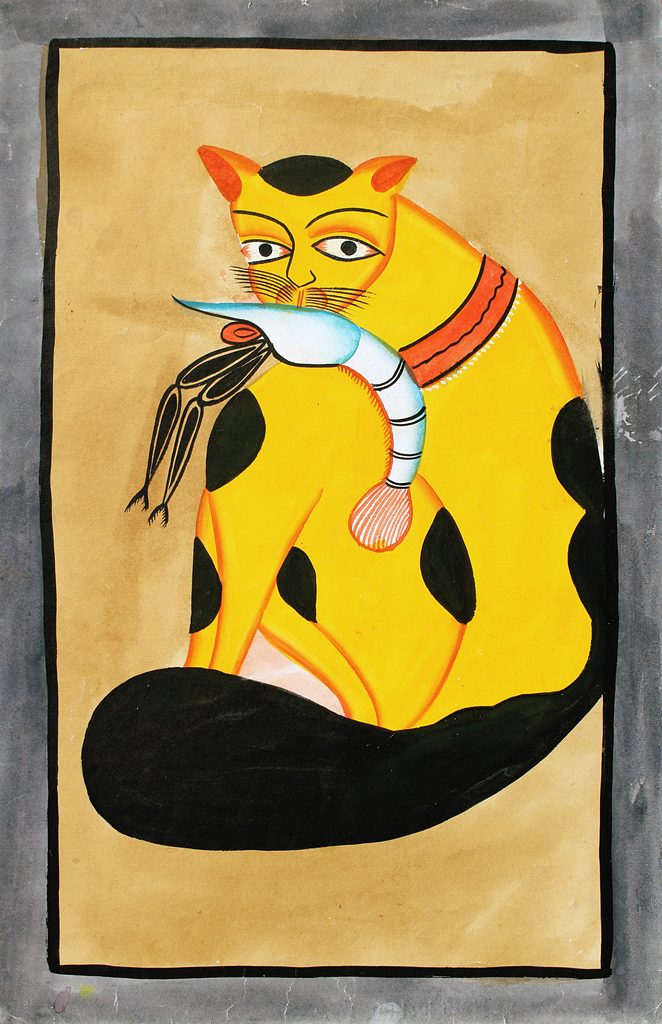
Why Kalighat Painting Still Appeals to Collectors
For someone discovering Indian folk art today, Kalighat painting offers several ways into a collection.
First comes the visual appeal. The work can be bold without being visually crowded. Strong contours and expressive figures make the compositions immediately recognisable.
Then comes the cultural context.
A Kalighat-inspired work is connected not only with a regional craft tradition but with a particular chapter in Bengal’s social history. It carries traces of rural storytelling, pilgrimage, nineteenth-century Calcutta, popular humour and changing urban life.
For collectors who enjoy researching what sits behind an image, that history adds another layer of interest.
There is also the question of continuity.
Contemporary patuas continue to work with Pattachitra and Kalighat visual languages, sometimes returning to religious subjects and at other times responding to present-day events, social behaviour and popular culture.
This makes the tradition a living conversation rather than a museum category.
For Mojarto’s audience, that distinction matters. A collector exploring Indian folk art can encounter works that remain connected with traditional artistic knowledge while also reflecting the individual hand and imagination of a present-day artist.
It creates a meaningful bridge between heritage and contemporary collecting.
What to Notice When Exploring Kalighat and Pattachitra Art
Collectors do not need formal art-history training to begin recognising the differences.
Start with the composition.
Is the image telling several connected episodes, or has the artist reduced the subject to one decisive moment?
Look at the line. Kalighat paintings often depend heavily on contour. A figure may be defined by a few assured brushstrokes rather than dense surface detail.
Then study the subject.
Religious imagery can appear in both traditions, so subject matter alone does not determine the style. Pay attention to how the story is being told.
You may also notice contemporary artists working across both traditions rather than treating them as rigid categories.
That is entirely consistent with their history.
The original patuas were adaptable artists. Their willingness to change format, subject and method was exactly what allowed traditional Bengali folk art to move from rural scroll performance into the urban world of Kalighat.
Understanding that journey can make the experience of collecting far richer.
You are no longer looking only at a colourful figure on paper. You begin to see the migration of artists, the changing city, the temple crowds, the storyteller’s instinct and the brushwork that turned a long narrative into one unforgettable image.
From Scroll to Single Image, the Story Continues
The journey from Bengal Pattachitra art to Kalighat was not a clean break between an old style and a new one.
It was adaptation.
The patuas carried their storytelling knowledge with them and reshaped it for a different audience. The scroll became a sheet. The sequence became a single scene. Rural storytelling entered an urban marketplace. Religious imagery expanded into humour, observation and social commentary.
That is why Kalighat painting holds such an important place in the story of Indian folk art.
Its visual simplicity came from considerable artistic intelligence. Artists worked out how much they could remove without losing the message.
For collectors today, this history changes the way the works are seen. A bold outline becomes more than a stylistic feature. An empty background is no longer simply empty. A familiar babu, goddess, musician or animal becomes part of a much larger story about how Indian artists responded to a rapidly changing world.
Mojarto offers art lovers an opportunity to explore this continuing relationship between Indian tradition and individual artistic expression. By looking closely at Kalighat and Pattachitra works, collectors can discover not just two styles of painting, but a remarkable chapter in the evolution of Bengal folk art.
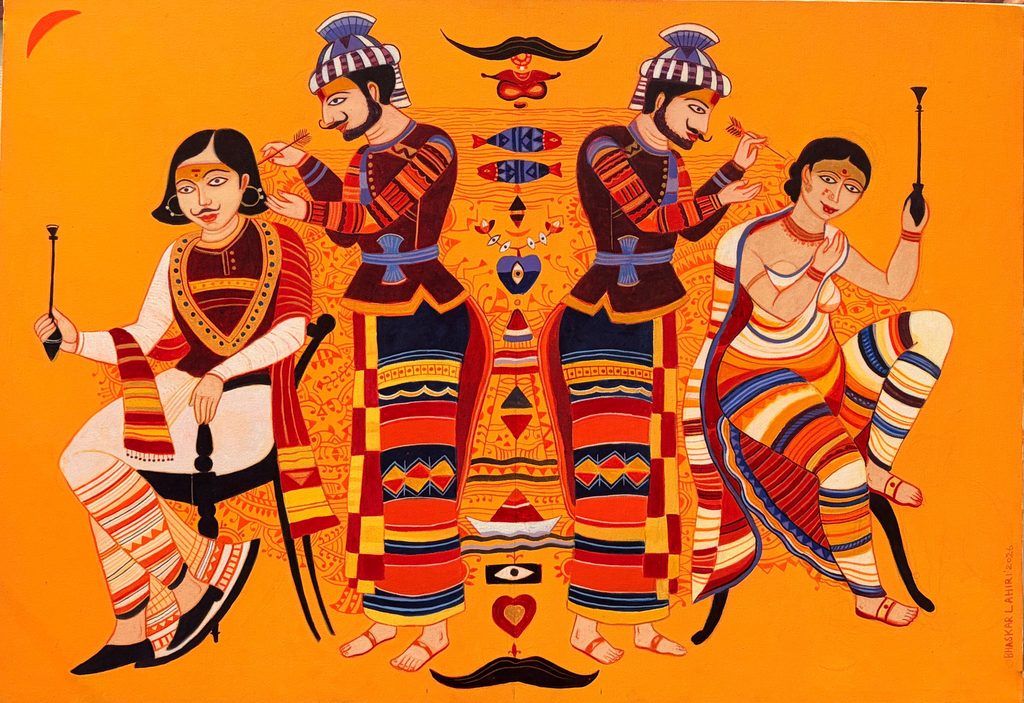
FAQs
1. What is Kalighat painting?
Kalighat painting is an Indian folk-art tradition that developed around the Kalighat temple area of nineteenth-century Kolkata. It is known for bold flowing outlines, simplified backgrounds, expressive figures and subjects ranging from Hindu mythology to urban life and social commentary.
2. How is Bengal Pattachitra art connected to Kalighat painting?
Bengal Pattachitra art was traditionally practised by patuas who created narrative scrolls and presented stories through painting and song. Some rural patuas migrated to Kolkata and adapted their skills to produce individual paintings for the urban and pilgrimage market around Kalighat.
3. What are the main features of the Kalighat painting style?
The Kalighat painting style typically uses confident brush contours, broad areas of colour, minimal backgrounds and strongly defined figures. The composition often focuses on a single subject or event rather than a long sequence of scenes.
4. What subjects appeared in traditional Kalighat paintings?
Early Kalighat works frequently depicted Hindu deities and mythological stories. Over time, artists also painted babus, women, animals, professions, scandals and scenes reflecting contemporary social behaviour in nineteenth-century Calcutta.
5. Why is Kalighat painting important in the evolution of Bengal folk art?
Kalighat shows how traditional Bengali folk art could respond to migration, urbanisation and changing audiences. Patuas adapted rural storytelling methods into a compact urban format while retaining their strong instinct for narrative and social observation.