
By P Abigail Sadhana Rao
Without community, there is no liberation.
— Audre Lorde
There are relationships that shape our lives in ways we may not fully recognise until we pause to consider them. A familiar presence, a shared silence, a conversation that stretches into the evening, a hand resting reassuringly on a shoulder or the simple knowledge that someone will be there when we need them. These moments may seem ordinary, yet they form part of the emotional architecture of our lives. Among them are the many relationships women build with one another; as sisters, friends, companions and confidantes.
Sisterhood is often spoken about in the language of solidarity and strength, but its meaning is far more expansive. It can be found in the intimacy of shared histories, the freedom of laughter, the comfort of being understood and the courage that grows when women stand alongside one another. It can be affectionate and playful, quiet and reassuring, or shaped by the determination to face circumstances that might otherwise feel overwhelming. It is not one fixed kind of relationship, but a collection of experiences through which women come to recognise, influence and support one another. Perhaps the most beautiful thing women can offer one another is the reminder that none of us has to navigate life entirely alone
Art offers a particularly compelling way to explore these connections. A painting can preserve a gesture, a glance or a moment of togetherness, allowing us to look more closely at relationships that often unfold away from public attention. Theses artworks on Mojarto, here approach sisterhood and female companionship through different visual languages. Together, they reveal how much can be contained in the simple artworks depicting women sharing a space.
The Language of Closeness
In Aniruddha Sarker’s Nature, two women appear intertwined in a gentle embrace, their bodies framed by an abundant landscape of trees, clouds, birds and small houses. One figure leans towards the other, while their arms form an almost continuous gesture across the composition. Their expressions are calm, and the closeness between them seems unhurried, conveying an intimacy that does not require an elaborate display.

The surrounding landscape is equally significant. Dense green foliage stretches across the painting, while red tree trunks, vivid skies and clusters of colourful houses create a richly layered environment. The women’s garments appear to merge visually with the surrounding landscape, bringing human presence and the natural world into a shared composition. Rather than functioning as a mere backdrop, nature seems to envelop the figures, placing their relationship within a larger world of interconnected life.
The artist identifies nature and human relations as the central theme of the work. Through this lens, the embrace becomes an invitation to consider the relationships through which human beings experience closeness, belonging and care. It can also open up a reflection on sisterhood: the ways in which affection and companionship become part of the environments in which we grow. The painting does not prescribe a particular relationship between the women; its strength lies in the tenderness of their physical connection and the openness of its interpretation.
A different kind of intimacy emerges in Srinivasa Chary’s Untitled-17. Two women sit beside one another, dressed in vividly patterned traditional clothing and adorned with jewellery. One rests her hand near her face, while the other sits with an arm placed at her waist. Their expressions are composed, their postures individual, and yet their proximity establishes a sense of familiarity. Neither figure appears to be performing for the other or demanding the viewer’s attention. They simply occupy the same space.
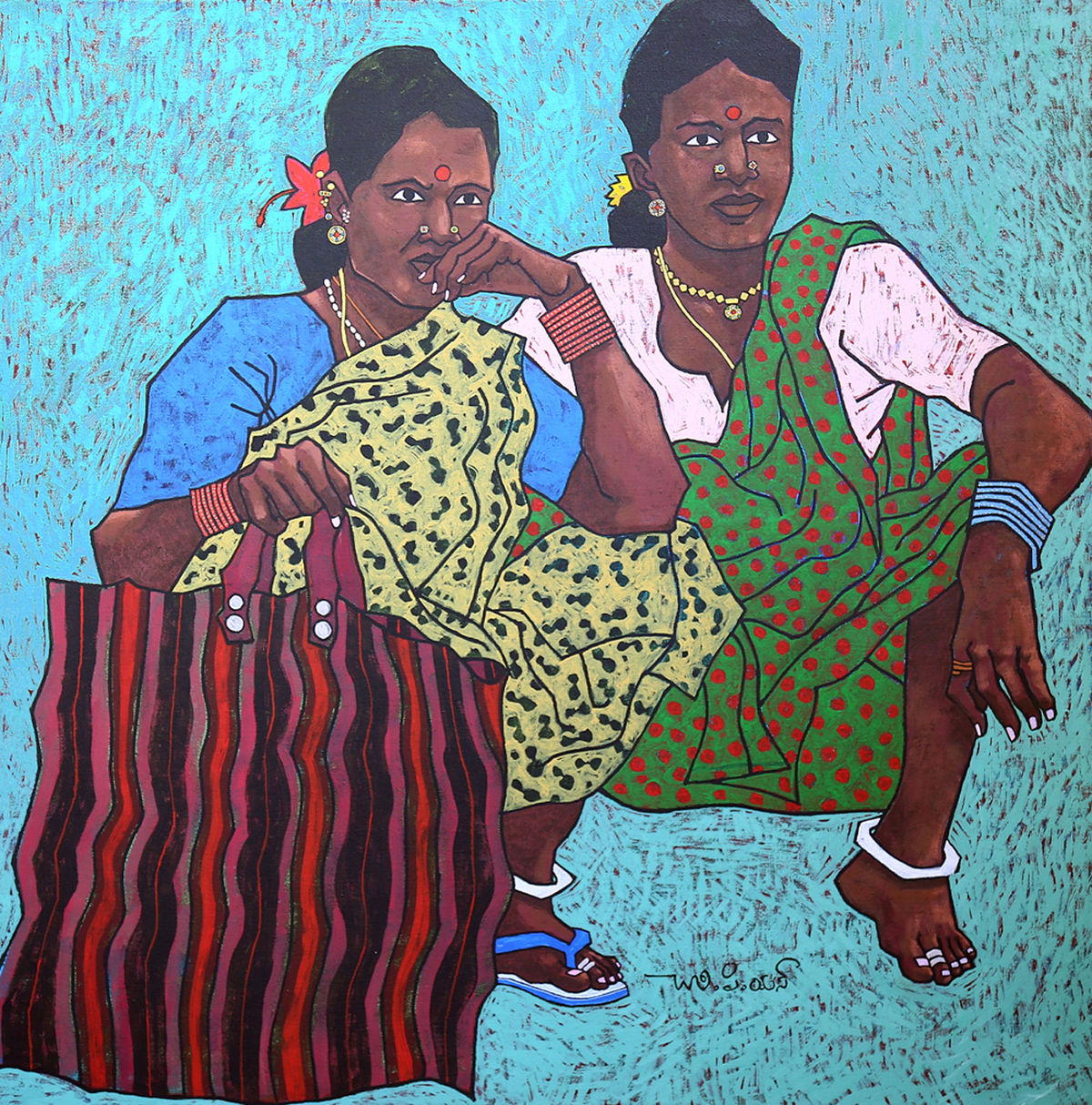
Chary’s description, To sit in silence still be, offers a particularly evocative point of departure. The artist speaks of his lifelong association with the people of Telangana, whose faces, gestures and attire have left a lasting impression on him. He approaches these visible details as ways of capturing something of their lived existence. This attention to the human landscape gives the painting a strong sense of cultural specificity. The clothing, ornaments, expressions and gestures are not incidental embellishments; they are part of the artist’s observation of a community and its everyday life.
What makes this work especially interesting in the context of female companionship is the possibility of a connection that does not depend on constant conversation. Silence, too, can have a social language. There are relationships in which the presence of another person is reassuring precisely because nothing needs to be explained or performed. The two women retain their individual composure while sharing a common space, suggesting that closeness need not erase difference. In this quiet scene, sisterhood can be understood as the ease of being together without needing to fill every moment with words.
The Joy of Being Together
If Sarker’s painting draws us towards the tenderness of an embrace and Chary’s towards the quiet familiarity of shared presence, Ramchandra S. Kharatmal’s Dancing Beauty introduces a more exuberant expression of female companionship. Two women are captured in the act of dancing, their arms raised and their bodies moving in a shared rhythm. Their gestures seem to echo one another, creating a sense of movement that extends across the canvas. One figure inclines her head with a gentle smile, while the other raises her arms behind her head, absorbed in the moment.

The painting’s vivid colours intensify this sense of celebration. A bright yellow blouse and flowing blue drape contrast with the deep blue background, while the second woman’s patterned garments introduce further visual rhythm. Their jewellery, flowers and traditional attire add to the richness of the composition. The figures are not static subjects arranged for observation; their bodies seem animated by music and movement, inviting the viewer into the energy of the scene.
Kharatmal describes the work as capturing the joyous essence of Maharashtrian women dancing in vibrant sarees. The painting therefore brings cultural expression into our understanding of relationships between women. Dancing together can be more than an individual display of skill or beauty. It can be a shared experience in which movement, rhythm and participation create a sense of connection. The women are distinct figures, but their gestures establish a visual conversation between them.
This is an important dimension of sisterhood that deserves attention. Relationships between women are not defined only by the support offered during difficult moments. They are also made up of laughter, celebration, playfulness and the freedom to enjoy one another’s company. Shared happiness is not a lesser form of intimacy. It is one of the ways relationships become meaningful, memories are formed and a sense of belonging is strengthened.
Shared Histories, Shared Worlds
The relationship between familiarity and belonging becomes even more explicit in Dhan Prasad’s Sisters. Two women sit facing one another, their expressions warm and attentive. Their smiles suggest an ease of interaction, while their postures create a sense of mutual engagement. One holds a musical instrument, introducing the possibility of a shared interest or cultural activity. The women are dressed in traditional attire, with jewellery and carefully rendered details that contribute to the character of the figures.

The artist situates the work within a rural setting inspired by everyday village life. Behind the women, a vivid yellow landscape contains small architectural forms, distant hills and vegetation. The background is rendered in a contrasting monochromatic style, allowing the figures to emerge with particular clarity. This interplay between the colourful foreground and the more restrained landscape creates a distinctive visual balance. It also places the sisters within a recognisable social and cultural environment rather than presenting them as isolated figures.
Prasad describes the painting as an exploration of the warmth, companionship and sense of belonging that develop between sisters through shared experiences. This brings another dimension to our understanding of sisterhood: the significance of a shared past. Biological sisters may carry memories of the same home, family traditions, childhood experiences and changing circumstances. Their relationship can contain a familiarity built over years, sometimes communicated through gestures or expressions that require little explanation.
Yet shared history does not mean identical lives. Sisters grow into individuals, developing their own aspirations, temperaments and ways of understanding the world. Their bond can hold both difference and recognition, independence and familiarity. Prasad’s painting captures the warmth of this relationship without needing to dramatise it. The women’s expressions and attentive positioning suggest that intimacy can be found in the ordinary act of being together.
Santosh Chattopadhyay’s Two Sisters takes the subject in a more socially conscious direction. The two figures stand closely together, their faces turned towards the viewer. Their expressions are composed, and their upright posture gives them a striking presence. One woman’s hand rests gently on the other’s shoulder, creating a gesture of reassurance within the otherwise still composition. Their closeness is visible, but so is their individuality.
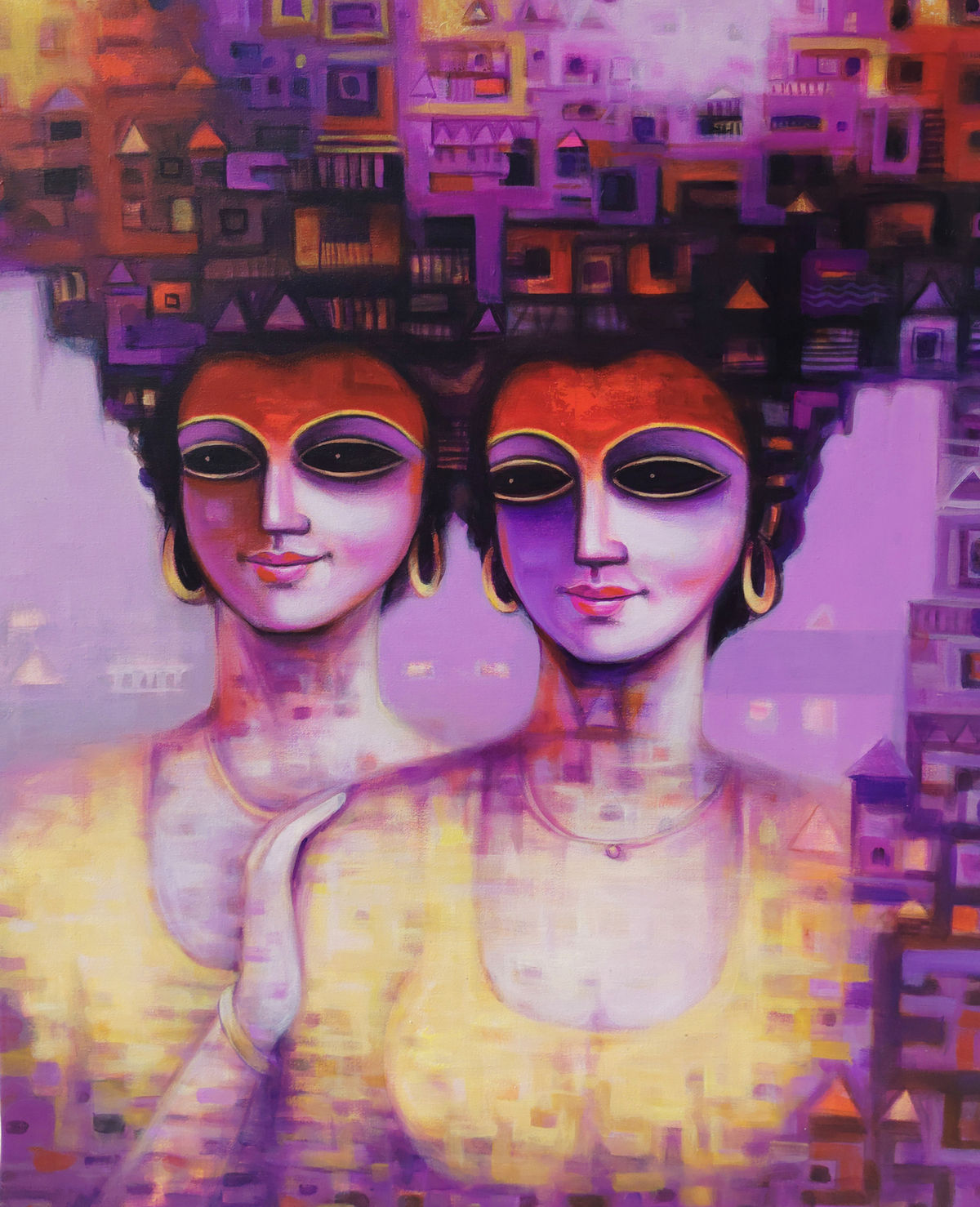
The background is filled with architectural forms and overlapping structures in shades of purple, red and orange. Houses and geometric shapes create a dense environment around the women, suggesting the complexity of the society in which they live. Their figures appear partly integrated into this urban landscape, as though their personal identities and aspirations cannot be separated from the wider world they inhabit. The expressive use of colour adds emotional intensity, while the contrast between the figures and their surroundings draws attention to their presence.
The artist’s statement gives the work a clear social dimension: the two sisters are trying to establish themselves in society, holding their heads high despite its adversities. This moves sisterhood beyond the language of affection and into the realm of resilience and mutual encouragement. The hand placed on a shoulder becomes particularly meaningful in this context. It can be read as a gesture of support, while the women’s upright bearing conveys determination. Their relationship is presented not simply as a source of comfort, but as part of how they face a world in which they are seeking to establish their place.
The painting also raises broader questions about women’s visibility, agency and participation in society. What does it mean for women to claim space, pursue their aspirations and define themselves in environments that may not always make that process easy? Chattopadhyay’s work does not offer a detailed narrative of the adversities the sisters encounter, but the artist’s statement encourages us to consider the social pressures surrounding their lives. Their togetherness becomes a visual expression of solidarity: not an escape from the world around them, but a way of meeting it.
Beyond the Familiar Idea of Sisterhood
Placed alongside one another, these five artworks reveal how varied the visual language of female relationships can be. An embrace, a shared silence, a dance, an attentive exchange and a reassuring hand on a shoulder each communicate something different about human connection. None of these gestures alone can define sisterhood, and that is precisely what makes the collection interesting. It resists reducing women’s relationships to a single sentiment or ideal.
The works also move between different contexts of human experience. Sarker’s Nature places affection within an abundant natural landscape; Chary’s Untitled-17 draws attention to the gestures and attire of women in Telangana; Kharatmal’s Dancing Beauty celebrates the energy of shared cultural expression; Prasad’s Sisters explores the intimacy of family and rural belonging; and Chattopadhyay’s Two Sisters considers solidarity in the face of social adversity. Each artist approaches the subject from a distinct visual and thematic perspective, offering a wider view of the lives and relationships of women.
This diversity matters because sisterhood is not confined to biological kinship. It can emerge between friends, colleagues, mentors, neighbours and women who may have little in common beyond the recognition of one another’s humanity. Nor does it require women to share identical circumstances or perspectives. It is shaped through the everyday choices to listen, encourage, celebrate, respect and stand alongside one another. Such relationships can be affectionate and uncomplicated, but they can also require patience, understanding and the willingness to acknowledge differences.
Art allows these relationships to be seen and considered beyond the private spaces in which many of them unfold. By giving form to gestures, expressions and shared experiences, artists make ordinary moments worthy of attention. They remind us that the social lives of women are not secondary narratives, but an essential part of how communities are formed and how individual lives acquire meaning.
Perhaps the most compelling aspect of these paintings is that they do not present sisterhood as a grand declaration. Instead, they locate it in the details: the ease of an embrace, the comfort of silence, the exhilaration of dancing, the familiarity of a shared history and the quiet reassurance of standing together. These are different expressions of the same fundamental human need for connection.
To look at these artworks is to be reminded that the stories of women are rarely shaped by individual experience alone. They are also shaped by the people who share their worlds, witness their changes, celebrate their joys and offer companionship through uncertainty.
In bringing these relationships into focus, the artists on Mojarto invite us to look more closely at the many forms of sisterhood that exist around us, and to recognise the profound significance of women being present in one another’s lives.