
At first glance, a Gond painting may appear to be a joyous gathering of colour, animals, trees and finely repeated patterns. Look a little longer, and the picture begins to move.
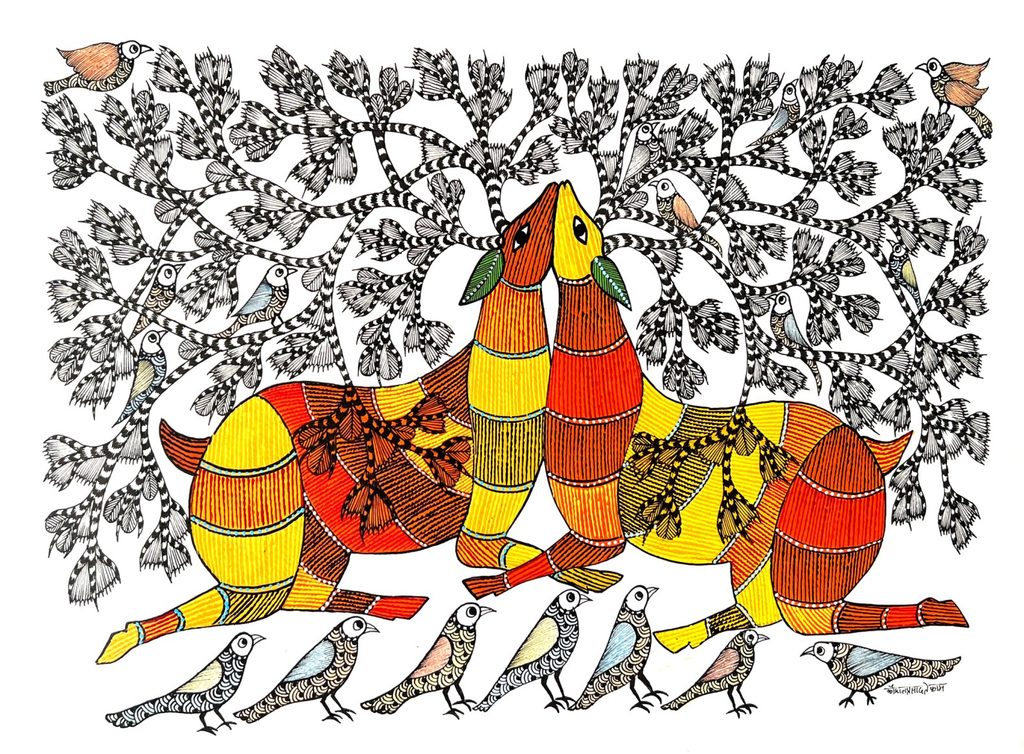
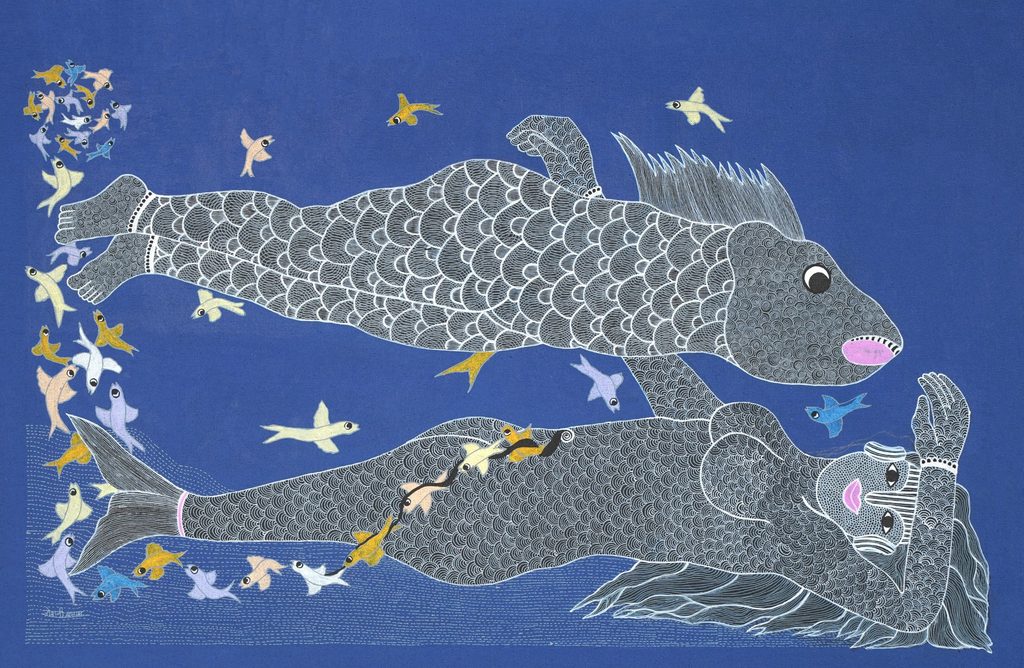
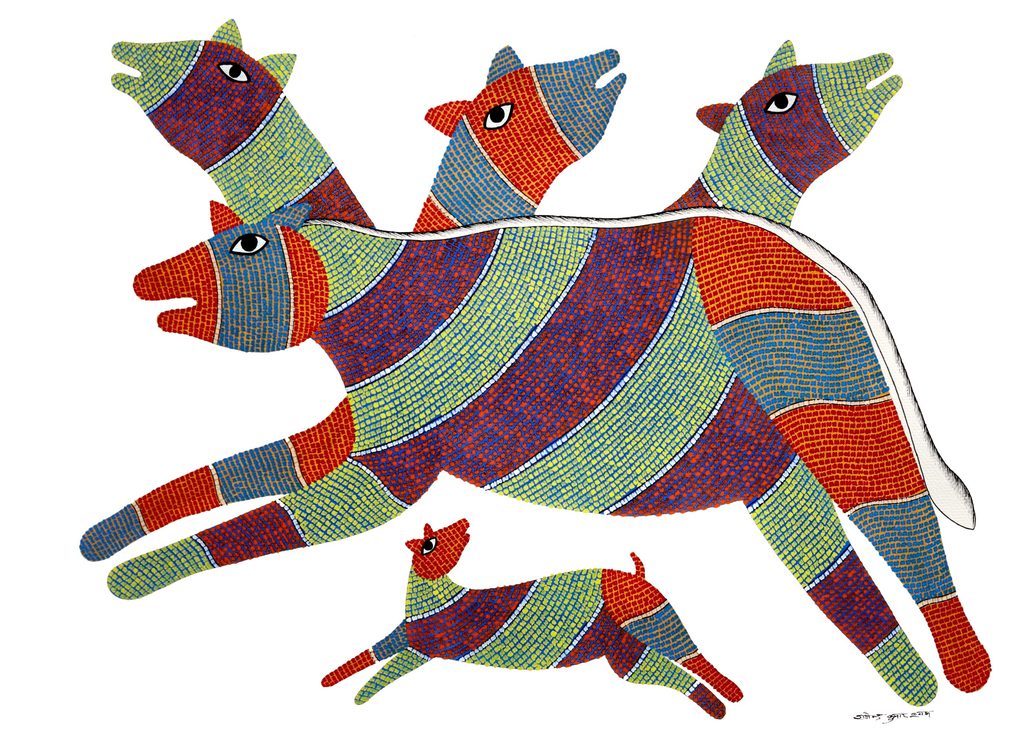
A deer carries a forest across its body. Fish swim through lines that resemble flowing water. The branches of a tree turn into birds. A tiger may contain leaves, scales, dots and rippling marks, as though several living worlds exist inside one creature.
This is the special pull of Gond art. It does not simply show nature. It imagines nature as active, connected and full of memory.
For a new collector, understanding that visual language changes the experience of looking. The lines are no longer decorative fillers. The animals are not included merely because they are attractive. Every form can carry a relationship, a remembered story or an artist’s personal interpretation of life.
That is also why no two serious Gond artists should be viewed as interchangeable. The tradition may provide a shared cultural ground, but each artist develops an individual rhythm, choice of subject and way of filling forms.
For art lovers exploring original Indian folk art on Mojarto, learning to read these details can turn a beautiful painting into something far more meaningful.
The History of Gond Art Is Still Being Written
The History of Gond art is closely connected to the Gond and Pardhan Gond communities of central India, particularly regions within Madhya Pradesh.
Painting was traditionally part of domestic and ceremonial life. Gond homes were decorated during weddings, festivals and other important occasions. Geometric designs known as digna appeared on walls and floors, while bhittichitra compositions included animals, flowers, leaves and other forms from the surrounding environment.
These images were created using locally available materials. IGNCA records the use of vegetable and mineral colours made from sources such as clay, flowers, leaves, rice, stones and turmeric. Brushes could be fashioned from twigs and pieces of cloth.
The shift from walls and floors to paper and canvas is a crucial part of the story.
In the early 1980s, artist and curator J. Swaminathan was involved in finding artists for Bharat Bhavan in Bhopal. During this period, the work of Jangarh Singh Shyam from Patangarh gained attention. Jangarh began creating paintings on paper and canvas, developing a highly distinctive language drawn from Pardhan Gond memories, deities, animals, stories and village life.
His work eventually became associated with the term Jangarh Kalam. He achieved national and international recognition, and his practice inspired artists from his family and wider community to pursue their own artistic paths. IGNCA describes him as the first Gond artist to use paper and canvas for this work, while Google Arts & Culture identifies him as the creator of a new school of Indian art known as Jangarh Kalam.
This history matters because contemporary Gond painting is not simply an unchanged ancient style transferred from a mud wall to a sheet of paper. It is a living artistic movement shaped by tradition, modern materials, individual invention and changing experiences.
Artists working today may paint ancestral stories, but they may also address cities, transport, technology, environmental loss or events from their own lives. Gond art continues because it is capable of growing.
Reading the Main Gond Painting Elements
The most recognisable Gond painting elements include strong outlines, flat areas of colour and repeated marks that fill the bodies of animals, birds, trees and human figures.
Those repeated marks may take the form of dots, curved lines, scales, dashes, loops, waves, triangles or delicate parallel strokes. They create texture, but they also create energy.
A large animal filled with small rhythmic lines does not feel heavy or still. Its body appears to pulse. A tree made from repeated patterns can seem to breathe. The surface becomes active even when the subject is standing quietly.
This rhythmic quality is one reason Gond paintings hold attention from both near and far. From a distance, the viewer first notices the bold silhouette and composition. Up close, the hand-drawn detailing reveals time, concentration and the artist’s control.
Colour also plays an important role. Bright reds, yellows, greens, blues and oranges often appear beside earthy or darker tones. Some artists create crowded scenes with several connected figures. Others leave areas of open space around a single animal, tree or deity.
There is no universal pattern dictionary that applies to every work. A set of dots does not always carry one fixed meaning. Artists develop personal methods of detailing, often described as visual signatures.
Google Arts & Culture’s documentation of Gond artists highlights this individuality. One artist may use fine scales, another may prefer curved bands, while another builds bodies using small plant-like forms. These choices help the viewer recognise an artistic hand rather than only a broad category.
For collectors, this is important. A convincing work should not feel like a formula assembled from a tree, a deer and a few dots. Look for confidence in the line, balance in the composition and a pattern language that feels deliberately connected to the subject.
Why Animals in Gond Art Feel So Alive
Animals in Gond art are often the first figures viewers notice. Deer, tigers, birds, elephants, snakes, fish, turtles, horses and peacocks appear frequently, sometimes alone and sometimes interacting with people, plants or other creatures.
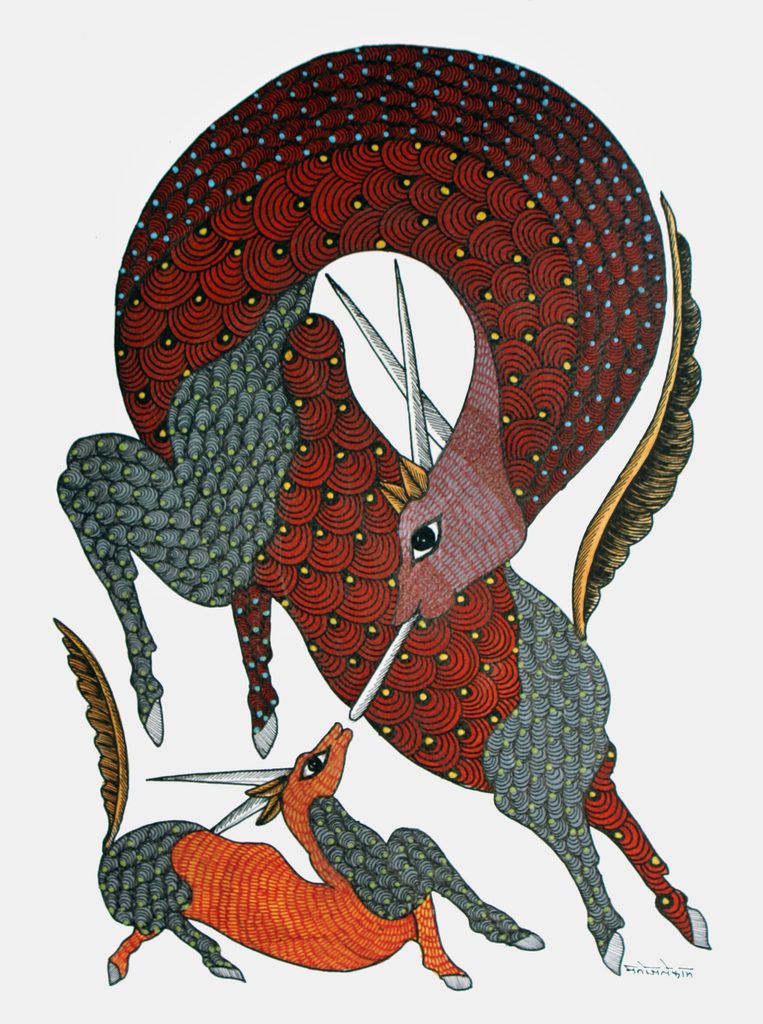
Yet these animals rarely behave like scientific illustrations. Their proportions may shift. Antlers may grow into branches. A bird may contain an entire landscape. Fish may appear to carry the movement of a river within their bodies.
This imaginative freedom reflects a worldview in which the natural world is not separate from human experience.
Animals can be remembered through observation, oral storytelling, spiritual beliefs and everyday encounters. Their role changes depending on the artist and narrative. A tiger may suggest power in one painting, but in another it may be part of a forest story or a personal memory. Birds may indicate movement, communication, community or the constant presence of life around a tree.
The meaning should therefore be read through the complete composition, not assigned through a simplistic symbol chart.
Ask what the animal is doing. Is it protecting, travelling, feeding, watching or transforming? Is it shown alone, or is its body connected to other forms? Does the artist make it appear playful, sacred, threatening or calm?
A painting of several birds in a tree may be about community. A deer whose antlers become flowering branches may collapse the difference between animal and plant life. A fish filled with flowing lines may suggest that water lives within the creature as much as the creature lives within water.
In one Google Arts & Culture presentation, Gond artists depict everything from ants hidden in grass to flying horses and deer whose antlers become trees. The examples show that imagination is not a break from tradition. It is one of the tradition’s strengths.
Gond Art Stories and Symbolism
The most rewarding way to approach Gond art stories and symbolism is to think of the painting as a visual conversation.
Some works draw upon folktales heard from parents and grandparents. Others feature deities and protective beings from Gond and Pardhan Gond belief systems. Paintings may also record farming, music, dance, festivals, forest life or relationships between people and other living beings.
Durga Bai Vyam, for example, is known for narrative paintings rooted in stories she heard from her grandmother. IGNCA notes that her work draws from the Pardhan Gond pantheon as well as folktales connected to her childhood in Madhya Pradesh.
A tree is one of the most familiar Gond subjects, but it does not function as a generic design. It may provide shelter, hold birds, connect different forms of life or stand at the centre of a community. Its branches can become pathways through which the eye travels.
The human relationship with nature is also rarely presented as one of ownership. People, animals, plants, rivers and spirits may occupy the same visual field. One form grows into another. This makes the painting feel less like a scene observed from outside and more like a network in which every element depends on another.
Contemporary stories have also entered this language. Artists have interpreted urban travel, machines, ecological damage and social change through Gond methods of pattern and narrative. The visual vocabulary remains recognisable, but the subject responds to the artist’s present.
This is where collectors should slow down. Instead of asking only, “What does this animal symbolise?” ask, “What story is this particular artist telling through this animal?”
The second question leaves room for individuality.
What Collectors Should Notice Before Choosing a Work
A strong Gond painting rewards careful looking. Begin with the overall composition. Does your eye move naturally through the work, or do the figures feel randomly placed?
Then study the patterning. Hand-created marks often reveal small variations in spacing and direction. These differences give the surface rhythm. Mechanical-looking repetition may copy the appearance of Gond art without capturing its visual vitality.
Look at how the internal patterns relate to the form they fill. Lines inside a fish may suggest water or movement. Marks across a bird may reinforce the direction of its feathers. In the most engaging works, the detail does more than occupy empty space.
The artist’s identity and practice matter too. Read the profile, study several works and notice whether a personal language becomes visible. A collector should be able to recognise differences between artists rather than treating every dotted animal painting as the same tradition.
The story behind the work may deepen the connection, but it should support what you see rather than replace it. A long description cannot rescue a weak composition. Ideally, visual quality and narrative meaning should strengthen each other.
Collectors should also consider what kind of emotional response the work creates. Some Gond paintings feel celebratory and communal. Others feel mysterious, meditative or quietly concerned about the natural world.
Choose the work that continues to hold your attention after the immediate brightness has settled.
Discovering Original Gond Art Through Mojarto
People who want to buy original Gond art online can use Mojarto to explore works by Indian artists across folk, tribal, modern and contemporary practices.
Browsing several works together is particularly valuable. It allows collectors to compare subjects, line work, colour choices and individual pattern styles. You may begin by searching for a tree or animal that interests you, but gradually find yourself drawn to the way a particular artist tells stories.
That shift is meaningful. It moves the decision away from purchasing a decorative category and towards supporting an individual artistic practice.
Mojarto also gives new collectors space to develop taste at a comfortable pace. Read artist information, compare portfolios and return to works that remain memorable. Over time, you will begin to notice the difference between a familiar Gond motif and an artist who has transformed that motif through personal imagination.
Original Indian folk art carries far more than surface beauty. It carries cultural memory, creative labour and a continuing relationship between artists and the worlds they inhabit.
A thoughtful purchase recognises all three.
A Living Tradition, Not a Frozen Style
Gond art is often described through its colourful animals and intricate patterns. Those qualities are certainly part of its appeal, but they are not the whole story.
Its deeper power lies in connection. A creature can contain a forest. A tree can become a community. A remembered folktale can take on a new visual life in the hands of a contemporary artist.
The history begins in domestic and ceremonial traditions, but it does not end there. Through Jangarh Singh Shyam and generations of artists who followed, Gond painting found new materials, audiences and subjects while retaining its narrative energy.
For collectors, the best way to respect the tradition is to look beyond the label.
Learn the artist’s name. Notice the individual pattern. Follow the story across the surface. Ask how animals, people and plants relate to one another.
Once you begin looking this way, a Gond painting no longer feels like a collection of decorative elements. It becomes what it has always had the capacity to be: a living world made visible through line, colour and story.
Frequently Asked Questions
1. What is Gond art?
Gond art is a visual tradition associated with Gond and Pardhan Gond communities of central India. It is known for narrative subjects, animals, trees, deities, strong outlines and intricate patterns created with dots, lines and repeated marks.
2. Where did Gond painting originate?
Its roots are connected to domestic and ceremonial painting traditions practised in Gond communities, particularly in Madhya Pradesh. Contemporary Gond painting on paper and canvas developed significantly through Jangarh Singh Shyam and artists influenced by his work.
3. Why are animals important in Gond art?
Animals reflect close relationships with forests, oral stories, memory and spiritual beliefs. Their meaning depends on the artist and composition. They may represent movement, community, protection, transformation or the connection between different forms of life.
4. What makes each Gond artist’s work different?
Artists often develop individual ways of drawing forms and filling them with dots, lines, scales or other repeated marks. Subject choices, compositions, colours and storytelling approaches also help create a recognisable personal style.
5. Where can collectors buy original Gond art online?
Collectors can explore original Gond and other Indian folk artworks on Mojarto. Reviewing artist profiles and comparing several works can help buyers understand individual styles before selecting an artwork.