
By P Abigail Sadhana Rao
An inexplicable pull draws you toward Durga Puja, one where the enchantment is as mystical as it is mesmerizing. It arrives in the rhythm of the dhak, in the scent of flowers and incense, in the elaborate pandals that transform familiar streets into extraordinary worlds. And everywhere, at the centre of it all, is the image of a goddess who is at once divine and deeply human.
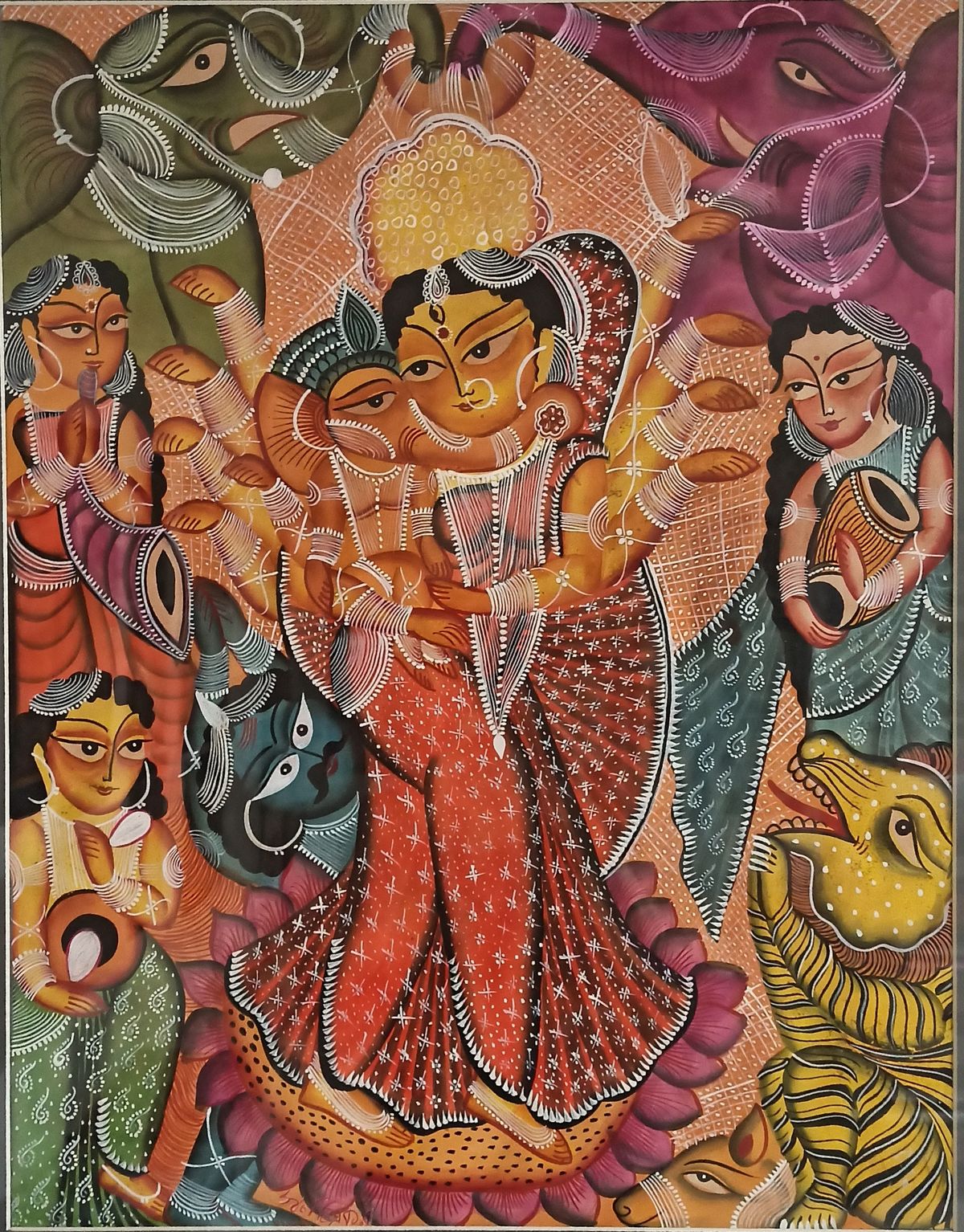
But before Durga Puja becomes a festival of light, music and gathering, it is an act of creation.Clay is shaped by hand. Straw becomes structure. Paint gives expression to a face. Jewellery, ornamentation and elaborate backdrops turn an image into an experience. Generations of artisans, sculptors and artists participate in this transformation, bringing mythology into the present through the language of materials, colour and imagination.
Durga Puja is, in many ways, one of India’s most compelling encounters between art and devotion. It asks us to look beyond the finished image and consider the hands, histories and creative impulses that make it possible.
The Goddess as a Work of Art
The image of Goddess Durga has never belonged to a single artistic vocabulary. Across India, she appears in temple sculpture, folk traditions, miniature paintings, contemporary canvases and elaborate festival installations. Her many arms, her lion and her confrontation with Mahishasura carry a familiar mythology, yet every artist finds a different way to interpret her presence.

In one rendition, she is fierce and monumental. In another, she is tender, radiant or contemplative. Her eyes may convey the stillness of a meditative gaze or the intensity of a force that refuses to be subdued. Perhaps this is what makes Durga such an enduring subject for artists. She is not merely an image to reproduce, but an idea to interpret: strength that protects, power that creates, and the possibility of transformation. For the contemporary artist, the challenge is not simply to revisit a familiar icon. It is to discover what the icon continues to mean.
Tradition meets Canvas
Tradition stays alive by moving. It survives through reinterpretation, through the willingness of each generation to look again at what it has inherited. On Mojarto, contemporary paintings inspired by Durga Puja offer different points of entry into this conversation. Some return to recognisable religious iconography, while others turn towards ritual, community and the emotional life surrounding the goddess.
Agomoni celebrates Maa Durga’s arrival as a homecoming. In Anupam Pal’s painting Agomoni (Durga), the goddess arrives by boat, accompanied by her divine family. Swans glide alongside the vessel, while an owl spreads its wings above, set against a luminous yellow backdrop.
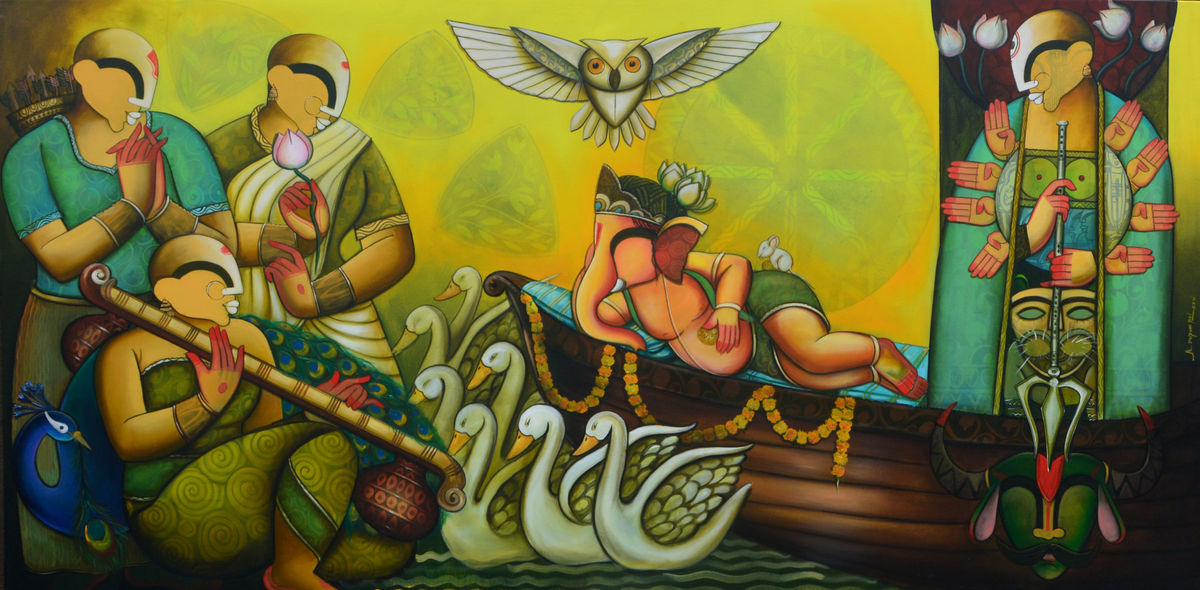
Through stylised figures, intricate details and vibrant colours, Pal brings this cherished tradition into a contemporary artistic language. What makes this painting particularly evocative is its portrayal of Durga not only as a powerful goddess, but also as a daughter returning home. Through Agomoni, an age old narrative finds fresh expression, reminding us how art keeps cultural traditions alive by allowing each generation to experience familiar stories anew.
Artist Mousumi Mukherjee turns our attention towards two women worshipping Goddess Durga. Rather than focusing exclusively on the deity, the painting centres the act of devotion itself. This is an important distinction. Religious art can tell us about the divine, but it can also tell us about the people who seek connection with it.

Their gestures, their attention and their shared experience become part of the subject. In this sense, the painting invites us to consider devotion as a human experience, one shaped by memory, belonging and the need to participate in something larger than oneself.
Artist Sumon Naskar brings the viewer into the world of Sindoor Khela, the ritual in which married Bengali Hindu women apply vermilion to the goddess and to one another during the concluding celebrations of Durga Puja. The subject is significant because it shifts our attention from the goddess alone to the community gathered around her.
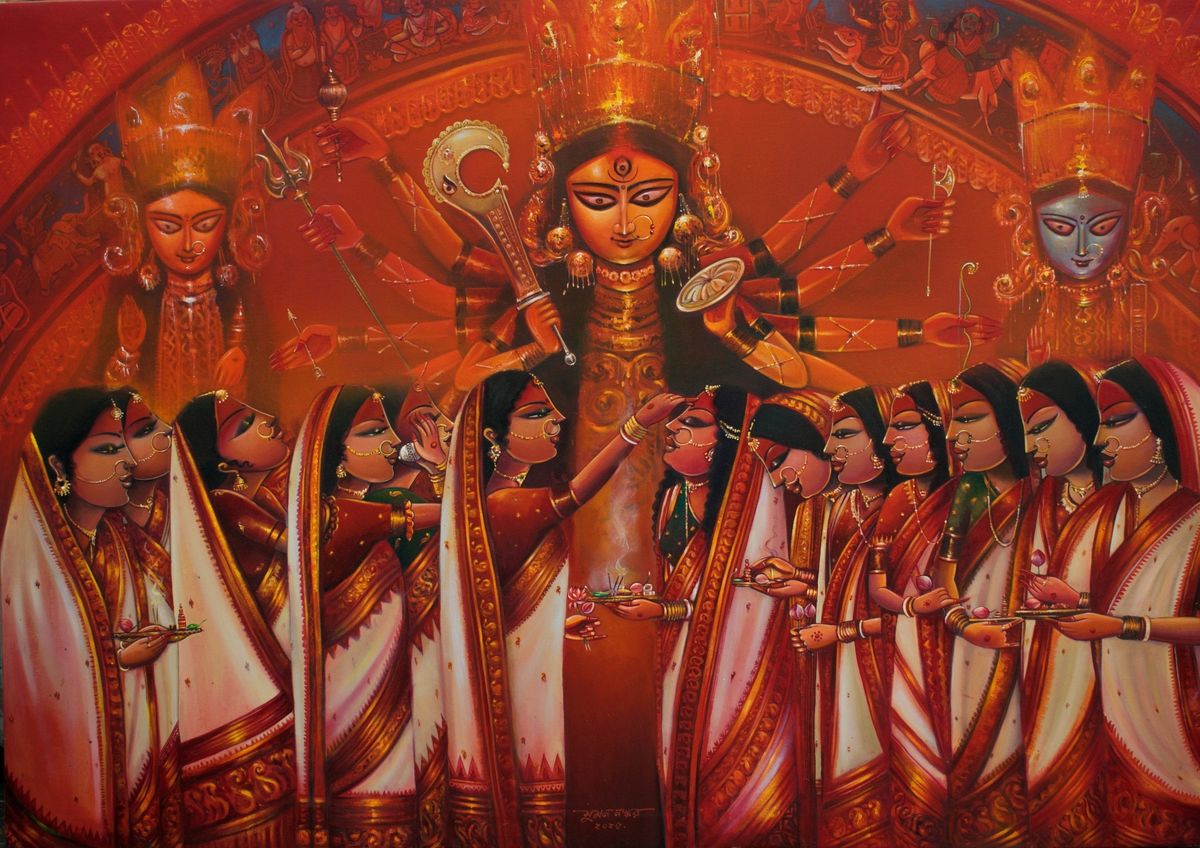
Devotion becomes something embodied and shared, expressed through gestures, colour and the intimacy of ritual. Naskar’s wider artistic engagement with Bengali culture, relationships and feminine expression gives this work a place within a larger conversation about how cultural memory finds its way onto canvas.
The Artisans of Durga Puja
To speak of Durga Puja and art is also to speak of the artisans who make the festival possible.
In Kolkata, the traditional clay images of Durga are closely associated with Kumartuli, the historic neighbourhood known for its community of potters and idol makers. Their practice involves much more than sculpting a recognisable form. It requires an understanding of proportion, anatomy, structure, surface and expression.

The goddess begins with humble materials. Straw provides the framework, clay builds the body, and successive layers give the figure its shape. Paint and ornamentation complete the transformation. The process is both technical and imaginative. The face must convey an extraordinary combination of power and serenity. The eyes, traditionally painted in a ritual known as Chokkhu Daan, carry particular significance in the making of the image.
Yet the artistry does not end with the idol. Pandals themselves become immersive environments, drawing on architecture, sculpture, lighting, textiles and installation art. Some evoke historical structures, others interpret contemporary concerns, and many transform everyday materials into astonishing visual experiences.
Durga Puja therefore offers a reminder that art does not exist only in galleries. It can inhabit streets, temporary structures, neighbourhoods and collective rituals.
Shakti: The Power of the Feminine
The figure of Durga also invites a deeper reflection on the idea of Shakti, understood in Hindu traditions as divine feminine power.
She is not powerful because she exists in isolation, untouched by the world. Her mythology is shaped by confrontation, responsibility and the restoration of balance. Her victory over Mahishasura represents the triumph over destructive forces and the possibility of order emerging from conflict.

Artists have returned to this symbolism across generations because it offers a language for thinking about power beyond domination. Durga can represent protection, courage, resistance and the capacity to act when action becomes necessary.
For contemporary viewers, her image may evoke different associations: the strength of women, the endurance of communities, the struggle against injustice or the courage required to begin again. Art does not have to settle these interpretations into a single meaning. Its strength lies partly in allowing them to coexist.
Why Durga Puja Continues to Inspire Artists
Every year, the goddess returns, and every year, she is made anew. This repetition is not a limitation. It is the source of the festival’s artistic vitality. Familiar stories create room for fresh interpretations, while inherited techniques offer artists a foundation from which to experiment.
A contemporary painting of Durga can preserve a visual tradition while introducing a new palette, a different composition or a personal emotional register. A festival installation can honour local craftsmanship while challenging conventional ideas of space and spectacle.The relationship between art and devotion is therefore not simply one of preservation. It is also one of renewal.
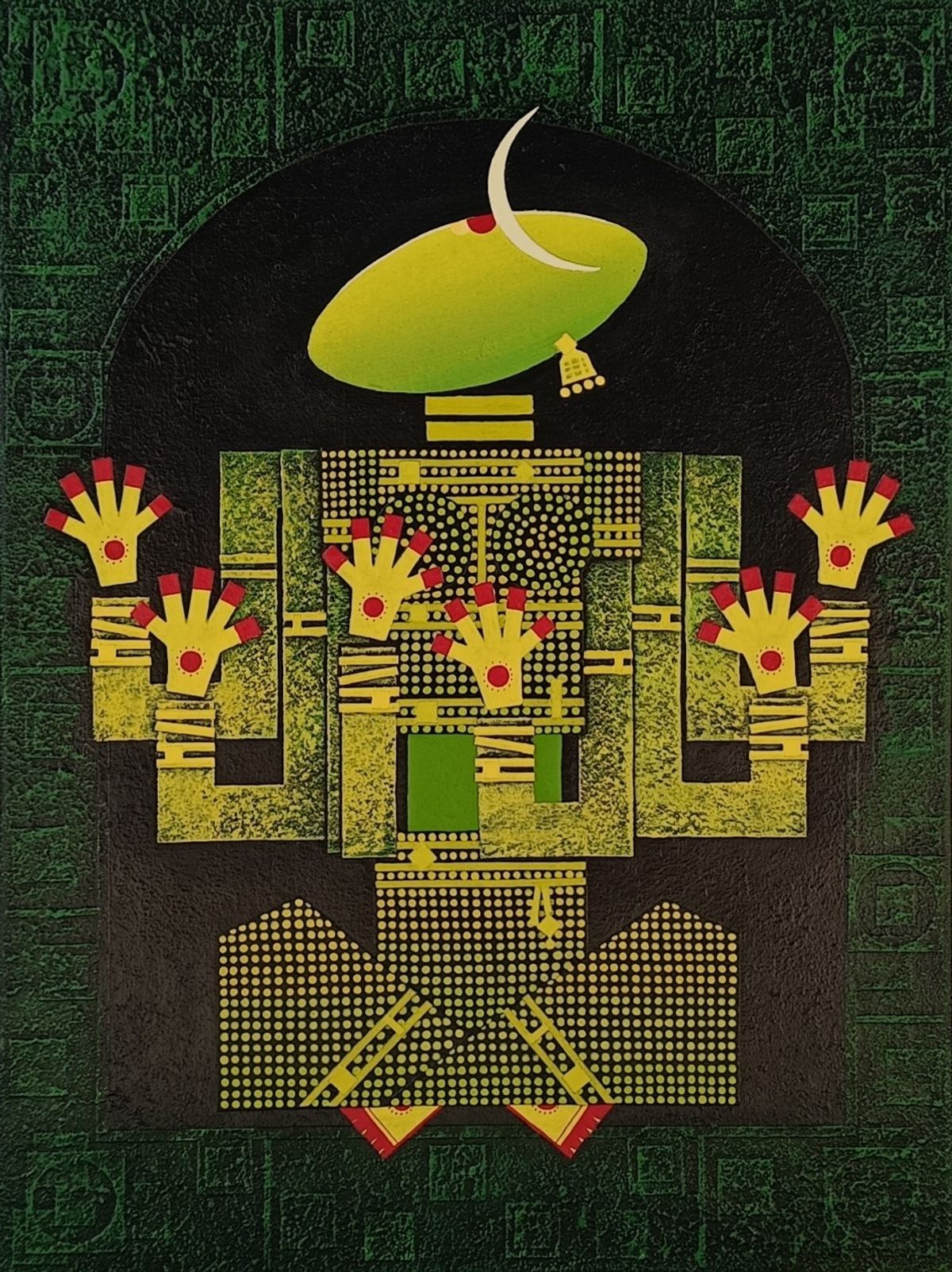
Perhaps that is the enduring appeal of Durga Puja; the knowing that something ancient can continue to feel immediate, that a story told for generations can still speak to the present, and that the act of making remains a powerful way of keeping cultural memory alive. This Durga Puja, explore the many ways artists interpret the goddess, her strength and the cultural worlds surrounding her.
At its best, collecting art allows us to live with images that continue to reveal something new over time. Discover paintings inspired by Indian mythology, culture and contemporary artistic expression on Mojarto, and find a work that speaks to you.