
There is a reason a Pichhwai painting makes people stop and look twice.
From a distance, you notice the colour first. Then comes Shrinathji, often standing at the centre of an elaborate composition. Move closer, and another world appears. Cows gather in neat rows. Lotuses open across dark water. Peacocks, gopis, trees, moonlit skies and floral borders begin to reveal themselves.
Nothing feels accidental.
That is the attraction of Pichhwai art. The beauty is immediate, but the real pleasure begins when you understand what the artist has painted and why.
Pichhwai developed as devotional art connected with the worship of Shrinathji, a form of Krishna, and is strongly associated with Nathdwara in Rajasthan. Historically, large painted cloths were placed behind the deity in a shrine, with imagery changing according to religious festivals, seasons and rituals. The Metropolitan Museum of Art describes Pichhwai as a shrine backdrop closely associated with the worship of Shrinathji at Nathdwara.
Today, Pichhwai has travelled far beyond the temple setting. Collectors encounter historic works, traditional Nathdwara paintings and newer interpretations in which artists retain the old vocabulary while adjusting colour, composition and visual emphasis for contemporary audiences.
For someone choosing a Pichhwai for a personal collection, knowing the difference between simply attractive ornamentation and meaningful imagery makes the purchase far more rewarding.
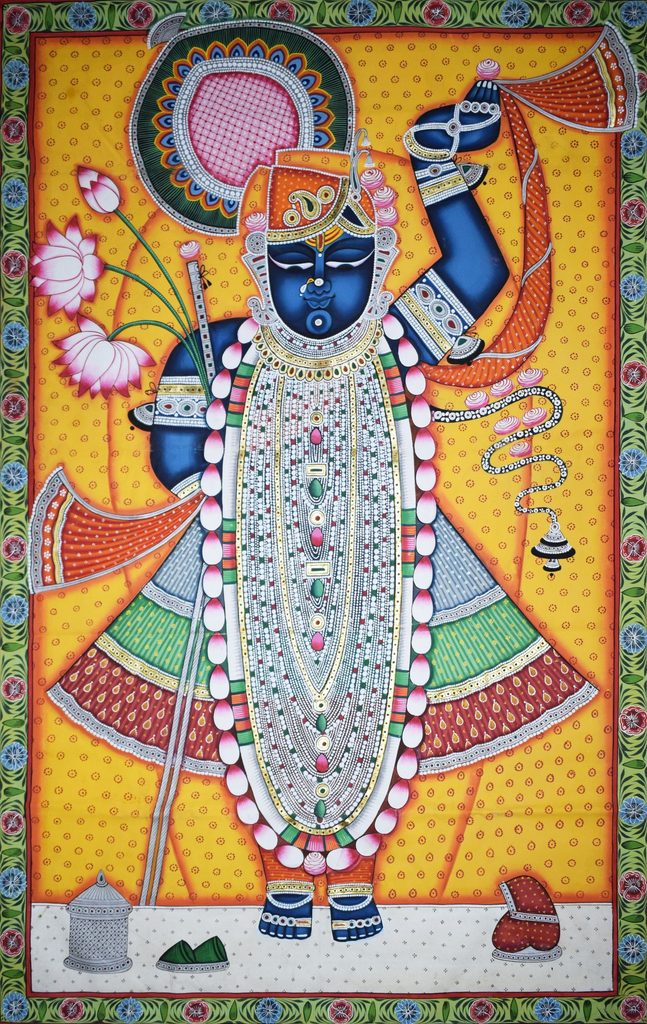
Pichhwai Began With Devotion, Not Decoration
The name itself offers a clue to the original purpose of the art form. Pichhwai, also written as Pichhwai or Pichvai, refers to a painted textile placed behind the sacred image.
The tradition became particularly associated with Nathdwara, the Rajasthan temple town centred on the worship of Shrinathji. The Art Institute of Chicago describes Pichvais as large paintings on cloth created for the Pushtimarg devotional tradition and used in the seasonal and daily worship of Shrinathji.
This background matters when looking at Traditional Pichhwai paintings.
They were not originally conceived as generic wall decoration. Their imagery responded to a living religious calendar. A composition could relate to a particular celebration, season, ritual or episode from Krishna’s life.
That gives Pichhwai a character quite different from art where symbols are added simply because they look attractive.
A lotus, cow or peacock may add visual beauty, but within the Pichhwai tradition it can also support the devotional atmosphere surrounding Krishna.
The British Museum’s records of Nathdwara painting show the close relationship between art and temple ritual. One late 18th-century work depicts the Annakuta festival, when food offerings commemorate Krishna lifting Mount Govardhan to protect villagers.
This is why learning the story behind a painting can change the way you experience it.
What first appears to be a decorative scene may actually represent a specific celebration.
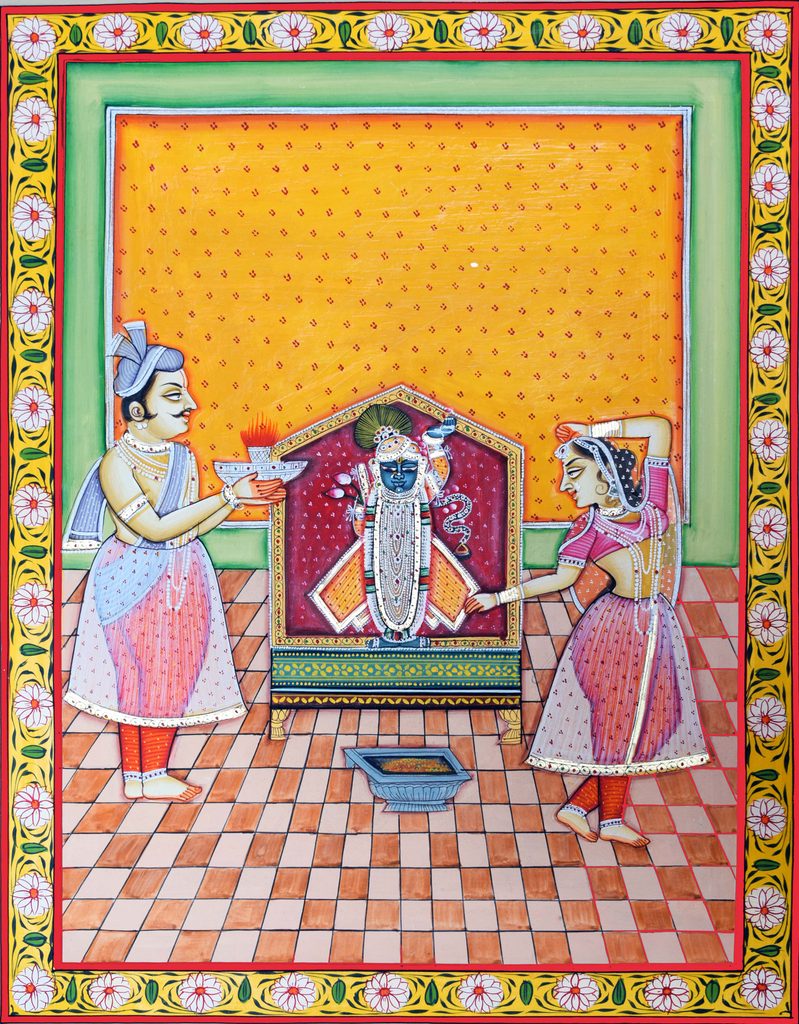
Understanding the Most Recognisable Pichhwai Painting Themes
Most Pichhwai painting themes grow from the life, worship and symbolic world of Krishna.
Shrinathji is frequently the central figure. He is represented as Krishna in the act associated with lifting Mount Govardhan, and the surrounding imagery helps establish the season, festival or devotional mood of the painting.
Some compositions are visually crowded, filled with attendants, offerings, architecture and animals. Others rely on repetition, such as rows of cows or a field of lotus flowers, to build rhythm.
Several themes appear repeatedly.
Shrinathji and divine darshan
In many works, Shrinathji commands the composition. Clothing, jewellery, flowers and accompanying figures may change according to the subject being portrayed.
Rather than looking only at how richly the figure is decorated, notice how the artist builds attention around the deity. Borders, repeated forms and surrounding figures often guide the eye towards the centre.
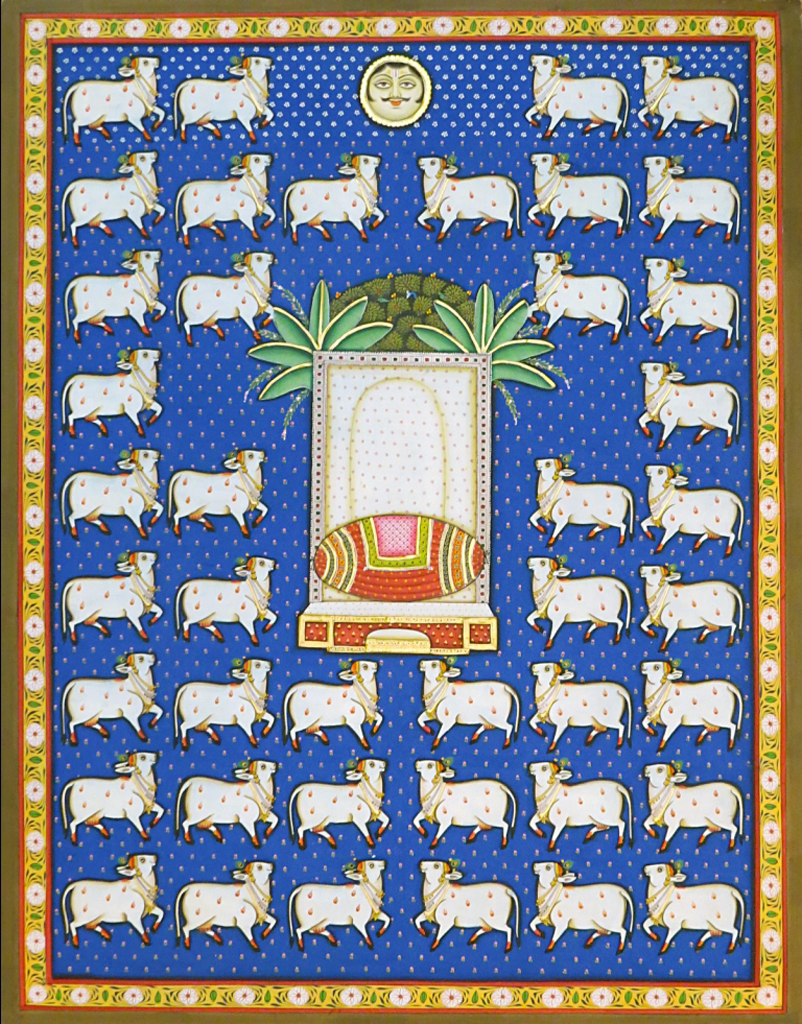
Krishna and the cows
The cow has an obvious connection to Krishna’s identity as a cowherd. In Pichhwai, cows can appear individually or in beautifully ordered groups.
Their repetition creates serenity. You may see different markings, jewellery or decorative details painted on each animal, giving an apparently simple composition much more personality.
Lotus-filled scenes
The lotus appears frequently in Indian religious art and is strongly associated with purity and spiritual beauty. In Pichhwai compositions, lotus ponds can also establish a lush, idealised setting around the deity.
A lotus-based Pichhwai may appeal to someone who wants devotional symbolism without an extremely crowded narrative scene.
Festivals and ritual celebrations
Pichhwai paintings have long reflected the ritual calendar. Annakuta, Gopashtami and other celebrations connected with Krishna can shape the subject matter.
The Met, for example, holds a late 18th-century Pichhwai made for the Festival of Cows, or Gopashtami, showing how closely particular paintings could relate to specific moments in devotional life.
This festival connection is one reason two Pichhwai paintings featuring Shrinathji may look completely different.
Cows, Lotuses, Peacocks and More: Reading Pichhwai Painting Symbolism
Learning Pichhwai painting symbolism does not mean memorising a dictionary of motifs.
It means noticing relationships.
Start with the central figure. Then ask how everything around that figure contributes to the story.
Cows
Cows connect directly with Krishna’s pastoral identity. Depending on the painting, they may suggest affection, devotion and the world of Krishna’s childhood.
A composition dominated by cows often feels ordered and peaceful. Repeated white forms against a dark or richly coloured background can also create a powerful visual rhythm.
Lotus flowers
Lotuses carry long-standing associations with purity and divinity in Indian visual culture.
In Pichhwai, their repetition may create an atmosphere of abundance and sacred beauty. A composition covered with lotus blooms can feel meditative even when the surface is highly detailed.
Peacocks
Peacocks appear frequently in imagery surrounding Krishna and in broader Indian art. Their colour, movement and natural splendour make them especially suited to the lush visual language of Pichhwai.
The Museum of Art & Photography has specifically explored the peacock in relation to a Morakuti Pichhwai, showing the continuing importance of the bird within the tradition.
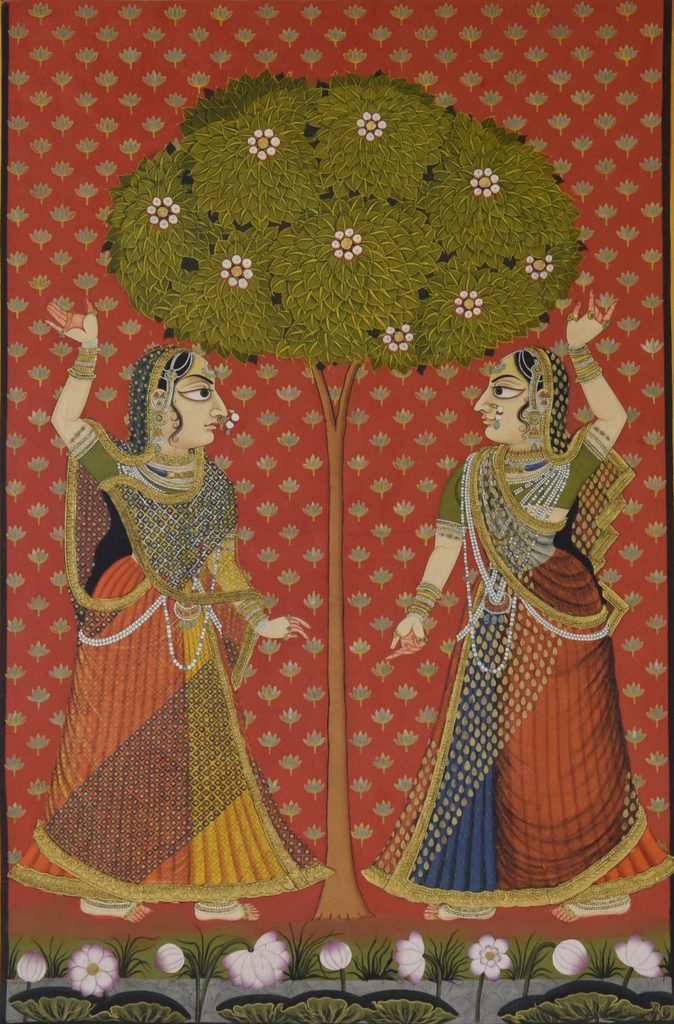
Gopis
Gopis, or cowherd women associated with Krishna’s stories, often appear as figures of devotion. Historic shrine hangings may show them carrying offerings, musical instruments, mirrors or ceremonial objects. A 19th-century Pichhwai fragment in The Met’s collection, for instance, contains rows of gopis surrounding the space that would once have centred Krishna.
Trees, flowers and gardens
Nature in Pichhwai is rarely an empty background.
Trees, flowering plants and pastoral settings build an idealised world around Krishna. They can also help communicate season and mood.
Once you recognise these relationships, Pichhwai becomes much easier to read. You stop seeing twenty separate decorative details and begin seeing one carefully constructed devotional environment.
Traditional Pichhwai and Contemporary Interpretations
Collectors today encounter several visual approaches to Pichhwai.
Some works remain close to the detailed Nathdwara tradition, with Shrinathji, elaborate borders, natural motifs and dense storytelling.
Others simplify the composition.
A contemporary artist may focus almost entirely on cows, lotuses or one central figure. Another may use a restrained palette instead of the dense colour associated with older examples.
Neither approach should automatically be treated as superior.
The question is what you want from the artwork.
If the history and devotional storytelling are what attract you, you may naturally prefer a detailed work in which Krishna, attendants, landscape and ritual imagery remain central.
If you respond more strongly to pattern and symbolism, a contemporary interpretation built around cows or lotuses may suit your taste better.
What matters is understanding what you are buying.
A new work inspired by Pichhwai should not be mistaken for an antique or historic temple textile. Likewise, a painting that borrows one popular Pichhwai motif should not automatically be treated as equivalent to a work grounded deeply in the Nathdwara tradition.
Read the artwork description. Look at the stated medium and artist information. Study several examples before deciding.
Mojarto currently lists original Pichhwai works, including examples executed with natural colours on cloth and categorised within Indian folk art.
That comparison process helps buyers recognise how much variation exists within the tradition.
How to Choose Pichhwai Paintings for Home Without Treating Them Like Decor
Searching for Pichhwai paintings for home often leads to advice about matching wall colours or filling empty spaces.
That is a very limited way to choose art.
Start with the painting, not the furniture.
Ask yourself what attracted you first.
Was it the presence of Shrinathji?
Was it the repeated cows?
The lotus imagery?
The richness of the storytelling?
The calm created by symmetry?
Your answer can help you choose between very different kinds of Pichhwai.
A highly detailed festival composition creates a different experience from a quiet lotus or cow painting. One invites prolonged narrative reading. The other may depend more strongly on repetition and visual rhythm.
Next, consider your relationship with the devotional content.
For some buyers, the religious meaning is central. They want a work that represents Krishna or reflects a particular spiritual connection.
Others may be interested primarily in Pichhwai as part of India’s artistic heritage.
Both responses are possible, but understanding your own reason for buying helps you choose more intentionally.
Then look closely at craftsmanship.
Study the line work around figures and animals. Look at repeated motifs. In a detailed composition, see whether the surface remains controlled or becomes visually confused.
Good intricacy is not the same as adding as much detail as possible.
The eye should still know where to go.
Colour is another useful clue. Traditional examples can contain rich greens, reds, blues, yellows and gold, while other Pichhwai works use more restrained combinations.
Choose colour because the artwork itself holds your attention, not merely because it resembles the rest of your interiors.
The strongest Pichhwai paintings for home should remain interesting even if your furniture changes ten years from now.
What to Check Before Buying a Pichhwai Online
When you buy original Pichhwai paintings online, slow down and read before clicking.
Begin with the medium.
Historic Pichhwais were strongly associated with painted textiles, and museum collections include works on cotton, linen and related textile surfaces. Contemporary listings may use natural colours, mineral colours or other painting materials depending on the artist and work.
Do not assume every piece labelled “Pichhwai” was produced through exactly the same method.
Next, identify the subject.
If the description names a festival, deity or particular narrative, spend a few minutes understanding it. The story may significantly increase your appreciation of the work.
Study the artwork information for:
- Artist or maker attribution
- Medium and surface
- Year of creation where available
- Original artwork status
- Subject or narrative
- Technique
- Available provenance or authenticity information
If the work is by a contemporary artist, look at other pieces by the same artist.
Does that person have a recognisable approach to Pichhwai?
Are the cows, floral forms or figures handled with a personal visual language?
Collectors should be interested in artistic identity, not only category labels.
Mojarto’s current Pichhwai listings provide artwork specifications and descriptions that can help buyers understand the subject and medium before purchasing.
That information becomes particularly useful when several paintings initially appear similar.
Why Pichhwai Continues to Attract Collectors
Pichhwai sits at an interesting meeting point.
It is devotional without being visually narrow.
It is historical without being frozen in history.
It is highly decorative, yet the decoration carries narrative purpose.
That combination gives Pichhwai art unusual staying power.
A collector can be drawn to it through faith, Indian cultural history, craftsmanship, colour or sheer visual complexity. Over time, the same painting may reveal more than the reason that first attracted the buyer.
You notice a cow you had overlooked.
You understand why the moon appears in a particular scene.
A row of lotuses that initially seemed ornamental begins to feel connected to the atmosphere of the entire image.
That gradual discovery is one of the pleasures of owning art with a strong visual tradition behind it.
Mojarto allows collectors to explore Pichhwai alongside other Indian folk and traditional practices, making it possible to compare works before making a decision.
Do not rush that comparison.
A Pichhwai should not be chosen merely because the category is currently popular in interiors. Choose one because you enjoy its visual language and because the subject continues to mean something after the first burst of colour has done its work.
A good painting catches your eye.
A good Pichhwai gives your eye somewhere to go next.
Frequently Asked Questions
1. What is Pichhwai art?
Pichhwai is a devotional painting tradition closely associated with Nathdwara in Rajasthan and the worship of Shrinathji, a form of Krishna. Historically, large painted cloths were displayed behind the deity and changed according to festivals, seasons and rituals.
2. What are the main themes in Pichhwai paintings?
Common themes include Shrinathji, Krishna’s pastoral life, cows, gopis, lotus ponds, peacocks and religious festivals such as Annakuta and Gopashtami. The imagery often reflects the devotional and seasonal calendar surrounding Krishna worship.
3. What do cows symbolise in Pichhwai art?
Cows are closely connected with Krishna’s identity as a cowherd and his pastoral stories. Their presence can reinforce the devotional environment of the painting, particularly in works connected with festivals such as Gopashtami.
4. How should I choose a Pichhwai painting for my home?
Choose according to the artwork’s subject, symbolism, craftsmanship and your personal response. Decide whether you prefer a detailed devotional narrative or a simpler composition focused on motifs such as cows or lotuses. Avoid choosing purely because the colours match your interiors.
5. Where can I buy original Pichhwai paintings online?
Mojarto features original Pichhwai works within its Indian art collection, including paintings categorised as folk art and works created using traditional materials such as natural colours on cloth. Buyers can review artwork information and compare different compositions before choosing.