
There’s something quietly transformative about standing before a painting that feels alive, not just with colour or form, but with spirit. That subtle energy, the kind that lingers in the silence between brushstrokes, is what defines Indian religious art. For centuries, artists across the subcontinent have translated devotion into image and faith into colour. Today, as India’s creative landscape evolves, that sacred impulse continues to flow, reshaping itself through a new generation of artists who carry the torch of tradition into the modern world.
At Mojarto, this meeting of the ancient and the contemporary is more than a visual experience; it’s a journey into the layered meanings of faith, identity, and art.
The Everlasting Pulse of Indian Religious Art
Religious art in India was never meant to be looked at; it was meant to be experienced. In temples, monasteries, and village homes, art was a form of offering, a dialogue between the divine and the devotee. The murals of Ajanta, the intricate Pichwais of Nathdwara, the folk paintings of Bengal and Mithila each carried the pulse of collective devotion.
What’s fascinating is how that same pulse survives in the twenty-first century. Today’s artists still paint the stories of gods and goddesses, but they speak to modern sensibilities. They borrow from abstraction, experiment with texture, and reimagine spiritual symbols for a generation that seeks meaning beyond ritual. This is the new face of spiritual expression through art, where devotion meets design and belief finds form in the language of now.
Reimagining Faith for a Modern Eye
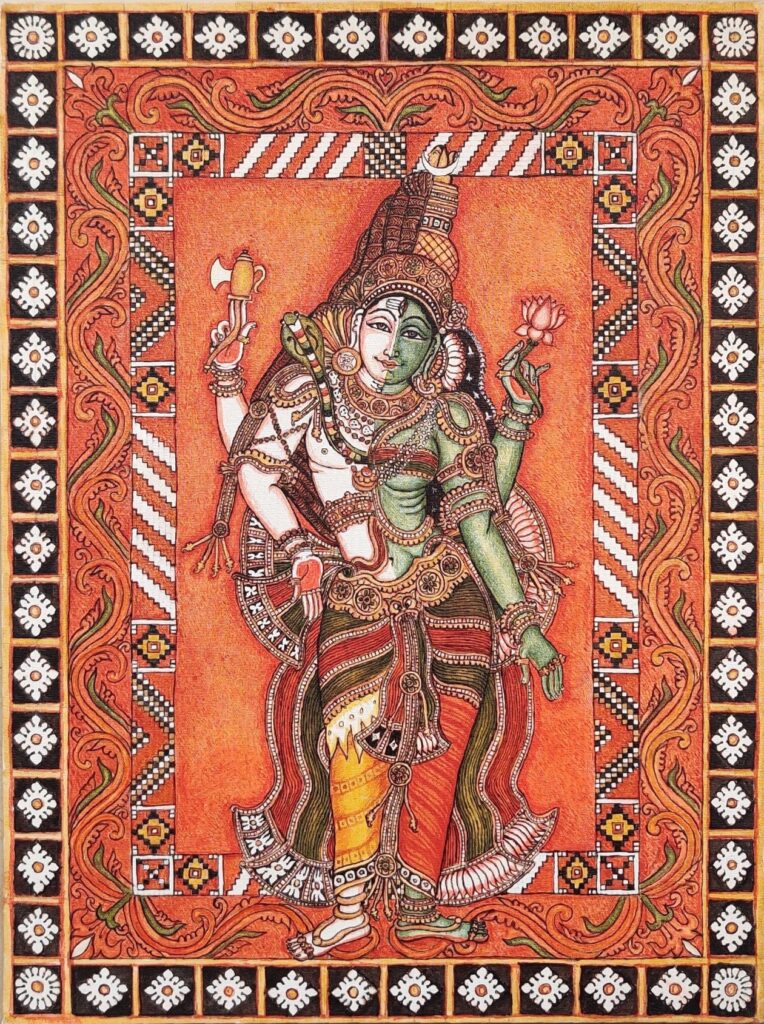
To see the world of Indian devotional art today is to see it in motion. The canvas may hold the image of Krishna or Shiva, but the expression is deeply personal: reflective, questioning, sometimes even raw. Artists aren’t merely recreating icons; they are exploring the emotional undercurrents behind them.
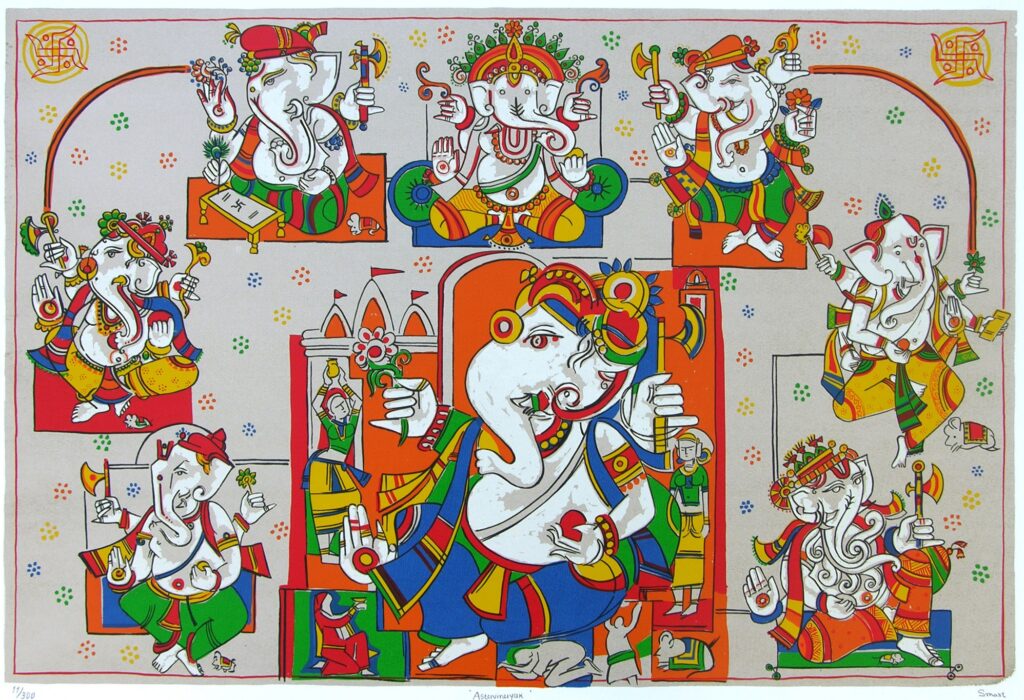
A contemporary painter might portray Durga not as a goddess with ten arms, but as a symbol of feminine power and resilience. A sculptor might reinterpret Ganesha as a geometric abstraction, capturing essence without form. Through these reinterpretations, the divine becomes human again: accessible, imperfect, and real.
For collectors, this modern perspective offers something extraordinary: art that speaks across centuries. Each piece becomes a bridge between tradition and modernity, between worship and wonder.
It’s this very transformation that has made Indian gods and goddesses in contemporary art such a captivating movement in today’s market.
Where the Sacred Becomes Story
One of the most beautiful aspects of visual storytelling in Indian religious art is its continuity. Long before writing existed, India told its stories through images: the dance of Shiva, the churning of the cosmic ocean, the birth of Lakshmi, or the teachings of Buddha.
Today, artists continue this tradition, but their storytelling has evolved. A single panel may capture the chaos of modern life through mythic symbolism. A minimalist piece might distil an entire epic into colour fields and texture. Every stroke becomes a verse, every symbol a memory of the sacred.
Collectors often find themselves drawn to this narrative quality. A painting may look abstract at first glance, but behind the abstraction lies mythology, retold, reimagined, and reframed for modern reflection. It’s not just decoration; it’s conversation. It asks the viewer to pause and listen.
Mojarto: Where Heritage Meets the Modern Mind
At Mojarto, we celebrate this evolution of spiritual art where history breathes in the hands of contemporary creators. Our curated collections reflect how Indian artists reinterpret ancient faiths, not by imitating tradition, but by reviving its essence in forms that resonate with today’s aesthetic.
Every artwork on Mojarto’s platform tells a story. Some capture the serenity of meditation, others the fierce rhythm of divine dance. Some reinterpret temple murals, while others build entirely new worlds rooted in Indian mythology. Through these diverse visions, we see how Indian religious art continues to evolve: alive, expressive, and deeply personal.
For collectors and enthusiasts, these artworks offer something more than visual delight: they carry a sense of continuity. Owning one is like owning a piece of living tradition, a reminder that spirituality doesn’t belong only to the past. It adapts, grows, and finds new meaning with every generation.
The Language of Contemporary Spiritual Art
The beauty of modern spiritual art lies in its honesty. Artists no longer feel bound to replicate divine figures in the same traditional forms. Instead, they seek to express what divinity feels like.
This shift has given rise to an extraordinary diversity in Indian divine art forms from vivid reinterpretations of mythic tales to serene, meditative abstracts that evoke the soul’s journey. Some artists weave texture and light into symbolic compositions; others use bold strokes to capture transcendence itself.
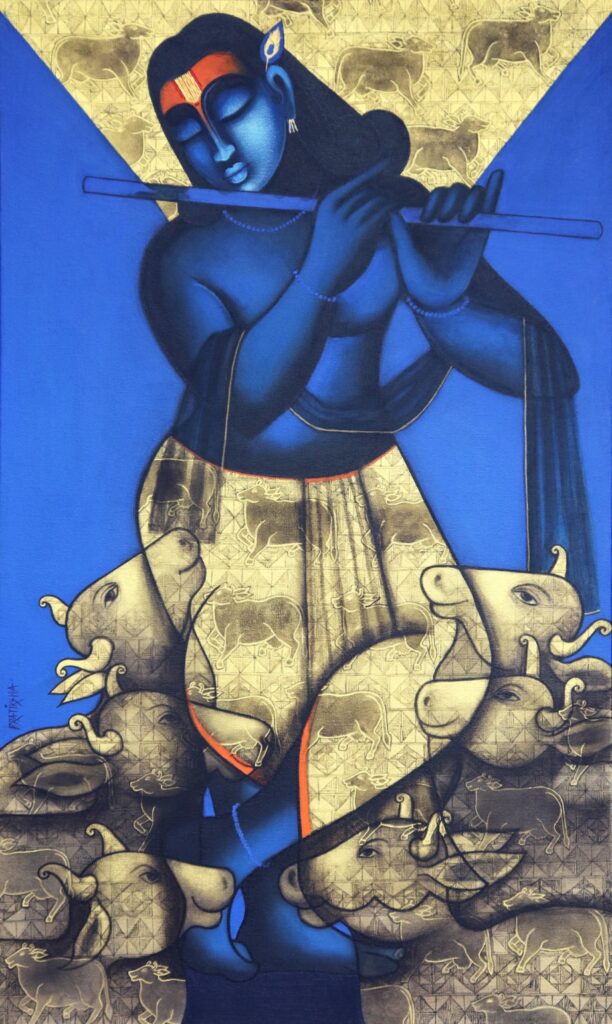
It’s this freedom that makes contemporary spiritual art so compelling to modern audiences. It connects to the same truth ancient painters sought: that art is not just seen, it’s felt. Whether it’s a modern reinterpretation of the Nataraja’s dance or a minimalist portrayal of Krishna’s flute, what remains constant is the spirit within the image.
Why Collectors Are Turning to Spiritual Narratives
Art collectors today aren’t just buying aesthetics, they’re buying meaning. And meaning is exactly what modern religious art delivers.
Here’s why this niche is drawing attention:
- Emotional depth – Devotional themes add a personal, introspective layer to a space. They invite calm, focus, and dialogue.
- Cultural continuity – Investing in these works supports artists who keep India’s sacred visual language alive, while making it relevant for the next generation.
- Universal resonance – You don’t have to follow a particular faith to connect with spiritual art. Its symbols: light, balance, and transformation are universal.
- Timeless appeal – Unlike fleeting design trends, spirituality never goes out of fashion. Each piece holds enduring meaning, making it a lasting investment.
At Mojarto, many collectors tell us they were first drawn by the beauty, but stayed for the story. A single canvas often becomes a focal point of peace in their homes, something to return to after the noise of the day.
From Tradition to Transformation
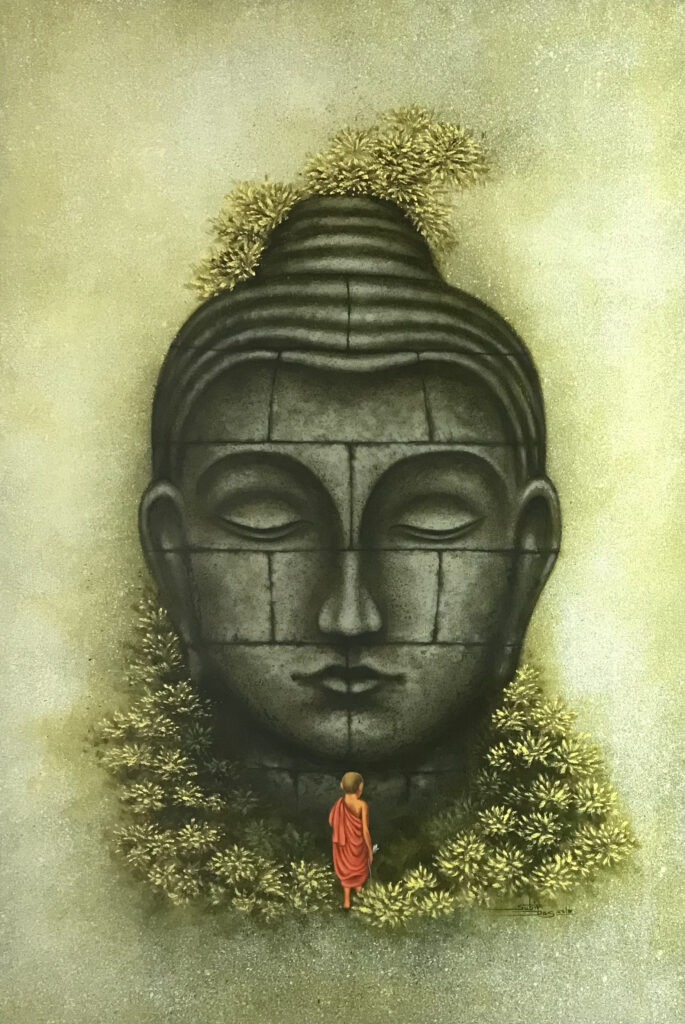
Modern devotional art isn’t about breaking away from the past; it’s about listening to it differently. The themes remain familiar: creation, destruction, compassion, and wisdom, but the interpretation changes with every artist’s voice.
For instance, a modern artist might depict Vishnu’s cosmic dream using surreal, dreamlike imagery. Another might reimagine the Goddess as a reflection of inner strength rather than outer power. These interpretations don’t dilute tradition; they expand it.
Through such works, artists aren’t merely painting gods; they are painting questions. What does devotion mean in a digital age? How does one seek the divine in a world of speed and noise? In searching for answers, they create art that speaks directly to the modern soul.
The Mojarto Perspective
As a platform, Mojarto recognises that art is one of the most powerful ways to connect with spirituality in a contemporary world. We curate works that speak to this spirit, art that doesn’t preach, but invites reflection.
Every piece you find on our platform carries its own rhythm: some rooted in mythology, others in meditation, some vibrant and ornate, others subtle and abstract. Yet all share one thing, a search for meaning.
For those looking to build a meaningful collection, these pieces hold immense potential. They’re not just visually stunning; they hold cultural, emotional, and even philosophical depth. In that sense, they become lifelong companions, reflections of one’s own spiritual journey.
A Quiet Revolution in Indian Art
What’s unfolding today is more than a trend; it’s a quiet revolution. Indian artists are reclaiming spirituality as a personal language, not limited to religion, but open to interpretation. They are blurring the lines between faith and philosophy, between devotion and daily life.
This is why the modern movement of Indian religious art feels so fresh. It’s not about worshipping a distant deity; it’s about rediscovering the divine within. And when you bring that energy into your home or collection, it changes the space around you: subtly, deeply, beautifully.
A Final Reflection
There’s a quiet truth that runs through every piece of spiritual art: the divine is not elsewhere. It’s here, in texture and tone, in silence and light.
For centuries, Indian artists have known this. What’s new is the way they express it with courage, emotion, and a deep awareness of the world we live in today. Whether through bold reinterpretations of mythology or serene meditative abstracts, this generation of artists reminds us that spirituality is timeless, even when styles change.
At Mojarto, we invite you to experience this renaissance. Discover how ancient faith finds a new voice through modern imagination. Let the stories, symbols, and emotions of these works speak to you, not just as art, but as inspiration.
Because at the end of the day, every brushstroke of Indian religious art carries the same message: that the sacred still lives among us, waiting to be seen, felt, and understood anew.