
By P Abigail Sadhana Rao
“I found I could say things with color and shapes that I couldn’t say any other way…things I had no words for.” — Georgia O’Keeffe
There are moments in life that seem to exist outside of time. A woman sitting beside an old radio. A child leaning against a window, watching the world go by. An empty chair facing a forest. Friends gathered around a table with cups of tea between them. A room remembered long after we have left it. Someone sitting alone, waiting, thinking, listening. Nothing extraordinary needs to happen in these moments, and perhaps that is precisely what makes them beautiful.
In a world that constantly asks us to move, respond and keep up, stillness can feel almost like a forgotten language. Yet artists on Mojarto have always known how to express it, through colour, light, gesture and composition. A painting can hold a fleeting moment in place and invite us to stay with it. These quiet moments in art remind us that stillness does not always mean silence or solitude.
Sometimes it is found in observation, sometimes in memory, sometimes in companionship, and sometimes simply in the pleasure of being present.
At the heart of these artworks found on Mojarto, is an idea that has always fascinated artists, stillness in art is rarely about complete silence, but rather about creating a moment in which the viewer feels permitted to linger.
Looking Out at the World
Sharmi Sen Dey‘s The Magical Town transforms an ordinary neighbourhood into a playful, dreamlike world. Warm ochres, burnt oranges, reds and earthy browns dominate the composition, while turquoise and blue shutters punctuate the warmth with striking notes of colour. Flecks of yellow, green, pink and white animate the surface, giving the painting the energy of a childhood memory. The irregular rooftops, clustered houses and overlapping windows create a rhythm that encourages the eye to wander through the town, discovering one little world after another.
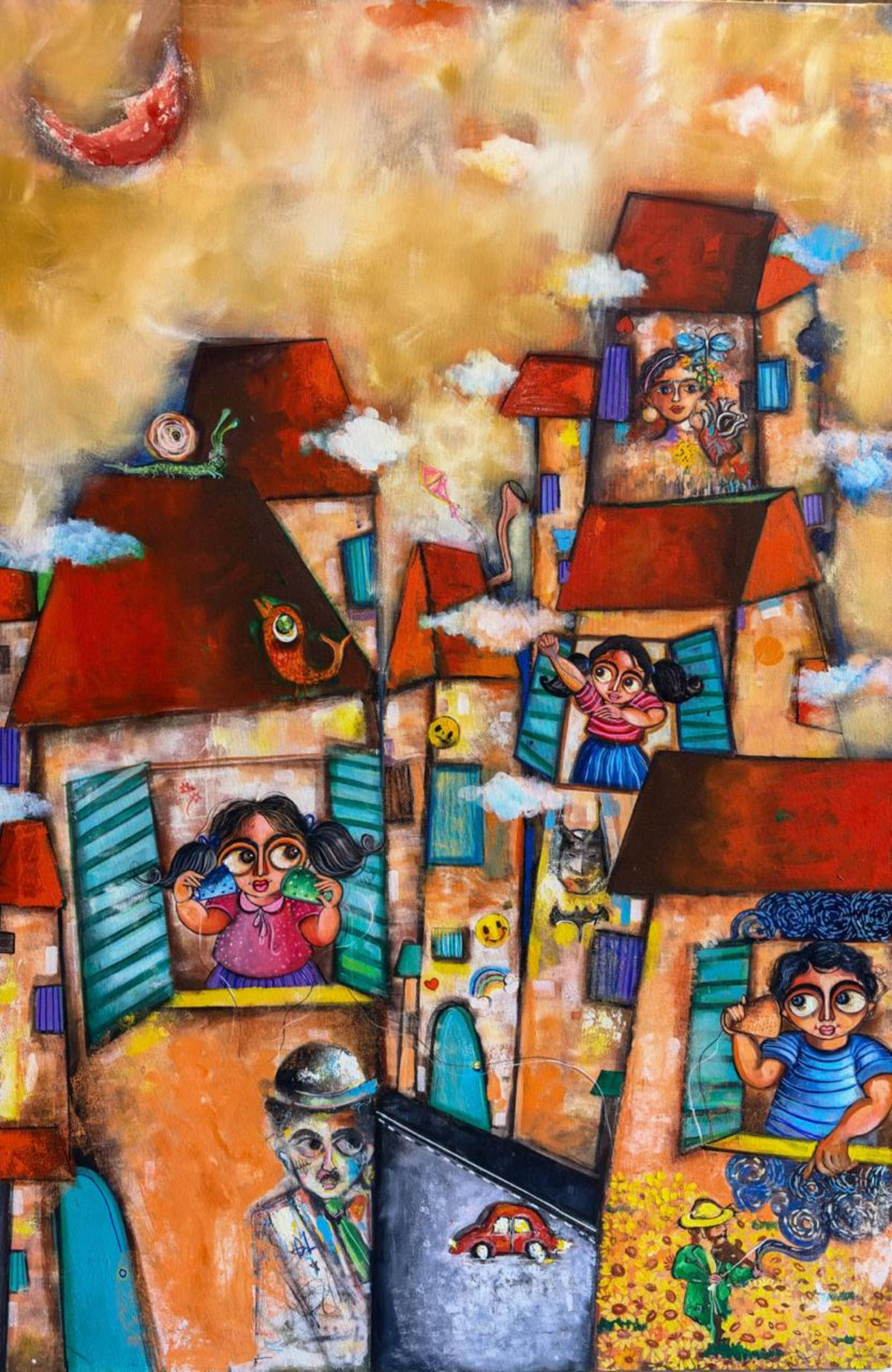
Yet beneath all this colour and movement lies a sense of quiet observation. The windows become intimate thresholds between the private and the public, revealing children who pause to look out, play or simply watch the world beyond their homes. There is something tender about these small acts of looking. The town may be bustling with colour, but each figure seems momentarily enclosed within a private experience. In this sense, The Magical Town becomes one of those quiet moments in Indian contemporary art that asks us to slow down and notice the world from a different vantage point. Perhaps a quiet moment begins not in complete silence, but in the simple act of looking.
A Chair by the Window
In Nivedita Pande‘s Whispering Woods, the act of looking becomes more contemplative. Rendered in oil on canvas, the composition places a solitary patterned chair before a large window, creating an intimate relationship between the enclosed interior and the landscape beyond. Rich ochres and mustard yellows give the room a warm, almost enveloping quality, while the violet sky and dense greens of the woods introduce a cooler and more mysterious world outside. Tiny illuminated houses nestled within the trees become distant points of human presence.
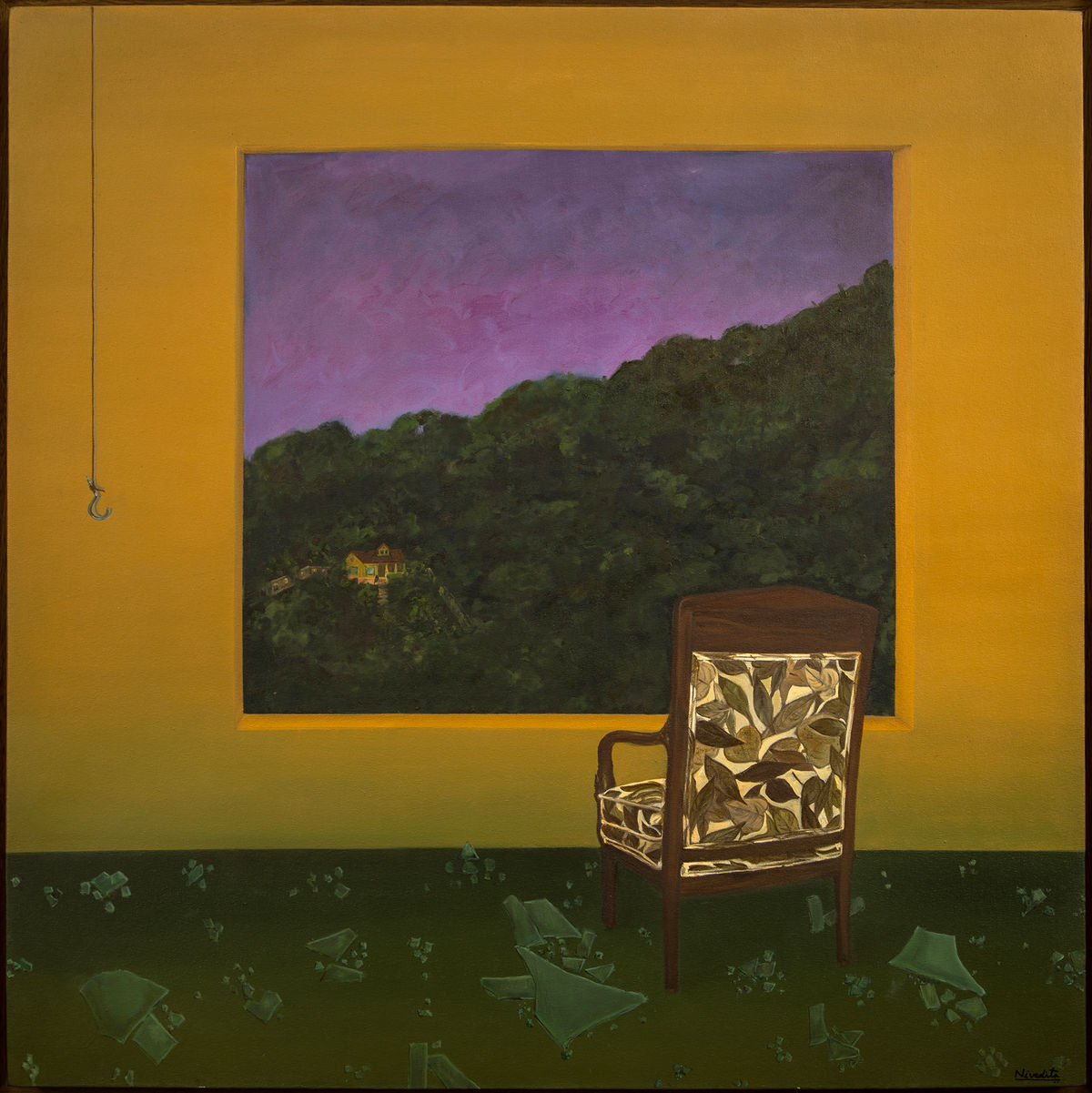
The chair is perhaps the most evocative element in the scene. Empty, yet strangely full of possibility, it seems to wait for someone to sit down and surrender to the view. There is something particularly moving about the absence of a figure. We are invited to occupy the space ourselves, to imagine the silence of the room and the landscape unfolding beyond the glass. The painting becomes a beautiful example of how quiet moments in art can transform an ordinary interior into a space for reflection. It asks nothing of us except to sit, look and let our thoughts wander.
The Comfort of Company
Quietness does not always mean being alone. Sometimes, it exists in the comfort of sitting beside people with whom silence does not need to be filled. Pallavi Dutta‘s Tea Ceremony, created in acrylic on paper, captures this gentle intimacy through the familiar ritual of sharing tea. Expressive animal headed figures gather closely around a table, each holding a cup, their bodies and gestures creating a sense of warmth and companionship. The dominant pinks, reds and magentas envelop the scene, while blue cups and deep teal shutters provide a vivid contrast. Patterns across the clothing, tablecloth and background add a rhythmic quality to the composition.
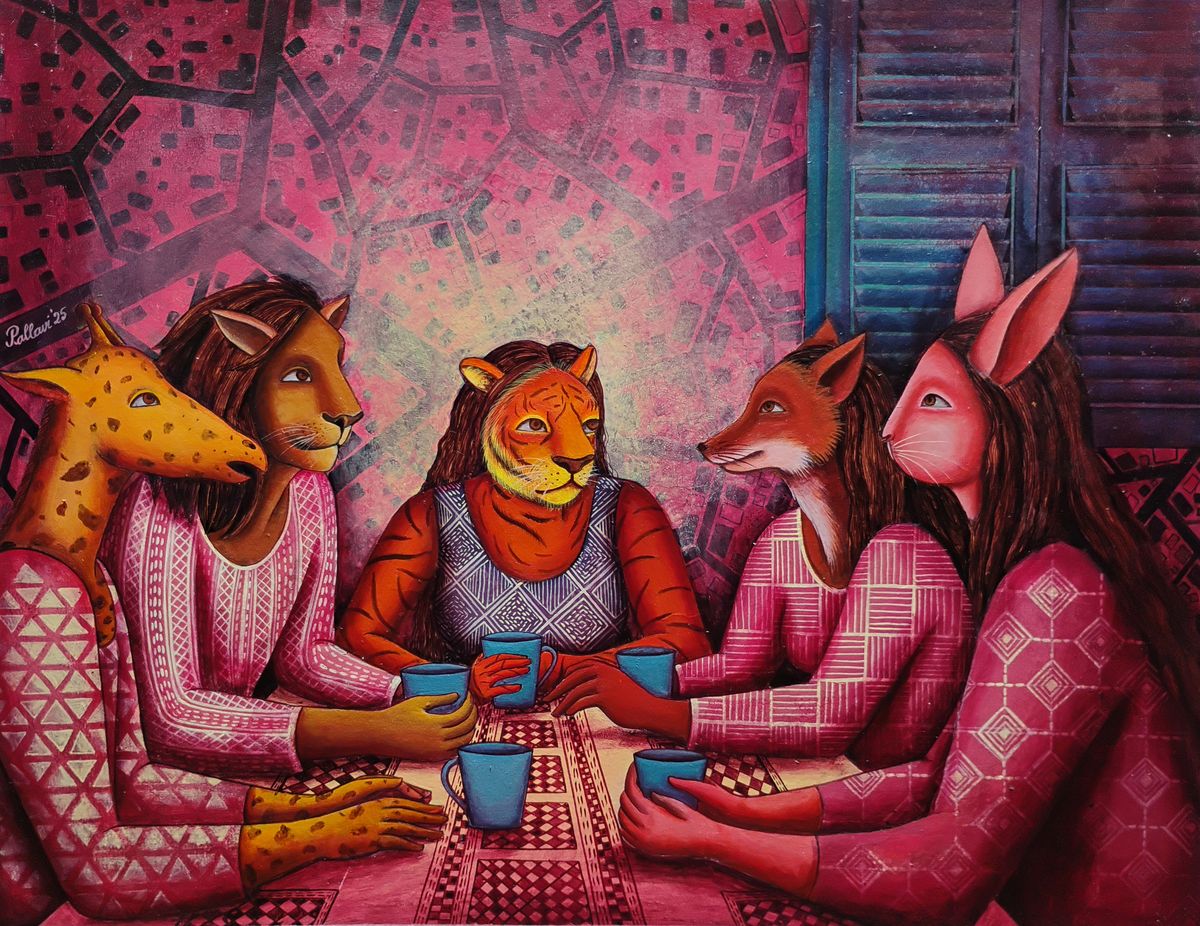
At the centre of the painting is something wonderfully ordinary. People have come together to drink tea, talk and spend time with one another. Nothing dramatic is taking place, and that is precisely its charm. The figures appear absorbed in the simple pleasure of being together. In this gathering, quiet moments in art are not necessarily solitary; they can emerge through the warmth of shared rituals and familiar company. Sometimes a quiet moment is simply the pleasure of having nowhere else to be, another cup of tea in hand and people around us who make the passing of time feel gentle.
When Memory Becomes a Room
Some quiet moments belong not to the present but to memory. Tamojit Bhattacharya‘s GHULGHULI, created in acrylic on canvas, seems to exist somewhere between a room and a recollection. Layered interiors, windows, furniture and domestic details emerge through softened forms, while muted greens, purples, pinks and earthy browns create the atmosphere of a half remembered home. Light filters through the window, becoming one of the brightest passages in the composition, while a hanging lamp, flowers, furniture and shadowy forms appear almost like fragments suspended within memory.
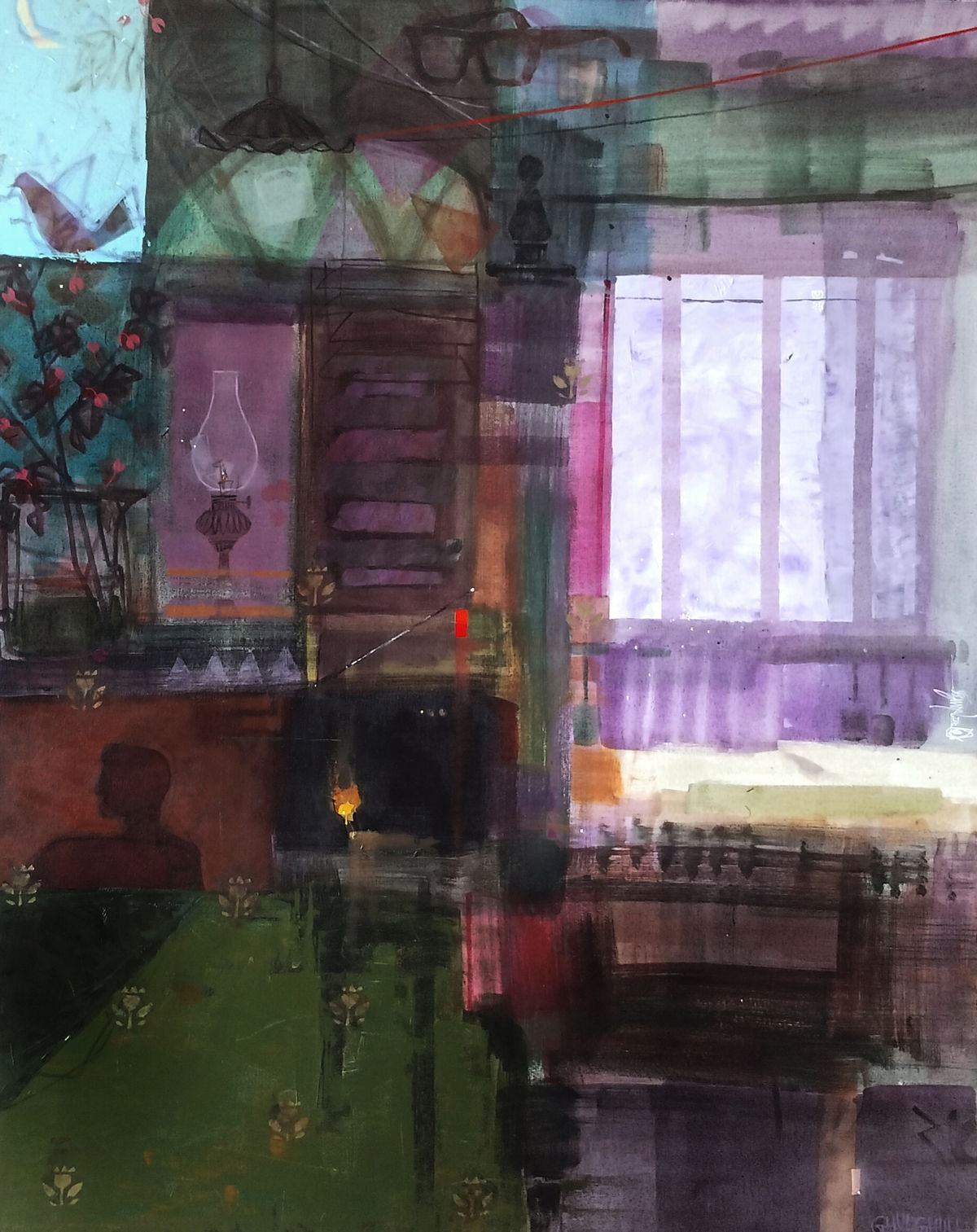
The softened edges and overlapping planes make the space feel less like somewhere being observed and more like somewhere being remembered. Childhood memories rarely return to us in perfect detail. They arrive as fragments: the colour of a wall, the shape of a window, the quality of afternoon light, the presence of a familiar object. This artwork gives these fragments a visual language, stillness in art becomes inseparable from memory, allowing an ordinary domestic space to acquire the softness of something remembered. It is this ability to turn memory into atmosphere that makes quiet moments in art so emotionally resonant. An ordinary room can become precious simply because it belongs to a time we cannot return to.
A Song Only She Can Hear
Memory and music meet in Pinaki Bhattacharya‘s Songs the Wind Remembers, where a woman sits beside an old radio, seemingly absorbed in a private moment of listening. The soft blue greens surrounding her create a dreamlike atmosphere, while the deep terracotta behind her introduces warmth. Against this setting, the bright yellow sari edged in blue and green becomes the visual centre of the composition. The open fan and vintage radio add another layer of nostalgia, evoking an era of slower evenings and familiar domestic rituals.
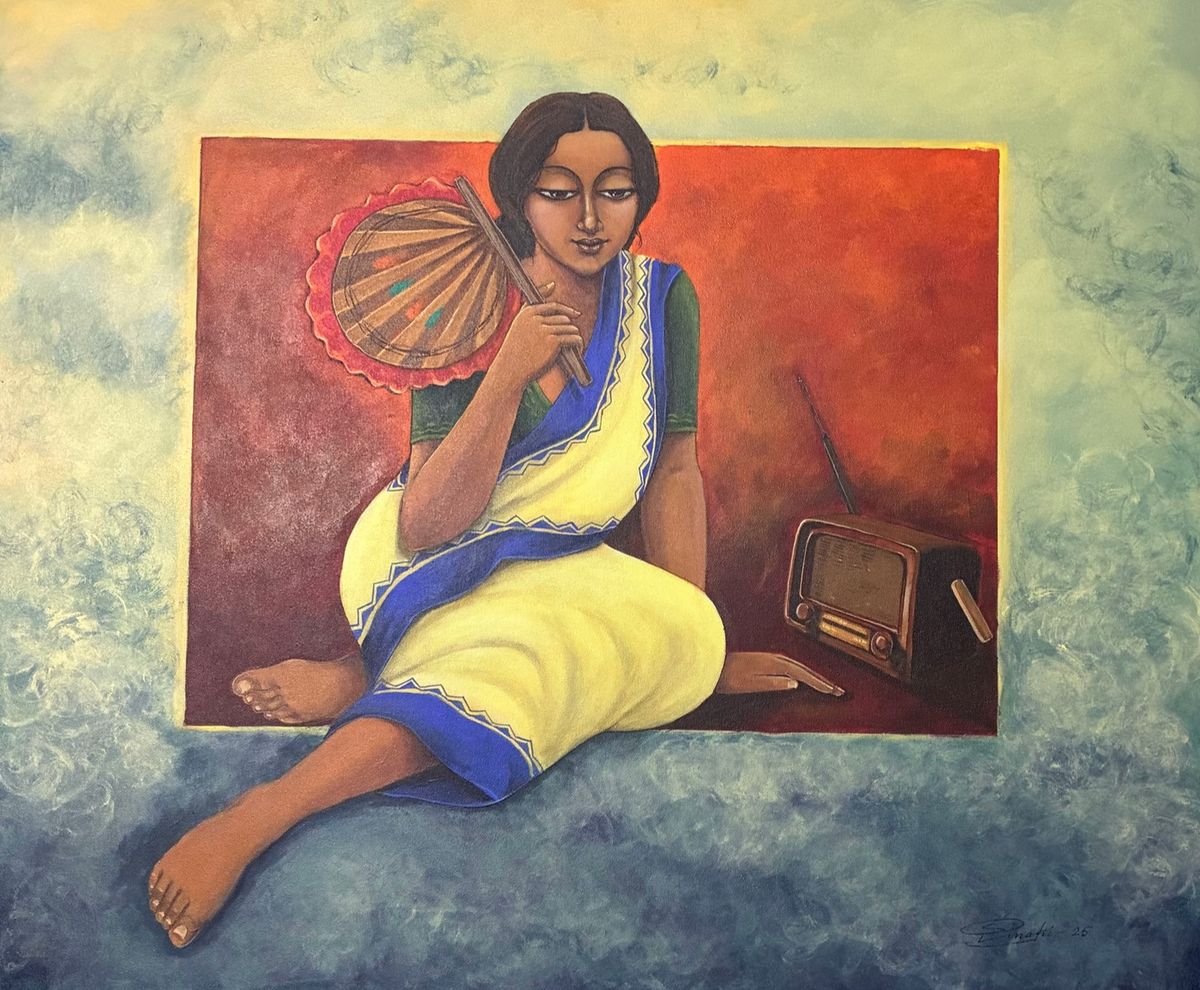
Her lowered gaze and relaxed posture suggest that she has drifted somewhere within her own thoughts. Perhaps the radio is playing a song she remembers. Perhaps she is simply enjoying the sound of music filling the room. There are moments when a familiar melody can make us stop what we are doing and transport us somewhere else. We may remain physically still, yet memory begins to move. Here, quiet moments in art become inseparable from the quiet moments of memory itself, as music becomes a vessel carrying voices, places and emotions from one time into another.
The Beauty of Waiting
If there is one painting in this curation that seems to embody the idea of a pause most directly, it is yet another work by artist Pallavi Dutta. Her Anticipating Woman Painting whereby a woman sits quietly within an almost fantastical natural setting, her face resting gently against her hand. Deep greens surround her, forming a cactus shaped architectural world, while the vivid pink of her dress and the warm yellow doorway provide moments of brightness. The blue surrounding the scene deepens its dreamlike quality, while the small potted plants and repeated cactus forms create a playful visual rhythm.
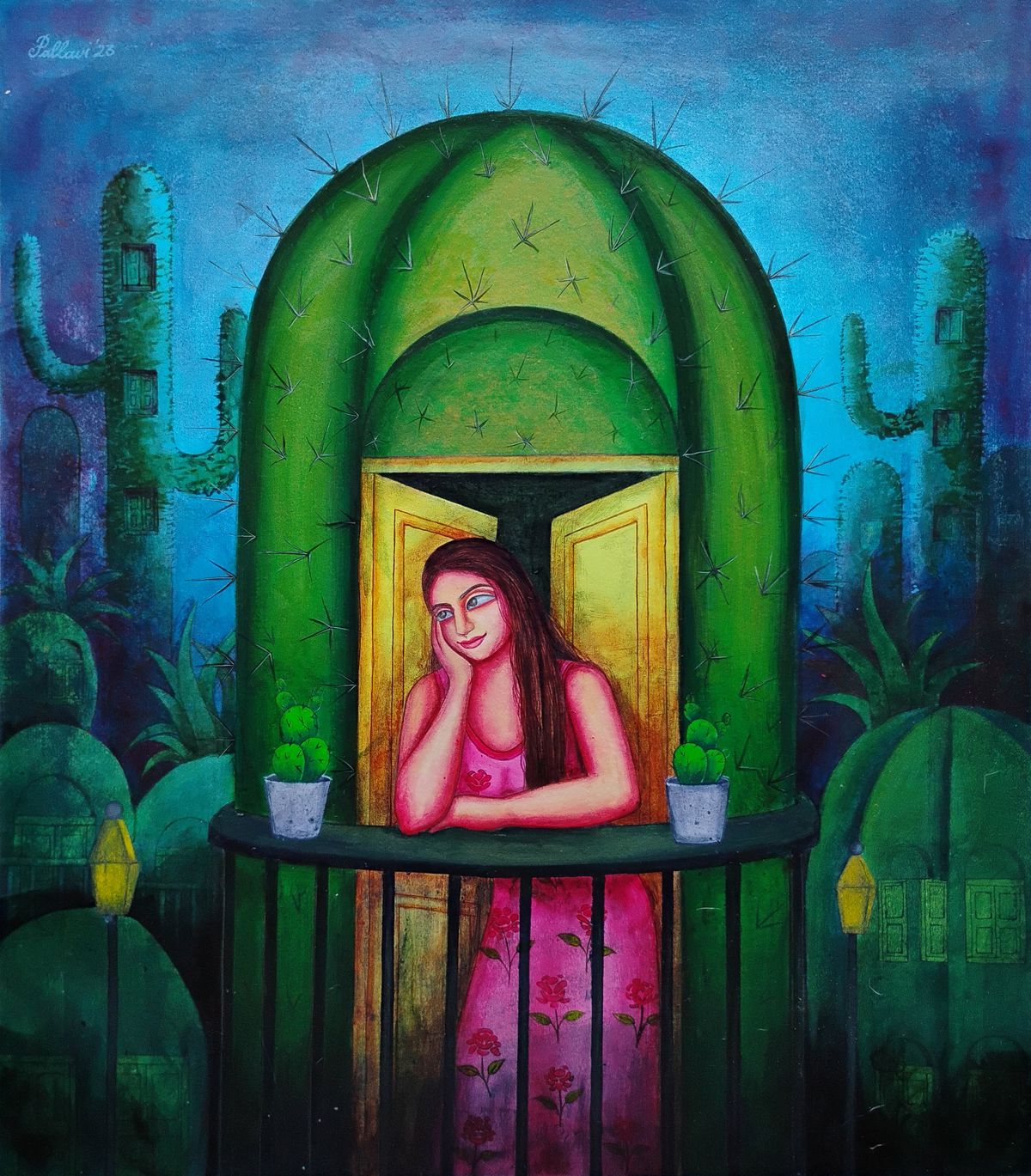
Her posture is relaxed, but there is something quietly expectant in her expression. She is waiting, yet there is no sense of urgency. She seems perfectly capable of inhabiting the present moment without needing to rush towards whatever comes next. The open doorway behind her introduces a beautiful sense of possibility, connecting the interior with the world beyond, while she remains comfortably where she is. The painting offers a gentle interpretation of the art of solitude, presenting being alone not as isolation, but as a space in which one can think, observe, daydream and simply exist. It captures another dimension of quiet moments in art, where solitude becomes an opportunity for reflection.
The Art of Pausing
Taken together, these works reveal how many forms a quiet moment can take. It can be a child looking through a window in a colourful town. It can be an empty chair facing a distant forest. It can be tea shared among friends, a room remembered from childhood, music playing on an old radio, or an afternoon spent alone in nature. Each artist approaches stillness differently, yet all of them find poetry in moments that might otherwise pass unnoticed.
What connects them is not silence alone, but attention. Each painting asks us to notice something that might ordinarily escape us: a shaft of light, a distant house, a cup held between two hands, the texture of an old room, a familiar song, the expression of someone lost in thought. This is where contemplative art finds its power. It does not necessarily demand an answer from us. Instead, it creates a space in which we can slow down enough to notice what we are feeling.
Across Indian contemporary art, artists often find profound emotional possibilities within familiar spaces, rituals, memories and everyday encounters. These paintings remind us that the ordinary can hold immense tenderness when we take the time to truly see it. Perhaps the art of solitude is not really about being away from the world, but about finding a moment in which we can finally hear ourselves within it.
Perhaps that is what makes these quiet moments in art so important. They allow us to experience ordinary life without rushing through it. They give us the space to look again, remember, listen and simply be. Beauty does not always arrive loudly. Sometimes it sits beside us. Sometimes it waits at a window. Sometimes it lives in the fading sound of a song.
And perhaps art does something similar.
It asks us to stop.
To look.
And, for a little while, to stay.
This is what stillness in art ultimately offers us, not just an escape from life, but a different way of seeing it while we pause to rest our minds from mundanity of life.
Discover More Art on Mojarto
If these moments of stillness, memory, companionship, and solitude have made you want to linger a little longer, explore the many worlds artists create on Mojarto. Discover original artworks, meet new artists and find a piece that speaks to your quiet moment and find something worth pausing for.