
By P Abigail Sadhana Rao
“Art is not what you see, but what you make others see.” — Edgar Degas
Floral portraits have long held a powerful place in Indian art, offering a way to view women not simply as figures but as living spaces where emotion, symbolism and nature meet. Today, contemporary Indian artists are redefining this tradition, blending figurative painting with the delicate presence of flowers to explore femininity as fluid, evolving, and deeply human. Their works on Mojarto show how the floral portrait has become a fresh visual language in modern Indian art.
Flowers are often the most overlooked presences in our world. They grow quietly in the background, unnoticed and uncelebrated, yet they continue to bloom and fade and return. As Immanuel Kant reminds us through the line “Look closely. The beautiful may be small,” there is a profound wisdom in this quiet rhythm. Flowers reveal the full cycle of life emergence, growth, fullness, decline, renewal, and they do so without resisting their stages. They remind us that every phase of our own lives carries meaning and deserves appreciation.
Many Indian floral portrait paintings on Mojarto reflect this philosophy with striking clarity. By merging flowers and faces, the artworks reveal what we often overlook in daily life; the resilience that grows in silence, and the emotional parallels between the journey of a flower and our own. These portraits invite us to slow down, observe, and recognise the beauty of becoming resting and transforming.
This curated collection brings together leading contemporary Indian artists who blend traditional aesthetics with modern sensibilities. From lotus-filled compositions to portraits framed by hibiscus chafa and wild blooms, each work draws viewers into moments of serenity, strength, and reflection.
More than portraits, these artworks become conversations between nature and identity, between femininity and form, between the intimate and the spiritual. They show how Indian artists today are reshaping the visual language of femininity and creating floral portraits that resonate with collectors and new audiences.
Radiant Femininity
In Sacred Yellow, Ramchandra Shivaji Kharatmal paints femininity as warmth itself, a quiet radiance settling over the canvas like morning light. The Chafa flower, deeply rooted in Indian devotion and aesthetics, rests gently in her hand, becoming both an offering and an intimate whisper from the past. Kharatmal, one of the widely recognised contemporary Indian artists working in the space of Indian figurative art, uses a minimalistic palette and a carefully balanced composition to heighten this sense of reverence, turning a simple bloom into an eternal gesture of grace.
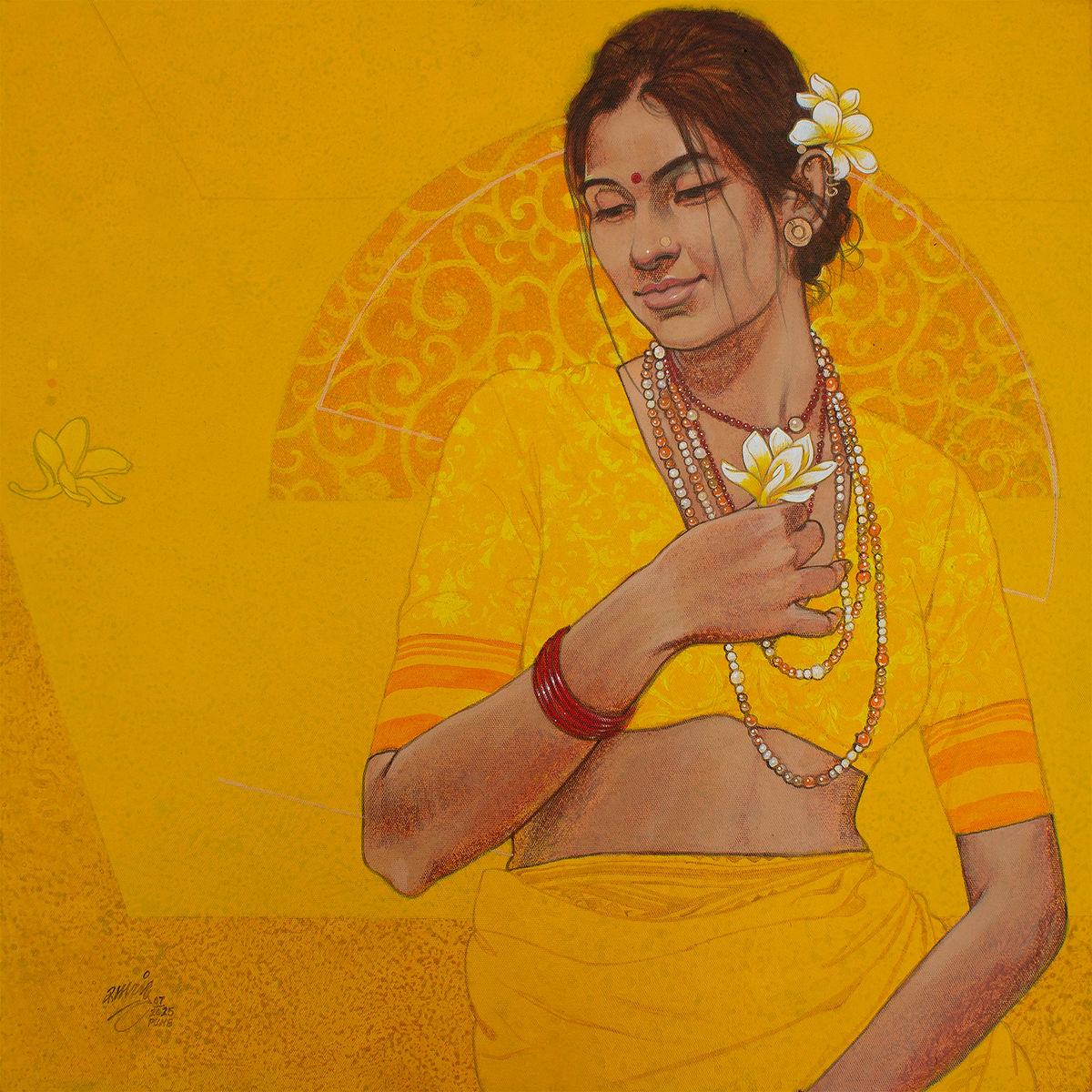
His reflections on feminine beauty deepen the meaning of this work. For him, women are not static symbols but living expressions shaped by shifting cultural and social dimensions. The lines between masculinity and femininity blur, expectations evolve and identities grow richer and more complex. In this changing world, femininity remains dynamic rather than monolithic and art must honour that evolution.
Here, the flower-inspired portrait becomes a dialogue between flowers and faces, between devotion and tenderness. As part of a larger tradition of floral portrait paintings in India, this piece reveals the subtle emotional landscape that connects nature and womanhood. Through this luminous portrait, Kharatmal suggests that as femininity transforms, art will always find renewed ways to honour its quiet power.
A Figurative Bloom
In Hibiscus Muse, Piyali Sarkar offers a portrait where tenderness and radiance meet in quiet harmony. Known for her contemporary figurative art, the Mumbai-based artist paints a woman who seems to bloom from within, her presence surrounded by lush hibiscus that mirror the warmth of her spirit. The vivid reds against an expanse of blue evoke a world where emotion is held close, steady and unafraid. As one of the distinctive contemporary Indian artists exploring feminine art in India, Sarkar’s approach feels both intimate and timeless.
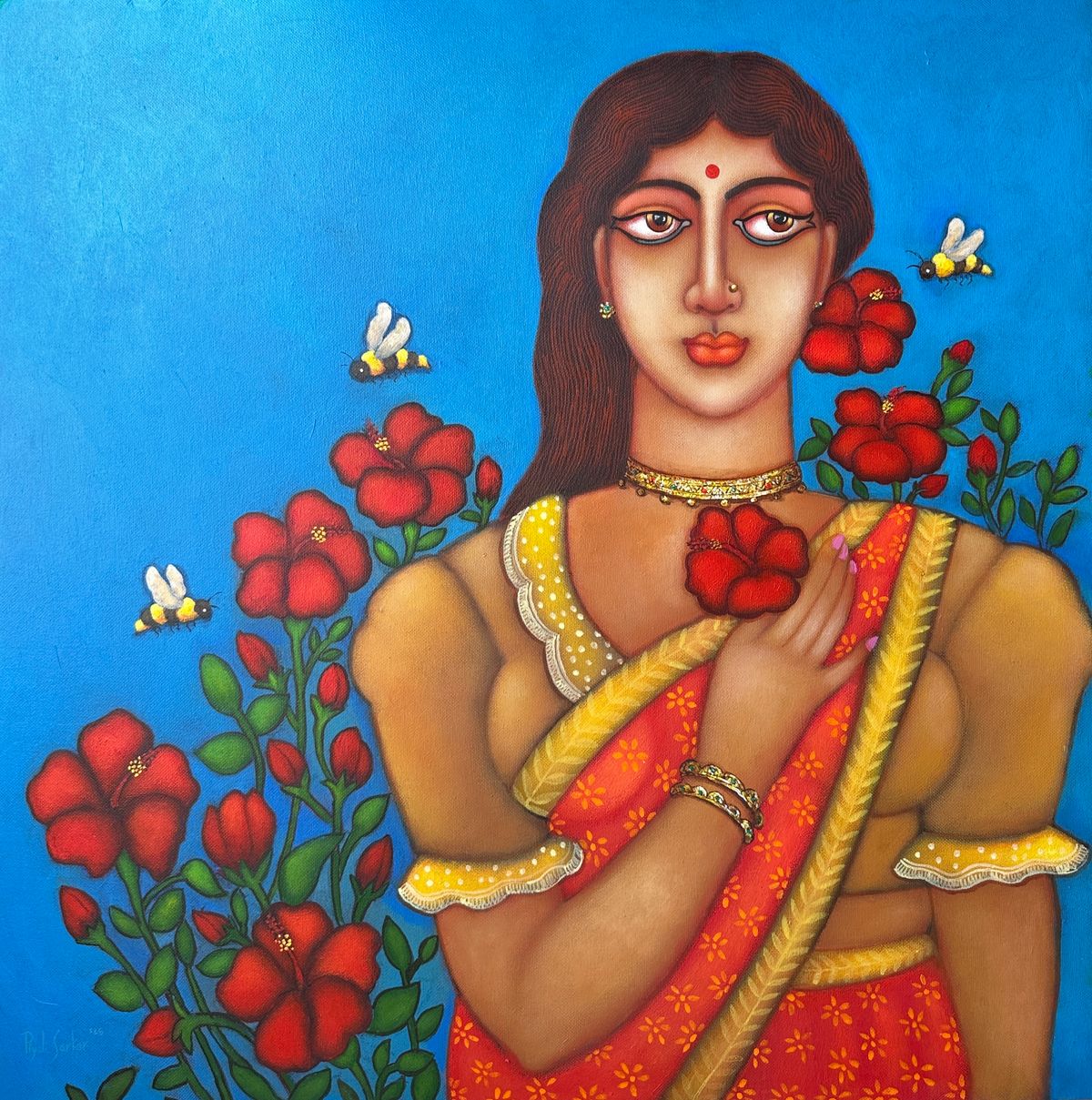
Piyali, who has long honed her craft in both contemporary and classic figurative flower paintings, captures a moment that feels suspended in time. The woman’s gaze is contemplative, her hand gently cradling a flower as if acknowledging the delicate truths it carries. Bees drift around her, suggesting life drawn to her quiet luminosity, a soft dialogue between flowers and faces, between nature and feminine grace. This subtle interplay places the work firmly within the tradition of Indian figurative art while giving it a fresh, modern resonance.
The floral portrait becomes a meditation on serenity and inner strength. Here, beauty is not ornamental but essential, blooming from a place of stillness. In this flower-inspired portrait, Sarkar’s muse reminds us that in the gentle bond between girl and flower, we often find the purest language of the heart.
Lotus Resilience
In Echoes of the Lotus Pond, Varsha Kharatmal draws us into a world shaped by still water, lotus petals, and the serene grace of womanhood. The lotus, long considered a symbol of purity, rebirth, and divine feminine energy in Indian lore, becomes a mirror for the women themselves. They stand poised among the blooms as though rising from the pond with the same unhurried strength, untouched by what lies beneath, luminous in their quiet self-assurance. As one of the contemporary Indian artists exploring feminine art in India, Varsha uses the lotus to express both inner calm and emotional depth.
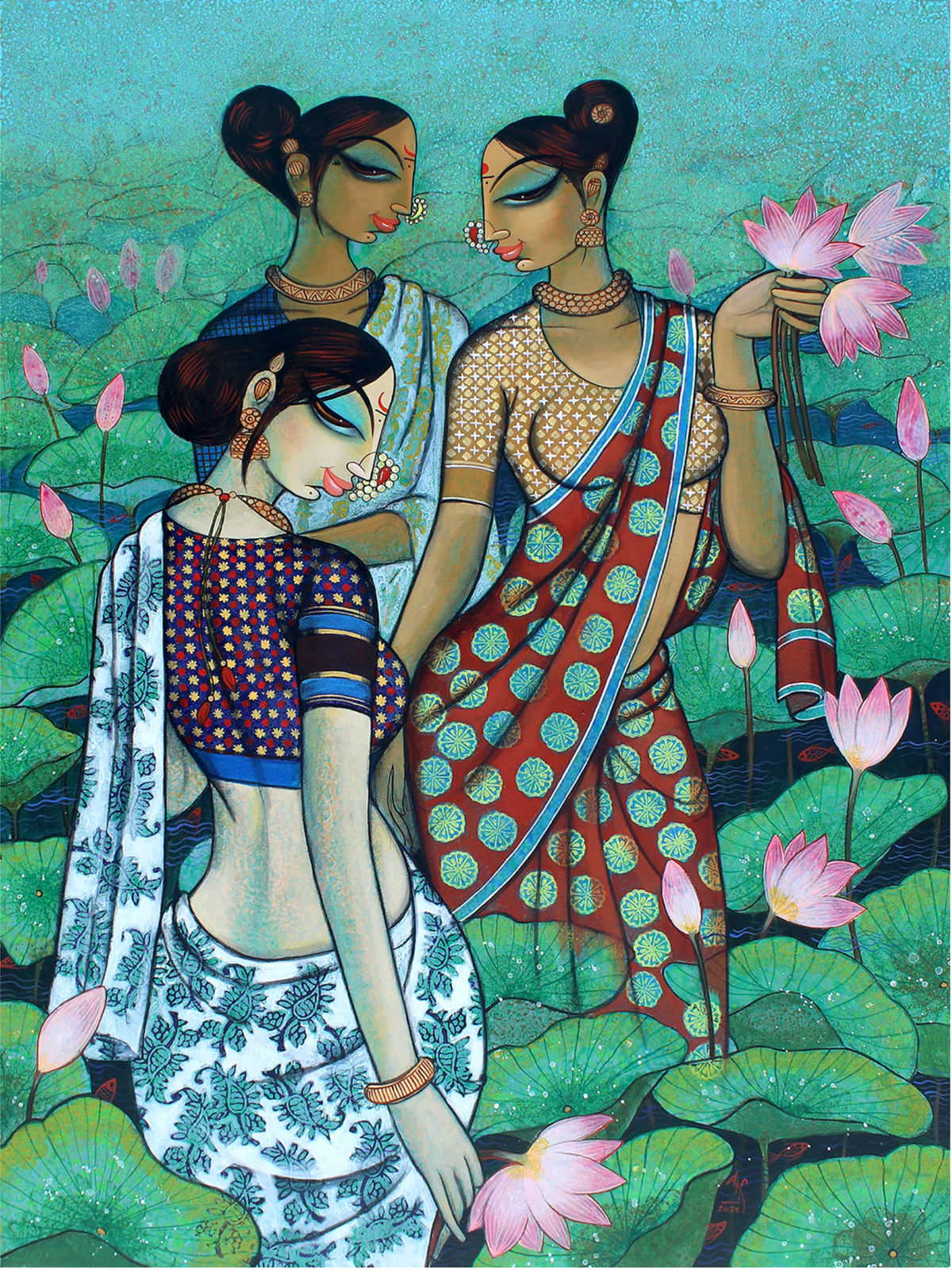
Instead of a siren-like allure, their expressions convey introspection and gentle confidence, the kind of feminine grace celebrated in classical Indian art. Varsha’s Ajanta-inspired linework and vibrant miniature-style motifs weave harmony between the figures and the tranquil green expanse surrounding them. Each sari feels like a story, each bloom a softly unfolding truth, grounding the work firmly within the lineage of Indian figurative art.
In this refined example of figurative flower paintings, the relationship between flowers and faces becomes a meditation on resilience. Through this Indian portrait painting, Varsha affirms a timeless idea in Indian aesthetic womanhood, like the lotus, which rises from depth into light, blooming with dignity above all it has endured.
Quiet Ascension
In Dream Scenario I, Sumita Maity imagines a world where the boundary between woman and landscape dissolves into pure serenity. A self-taught Kolkata-based artist known for exploring memory, identity, and the healing power of nature, Maity shapes this painting as a tender refuge. The woman floats amid lotus blooms and shifting blues, her expression holding a beautiful contradiction, serene and almost ethereal, yet weighted softly by an unspoken thought. It is the kind of emotional subtlety that defines her most intimate figurative flower paintings, where feeling rests just beneath stillness. As one of the contemporary Indian artists who bring quiet depth to feminine art in India, Maity offers a portrait that feels both dreamlike and grounded.

The lotus pond, a signature presence in her work, deepens this inner landscape. She gathers budding and full bloom lotuses close to her chest as if seeking solace in their softness, allowing their symbolism of renewal to steady her. The petals surround her like a soft halo, a floral portrait where nature and emotion merge into one continuous healing breath. This portrait reveals how Indian figurative art can hold both vulnerability and strength within a single moment of calm.
Embodied Emotional Reflection
In Emotions, Roshani Ingole paints a woman suspended in a moment of inward quiet, eyes closed, breath softened, as though she has finally allowed herself to feel something deeply and honestly. The warm terracotta tones that shape her skin radiate a quiet divinity, while the deep blue beside her becomes a threshold between the world she inhabits and the inner landscape she retreats into. As a self-taught artist who expresses emotion through colour and instinct, Ingole pours her sensibility into every stroke.

Soft white petals drift around her like tender reassurances. They do not simply adorn her; they embrace her, moving with the same gentleness that runs through so many figurative flower paintings. And within this calm, there is also a subtle sense of joy, not exuberant, but the quiet joy that comes from letting oneself feel without restraint.
This floral portrait captures the essence of Ingole’s vision: a new way of seeing the world where emotion becomes illumination, where colour speaks the truths the heart cannot name, and where the simple act of closing one’s eyes becomes a small, sacred awakening.
For more explorations of floral paintings that merge symbolism, emotion, and contemporary Indian aesthetics, discover a curated selection on Mojarto. From figurative blooms to evocative botanical narratives, the platform brings together works by leading contemporary Indian artists, offering a deeper look into how flowers continue to shape modern visual expression in India.