
By P Abigail Sadhana Rao
In the face of violence and injustice, art refuses silence. – Ai Weiwei
War has always shaped the course of human history, but it also shapes the inner landscapes of societies. Beyond political events and military strategies lies a quieter but deeply significant dimension: the psychological and emotional impact of conflict on individuals and communities. Throughout history, artists have responded to war not merely by depicting violence but by exploring its deeper consequences on memory, identity, and human consciousness. In this sense, art in times of war becomes a form of reflection, inviting viewers to pause and confront the realities of conflict through visual and symbolic expression.
In our well-connected societies, where news of conflict travels instantly across digital platforms, individuals are exposed to constant images of violence, political tension, and global instability. This continuous exposure can produce emotional fatigue or desensitization. Art offers an alternative mode of engagement. Rather than presenting events as fleeting headlines, artworks slow down perception and create a space for contemplation. Through symbolism, metaphor, and narrative imagery, artists encourage viewers to reflect on the moral, psychological, and cultural dimensions of war.
Digital platforms such as Mojarto have made it possible for audiences to encounter contemporary artworks beyond traditional galleries. By presenting works from emerging and established artists, such platforms expand the visibility of artistic responses to social and political realities. Within this context, contemporary artists continue to explore how conflict shapes human perception, collective memory, and emotional resilience.
Fragile Peace and Symbolic Tension
One recurring theme in art in times of war is the fragile nature of peace itself. Artists often express this tension through symbolic imagery rather than direct depictions of battle.
The drawing Ceasefire by Shubharanjan Paul, available through Mojarto, illustrates this subtle approach. The artwork presents a surreal bird-like figure whose form combines innocence with unease. The elongated, weapon-like beak introduces a visual contradiction: a creature of nature transformed into an instrument of aggression. This imagery reflects the paradox of modern conflict, where ceasefires and diplomatic negotiations exist alongside the persistent threat of violence. Through symbolic representation, the artwork invites viewers to consider the delicate balance between peace and hostility that defines many geopolitical realities.
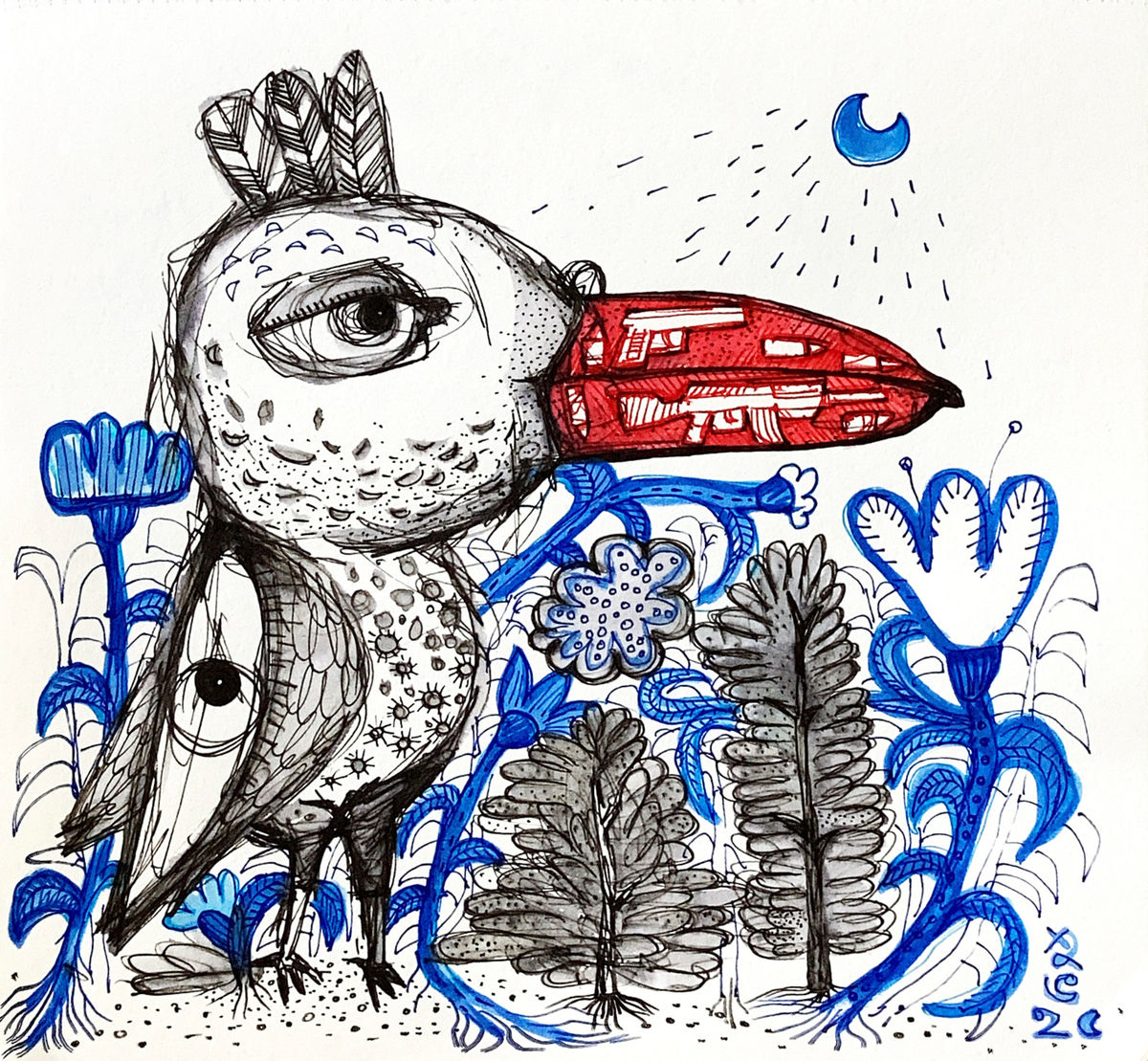
Such symbolic works reveal how contemporary artists responding to conflict rely on metaphor to express complex emotional landscapes. Instead of depicting war literally, they focus on the psychological tension surrounding it.
The Human Cost of War
While some artworks emphasize symbolism, others confront the devastating consequences of conflict more directly. One of the most profound themes within art in times of war is the loss of human potential.
The painting The Murderer by Rajib Sikdar, presented on Mojarto, explores this dimension through surreal imagery. The composition depicts severed heads placed upon pedestals within an unsettling landscape. The figures evoke philosophers, scientists, and visionaries whose contributions to humanity might have shaped the future. By presenting these symbolic figures as victims of violence, the artwork suggests that war does not only destroys lives but also erases the possibilities those lives might have created.

In this context, war and art intersect as a form of ethical reflection. The painting challenges viewers to confront the invisible losses embedded within historical conflicts: ideas that were never realized, innovations that never emerged, and voices that were silenced before they could shape the world.
Ignorance and the Roots of Conflict
Another recurring theme within art responding to conflict is the exploration of ignorance as a driving force behind violence.
This artwork, War by Sunil Lohar, uses elephants as a metaphor for human ignorance. Elephants traditionally symbolize memory and wisdom, yet in this work, they appear burdened with fragments of architecture and civilization. The image suggests societies carrying the weight of history while simultaneously repeating the same destructive patterns.

Within art in times of war, such metaphors reveal how conflict often emerges from collective failures of memory and understanding. By portraying ignorance visually, artists encourage viewers to question the cultural narratives and ideological structures that allow violence to persist across generations.
Psychological Numbness in Contemporary Society
Conflict is not always experienced directly but through media, digital platforms, and constant streams of information. This exposure can create emotional distance, a psychological coping mechanism that protects individuals from overwhelming distress.
Be Cool by Mrinal Dey reflects this phenomenon, whereby the artwork depicts a solitary figure seated calmly while scenes of destruction unfold behind him. The contrast between the figure’s composed posture and the chaotic background suggests a troubling sense of detachment.

Within art in times of war, such imagery highlights the psychological consequences of living in a world saturated with conflict. When violence becomes normalized through repeated exposure, societies may develop emotional numbness. By confronting viewers with this unsettling contrast, the artwork encourages reflection on how individuals process and respond to global crises.
Borders, Identity, and the Theatre of Conflict
Modern warfare is often defined not only by violence but also by the symbolic narratives surrounding borders and identity.
Mahesh Kummar explores this theme through a complex visual composition filled with performers, machines, and fragmented figures. The title of this artwork, LOC – Lakshmana Rekha, references the mythological boundary from the Ramayana, transforming it into a metaphor for contemporary geopolitical divisions.

In art in times of war, borders are rarely simple physical lines. They represent cultural identities, ideological tensions, and collective fears. Through layered imagery, the artwork presents conflict as a theatrical stage where narratives of nationalism, power, and belonging are constantly performed and contested.
Art as Reflection in Chaotic Times
Despite the devastation associated with conflict, art continues to serve as a vital space for reflection and emotional understanding. Art in such perilous times of war allows individuals to engage with complex realities beyond the immediacy of news and political discourse.
Through symbolism, narrative imagery, and psychological insight, contemporary artists reveal the deeper forces shaping human conflict. Their works encourage viewers to slow down, observe, and think critically about the world around them. In doing so, art becomes more than aesthetic expression. It becomes a medium through which societies can process trauma, question dominant narratives, and rediscover empathy.
Platforms such as Mojarto enable these conversations by connecting audiences with artworks that explore the emotional and philosophical dimensions of contemporary life. In a world marked by uncertainty and upheaval, art remains one of the few spaces where humanity can pause, reflect, and attempt to understand itself.