
By P Abigail Sadhana Rao
Cities have long fascinated painters, but it was not until the late nineteenth century that the urban landscape became a serious artistic subject. The Impressionists, particularly Claude Monet, were among the first to treat the city not merely as architecture but as atmosphere. Paris dissolved into light, smoke, and movement. The city was no longer a backdrop; it became a living, shifting organism.
Evolution of Abstract Cityscapes
By the early twentieth century, urban representation fractured dramatically. With Pablo Picasso and Georges Braque, the city was broken into planes, angles, and intersecting geometries. Cubism translated architecture into rhythm and structure. Soon after, Expressionist painters intensified the emotional charge of city life, rendering streets as psychological terrains rather than physical locations. The metropolis became restless, anxious, and electric.
Abstract cityscape paintings emerged from this lineage. Instead of documenting streets and skylines, artists began distilling the city into sensation: vertical thrusts, compressed spaces, collisions of colour, and pulsating grids. In modern cityscape paintings, buildings dissolve into memory, traffic becomes movement, and perspective collapses into layered time. Contemporary abstract cityscapes continue this trajectory, treating the urban environment not as a literal site, but as an internal condition, a landscape of experience, density, and motion.
Today, abstract cityscapes stand at a compelling intersection of history and immediacy. They carry the structural intelligence of Cubism, the atmospheric sensitivity of Impressionism, and the emotional urgency of Expressionism, yet they speak to the contemporary city, fragmented, accelerated, and perpetually evolving.
The Poetics of Night
In City at Night by Chaitali Chatterjee, the urban landscape bends into a luminous instability. Buildings tilt and stack in pastel planes of mint, coral, ochre, and blue, dissolving conventional perspective into emotional architecture. A dark river cuts through the centre, not as geography but as a pause, intensifying the chromatic density around it. The moon hovers above like a silent witness, lending the composition a theatrical stillness. This is not a mapped city. It is a felt one. The compression of facades and fractured rooftops recalls the spatial negotiations of early modernism, yet softened through colour that resists severity.

Within the tradition of abstract cityscape paintings, Chatterjee transforms density into vitality. There is none of the industrial harshness often seen in modern cityscape paintings. Instead, the work carries a psychological warmth, suggesting proximity and shared urban existence. Like the dream charged distortions of Marc Chagall, the city leans into imagination rather than documentation. As a contemporary abstract cityscape, it offers collectors a composition that balances structure with lyricism, ensuring both visual presence and interpretive longevity.
A Geometric Memory
In Blue Cityscape, the city is distilled into geometry, repetition, and tonal orchestration. Cubical dwellings stack into panoramic rhythm, their surfaces modulated through varied blues punctuated by muted ochres, greys, and restrained pinks. The absence of human activity is deliberate, shifting focus from narrative to structure. Windows appear as measured interruptions within a disciplined grid, reinforcing ventilation, symmetry, and architectural logic rather than anecdote. The long aerial sweep recalls the analytical clarity of Paul Klee, where cities become compositional systems rather than lived chaos. Yet Pawar’s palette carries warmth, filtered through memory and light rather than abstraction alone.
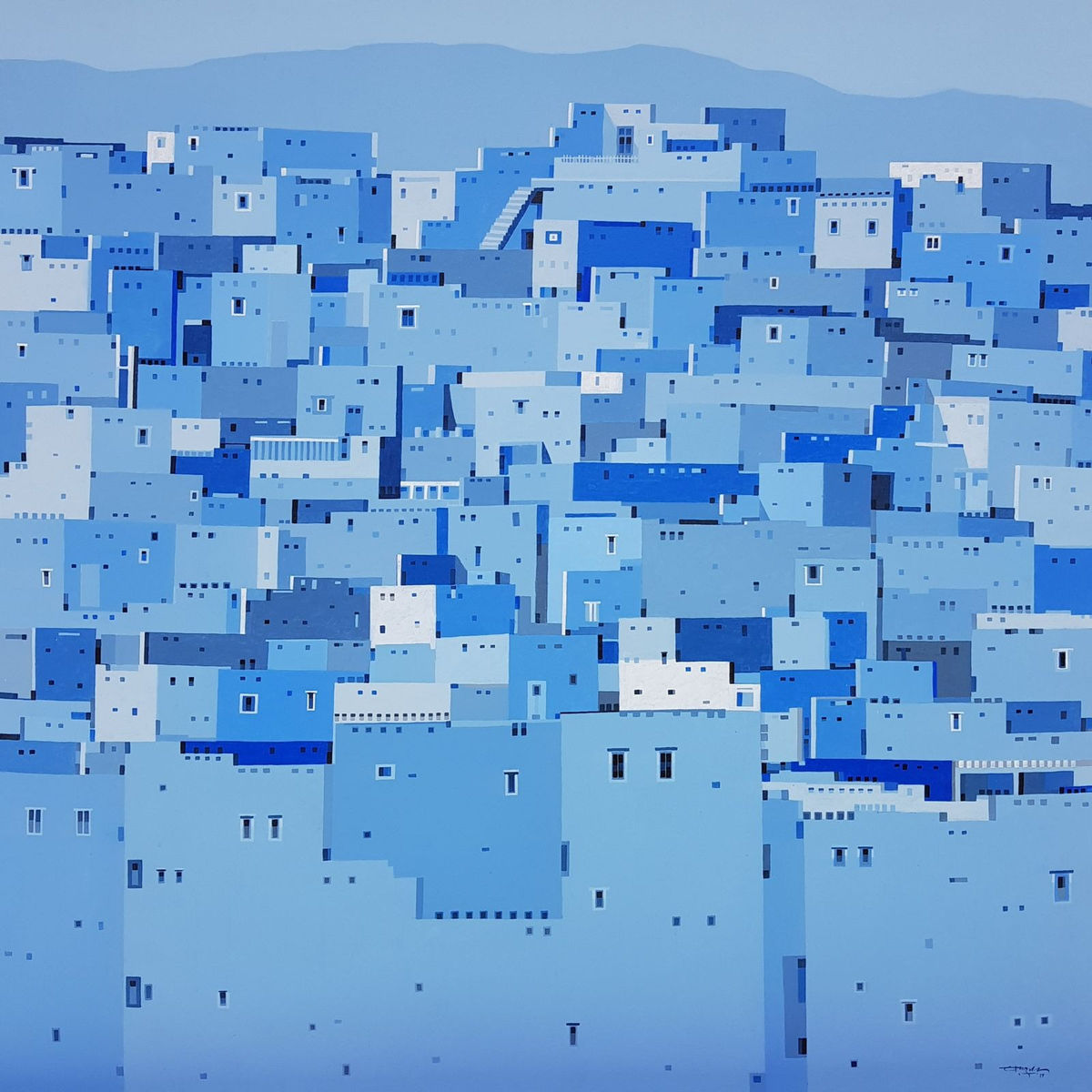
This artwork by Madan Pawar stands firmly in the lineage of formalism. The city becomes an exploration of plastic values, intersecting planes, and chromatic restraint. Unlike expressive modern cityscape paintings that dramatize density or urgency, Pawar’s approach is controlled, architectural, and meditative. The grid-like order evokes the structural intelligence of Cubism while remaining anchored in lived observation. For collectors, contemporary abstract cityscapes such as this offer visual stability and compositional harmony, making them enduring pieces that anchor space without overwhelming it.
The Meditative Urban Surface
City Lake is painted by Gajanan Kashalkar, wherein he transforms the urban form into a reflection and atmosphere. Structures hover along the water’s edge, softened by tonal gradations that blur boundary and solidity. The lake functions as both a mirror and a mediator, absorbing architectural mass into liquid rhythm. Colour appears less constructed than breathed into the surface, suggesting that the city here is not engineered but contemplated. The stillness recalls the atmospheric sensitivity of Claude Monet, yet stripped of descriptive fidelity. What remains is a distilled urban presence suspended between material form and meditative quiet.

The language of abstract cityscape paintings positions this work to shift attention from density to introspection. The city is not fragmented nor compressed but gently diffused, allowing negative space and reflection to carry equal weight. Contemporary abstract cityscapes often dramatize urban velocity, yet Kashalkar proposes an alternative tempo in which architecture becomes a contemplative surface. For collectors, modern cityscape paintings like this offer psychological calm without surrendering structural sophistication, making them quietly commanding presences within a space.
The Psychology of Urban Abstraction
Cities translate so naturally into abstraction because they are already experiences of compression rather than clarity. Urban life is lived through fragments: glimpses of windows from a moving vehicle, reflections in glass, overlapping conversations, vertical thrusts of concrete interrupted by sky. Density compresses space and time. Memory edits what we see, retaining colour, rhythm, and silhouette while discarding detail. Speed distorts perception, flattening foreground and distance into a single visual field. Fragmentation becomes the most honest language for representing the metropolis. Abstract cityscape paintings do not distort reality; they mirror how the city is actually absorbed by the mind. In this sense, contemporary abstract cityscapes are less about buildings and more about cognition, translating architecture into sensation, structure into pulse, and environment into psychological imprint.
Why Collect Abstract Cityscapes
Collectors are often drawn to abstract cityscape paintings because they operate between recognition and ambiguity. A skyline is suggested, yet never confined to a specific geography. Streets dissolve into gesture. Architecture becomes rhythm. This balance allows the work to remain open over time. Unlike literal urban views that anchor themselves to one location or narrative, contemporary abstract cityscapes evolve with the viewer. They shift in meaning depending on light, placement, and emotional context. The city becomes an interior landscape as much as an exterior one.
From a curatorial standpoint, modern cityscape paintings possess unusual longevity. Their structural grids, layered planes, and chromatic orchestration create compositional stability, while abstraction prevents visual fatigue. They can anchor minimalist interiors, dialogue with sculptural furniture, or contrast against restrained palettes without overwhelming space. For serious collectors, abstract cityscapes are compelling because they reflect the condition of contemporary life itself, fragmented yet interconnected, restless yet ordered. They offer both aesthetic presence and intellectual depth, a rare equilibrium in contemporary collecting.
Within the language of abstract cityscape paintings, this work shifts attention from density to introspection. The city is not fragmented nor compressed but gently diffused, allowing negative space and reflection to carry equal weight. Contemporary abstract cityscapes often dramatize urban velocity, yet Kashalkar proposes an alternative tempo in which architecture becomes a contemplative surface. For collectors, modern cityscape paintings like this offer psychological calm without surrendering structural sophistication, making them quietly commanding presences within a space.
Discover a curated selection of abstract cityscape paintings on Mojarto and explore contemporary abstract cityscapes that bring structure, rhythm, and urban energy into your space. Whether you are beginning a collection or refining one, Mojarto offers modern cityscape paintings that balance aesthetic depth with lasting presence.